
Remote exam prep tools are specialized digital resources designed to help students prepare for online exams through interactive, feedback-driven, and flexible learning experiences. The category covers everything from AI tutoring platforms and spaced repetition apps to online proctoring software and large question banks. Students who combine the right tools with structured productivity habits consistently outperform those who rely on passive review alone. This article breaks down the main tool types, the habits that make them work, and how AI and active recall methods raise your score faster than rereading notes ever will.
What are the main types of remote exam prep tools?
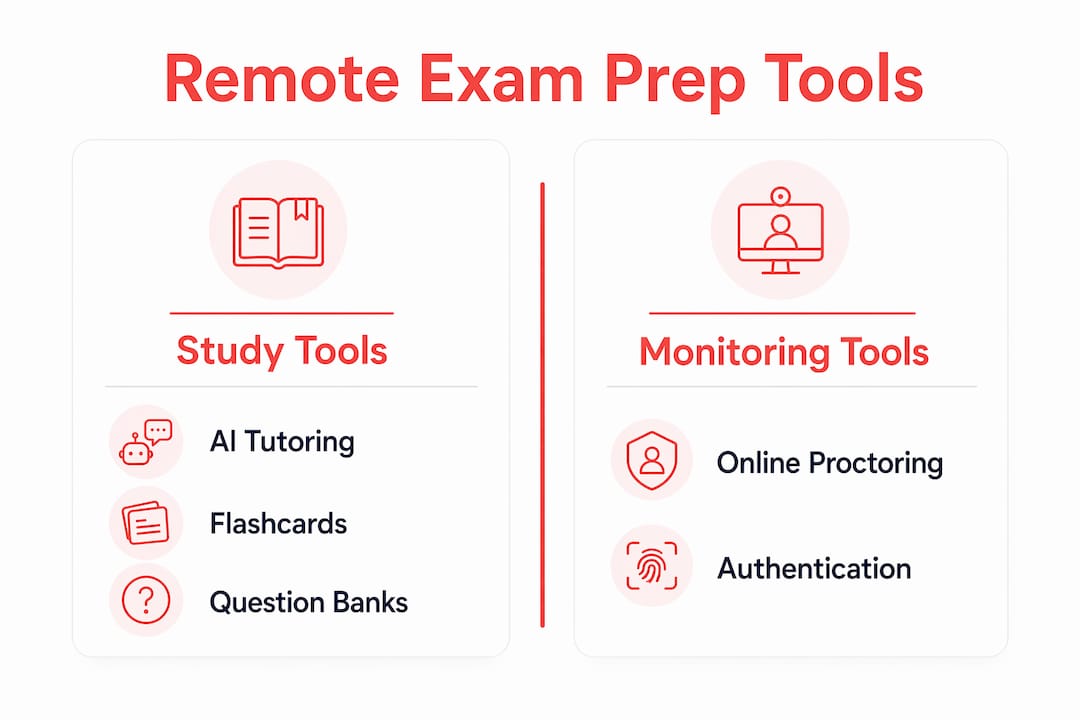
Remote exam prep tools fall into four broad categories, each serving a different function in your study plan. Understanding what each type does prevents you from doubling up on tools that solve the same problem while leaving real gaps in your preparation.
AI tutoring and concept explanation tools generate explanations, worked examples, and practice questions on demand. They work best when you use them to break down concepts you do not understand rather than to confirm what you already know. Pairing a general AI model with a specialized spaced repetition app creates an optimal study approach, combining concept learning with long-term retention.

Spaced repetition flashcard software, with Anki as the most widely used example, schedules card reviews at increasing intervals based on how well you recall each item. The spacing effect is one of the most replicated findings in cognitive science. A free Anki account combined with an AI model subscription running around $20 per month gives you concept learning and retention at a fraction of the cost of most prep courses.
Online proctoring and authentication tools verify your identity and monitor your environment during remote exams. Platforms using webcam monitoring, keystroke analysis, and browser lockdown software have become standard in high-stakes testing. Knowing how these systems work before exam day removes a major source of test anxiety.
Interactive question banks and gamified study platforms build active recall through repeated testing. Some platforms offer 6,400+ interactive questions in gamified formats that reinforce critical thinking rather than rote memorization. That volume matters because retrieval practice, not re-reading, is what actually transfers to exam performance.
| Tool type | Primary function | Key feature |
|---|---|---|
| AI tutoring tools | Concept explanation and Q&A | On-demand generation of examples |
| Spaced repetition apps | Long-term retention | Interval scheduling based on recall |
| Proctoring software | Exam integrity and authentication | Webcam, keystroke, and browser monitoring |
| Question banks | Active recall and practice testing | Large item pools, gamified formats |
| Adaptive platforms | Personalized difficulty progression | Live readiness scores, weakness mapping |
Nursepass fits the adaptive platform category. It offers over 1,200 NCLEX practice questions, a live readiness score, and subcategory heat maps that show exactly where your knowledge gaps are. More than 3,000 nursing students use the platform, and active users report a 95% pass rate.
How can students build productivity habits that complement remote study tools?
The right tools produce weak results without the right habits behind them. Remote exam prep productivity habits are the structure that makes your tools actually work.
Backward planning is the most underused scheduling method in student prep. Start from your exam date and work backward, assigning specific topics to specific days. Then triage subjects by marks per hour, spending the most time where you can gain the most points. Backward planning with time-boxing transforms vague study intentions into measurable daily targets.
Focus cycles prevent the mental fatigue that kills afternoon study sessions. The 50:10 method, 50 minutes of focused work followed by a 10-minute break, is one of the most effective structures for full-time exam prep. Completing 8–10 such cycles daily gives you a full productive day without burning out by week two.
- Set a fixed daily start time and treat it as non-negotiable.
- Plan the night before: write three specific tasks for the next morning.
- Work in 50-minute blocks with a hard stop at the 10-minute break.
- Close all study materials at a fixed end time each day.
- Track your streak with a minimum daily goal of just 5 minutes to maintain momentum.
Streak tracking with low minimum goals increases follow-through because it removes the all-or-nothing pressure that causes students to skip days entirely. A 5-minute minimum sounds trivial, but it keeps the habit alive on hard days.
Pro Tip: Set your study space up the night before. A cleared desk, open notebook, and closed browser tabs signal your brain that work starts immediately, cutting the warm-up time that eats into your first focus cycle.
Physical environment design matters as much as scheduling. Physically closing study materials at a set hour each evening signals mental rest and supports memory consolidation during sleep. A dedicated desk used only for studying creates a psychological boundary between work and rest, which reduces burnout risk over a long prep period.
What role do AI and active recall play in modern remote exam preparation?
Active recall is the single strongest predictor of exam success. Active retrieval outperforms hours spent rereading notes as a predictor of exam performance. The mechanism is simple: every time you retrieve information from memory, you strengthen that memory trace. Passive review does not trigger the same effect.
AI tools amplify active recall when used correctly. The key is how you prompt them.
- Use prompt chaining: ask the AI to explain a concept, then ask it to quiz you on that concept, then ask it to create a case study where you apply it.
- Use Socratic mode: instruct the AI to answer your questions with questions rather than direct answers. This forces you to reason through the problem rather than receive the answer passively.
- Use gamified question banks to simulate exam conditions. Timed practice under realistic conditions builds the retrieval speed that exams demand.
Specialized AI tools differ between those that provide direct answers and those that use Socratic questioning. Direct explanation tools work best when you are learning a concept for the first time. Socratic tools work best when you are consolidating knowledge you have already encountered. Knowing which mode to use at which stage of your prep is what separates students who use AI well from those who just chat with it.
Pro Tip: After every AI-generated explanation, close the chat and write a one-paragraph summary from memory. This single habit converts passive AI use into active recall practice.
Nursepass applies this principle through its adaptive engine. Questions adjust to your current competency level, so you are always working at the edge of what you know. That is the zone where learning happens fastest. Students using Nursepass report measurable accuracy improvements specifically because the platform prevents the comfort trap of practicing only what you already know well. For a deeper look at how adaptive tools fit into a full study plan, the adaptive study plan guide covers the full framework.
How can students overcome the challenges of remote exam prep?
Remote study creates two problems that classroom prep does not: isolation and the absence of external structure. Both are solvable, but they require deliberate design.
Isolation reduces motivation over time. The fix is not willpower. It is community. Digital study groups, accountability partners, and online forums create the social pressure that a classroom provides naturally. Checking in with a study partner each morning replicates the social contract of showing up to class.
"Treating your study schedule like a corporate job, with fixed start times, a dedicated desk, and clear end-of-day boundaries, prevents the blurred lines that turn remote prep into a source of chronic stress rather than productive work."
Distraction management requires a graduated approach. Start light distraction blocking two weeks before your exam, then tighten restrictions progressively as exam day approaches. Jumping straight to maximum restrictions too early causes compliance fatigue. A gradual escalation keeps the system sustainable.
- Two weeks out: block social media during study blocks only.
- One week out: extend blocking to all non-study hours.
- Exam week: full blocking except for scheduled breaks.
Realistic expectations prevent the motivation crashes that derail long prep periods. Progress in exam prep is not linear. Scores plateau, then jump. Treating a plateau as failure causes students to abandon tools and habits that are actually working. Track weekly averages, not daily scores, to see the real trend.
Key Takeaways
The most effective remote exam prep combines adaptive question banks, active recall techniques, and structured daily habits built around fixed schedules and deliberate environment design.
| Point | Details |
|---|---|
| Use the right tool category | Match each tool to its function: AI for concepts, spaced repetition for retention, question banks for retrieval practice. |
| Build backward from exam day | Plan subjects by marks per hour and assign daily targets to avoid vague, unfocused sessions. |
| Apply active recall, not passive review | Prompt chaining, Socratic AI use, and timed practice outperform rereading notes for exam performance. |
| Design your environment deliberately | A fixed desk, set start and end times, and graduated distraction blocking reduce burnout and improve focus. |
| Track streaks, not perfection | A 5-minute daily minimum keeps momentum alive on hard days and builds long-term study identity. |
The tool is only half the equation
Most students who struggle with remote exam prep are not using the wrong tools. They are using good tools passively. I have watched students spend hours inside question banks without ever pausing to analyze why they got an answer wrong. That is passive review dressed up as active practice.
The students who pass consistently do one thing differently: they treat every wrong answer as a diagnostic, not a failure. They stop, identify the gap, go back to the concept, and then test themselves again before moving on. That loop, mistake, diagnosis, review, retest, is what the best tools are designed to support. But the tool cannot run the loop for you.
My honest advice is to pick fewer tools and use them more deliberately. One spaced repetition app, one adaptive question bank like Nursepass, and one AI model for concept work is enough. Adding more tools creates the illusion of productivity without the substance. Consistency with three tools beats variety across ten.
The hardest part of remote prep is not finding the right resources. It is showing up at the same time every day, in the same chair, with the same intention, even when your score feels stuck. That discipline is what the tools are built to support. It is not something they can replace.
— Michael
Nursepass and your remote exam prep
Nursing students preparing for the NCLEX face one of the most demanding remote exams in healthcare education. Nursepass is built specifically for that challenge.
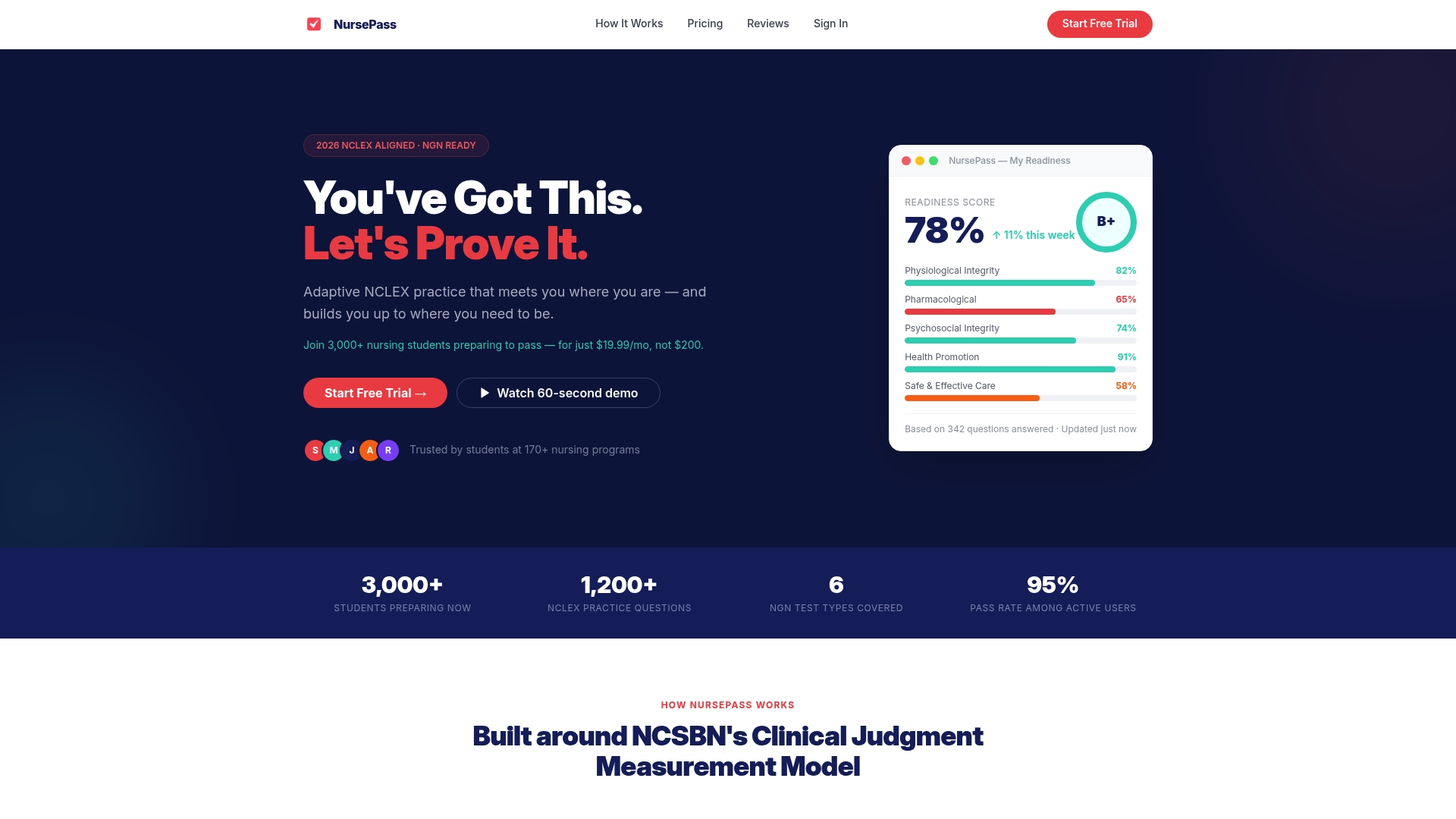
Nursepass delivers over 1,200 NCLEX practice questions through an adaptive engine that adjusts to your current competency level. The live readiness score shows you exactly where you stand on any given day. The subcategory heat maps show you where to focus next. More than 3,000 nursing students have used the platform, and active users report a 95% pass rate. If you are preparing for the NCLEX and want a structured, feedback-driven approach, start your prep with Nursepass today.
FAQ
What are remote exam prep tools?
Remote exam prep tools are digital platforms and techniques designed to help students study for online exams through interactive practice, real-time feedback, and flexible scheduling. They include AI tutoring tools, spaced repetition apps, question banks, and adaptive learning platforms.
What is the most effective study method for remote exam prep?
Active recall, specifically retrieval practice through timed question banks and prompt chaining with AI tools, is a stronger predictor of exam success than passive review methods like rereading notes.
How many focus cycles should I complete per day?
Completing 8–10 focus cycles of 50 minutes of study followed by a 10-minute break supports full-time exam prep effectiveness without leading to burnout.
How does Nursepass support remote exam preparation?
Nursepass offers over 1,200 adaptive NCLEX practice questions, a live readiness score, and subcategory heat maps that identify knowledge gaps. Active users report a 95% pass rate on the NCLEX.
When should I start blocking digital distractions before an exam?
Start light distraction blocking two weeks before your exam and escalate restrictions progressively through exam week. Gradual escalation sustains compliance better than immediate maximum restrictions.