
Nursing prep without classroom instruction is a structured, self-directed study method that builds the clinical judgment skills required to pass the NCLEX. Independent preparation, the industry term for this approach, centers on active engagement with digital question banks, NGN-style practice formats, and adaptive study plans rather than scheduled lectures. The 2026 NCLEX update places heavy emphasis on the Next Generation NCLEX (NGN) format, which tests clinical reasoning through bow-tie, highlight, and trend questions. Industry guidance recommends starting focused prep 1–6 months before your exam date to build both reasoning skills and testing endurance. Nursepass supports more than 3,000 nursing students through this exact model, reporting a 95% pass rate among active users.
What does nursing prep without classroom typically involve?
Independent NCLEX preparation replaces lecture attendance with daily, structured self-study using digital resources. The core components are question practice, rationale review, and progress tracking. Each element serves a specific purpose in building the clinical judgment the NCLEX measures.
The 2026 NCLEX tests NGN question formats including bow-tie items, highlight questions, and trend questions. These formats require you to think like a nurse, not recall a memorized fact. That shift changes how you should study from day one.

The NCSBN Clinical Judgment Measurement Model (CJMM) is the framework behind every NGN question. Understanding its six cognitive skills, which include recognizing cues, analyzing cues, prioritizing hypotheses, generating solutions, taking action, and evaluating outcomes, gives your study sessions a clear direction. Each question you practice maps to one or more of these skills.
Key components of independent nursing prep include:
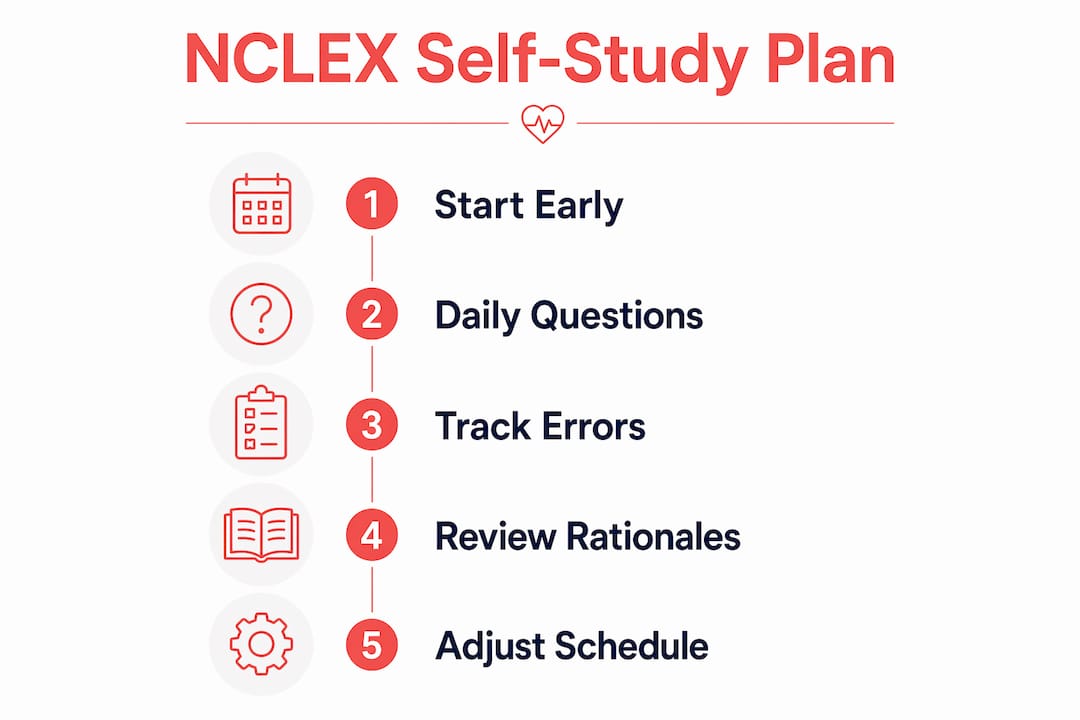
- Daily question practice: Aim for 50–125 questions per day with full rationale review for every answer, not just the ones you got wrong.
- NGN format exposure: Practice bow-tie, highlight, and trend questions regularly so the format feels familiar on exam day.
- Progress tracking: Monitor your accuracy by question type, especially Select All That Apply (SATA) items, using a readiness score or heat map.
- Online nursing study guides: Use structured self-study resources to organize content review around NCLEX test plan categories.
- Cost management: Subscription-based digital platforms start around $39 per month, and total prep costs can stay under $300 with careful planning.
Pro Tip: Review rationales for every question you answer, including the ones you got right by guessing. Correct guesses hide knowledge gaps that will cost you on exam day.
How do you build a self-study plan for NCLEX prep?
A structured timeline separates students who pass on the first attempt from those who do not. A 2–3 month preparation window gives you enough time to cover content, build clinical reasoning, and develop testing endurance without burning out.
Here is a phased approach that works for independent learners:
-
Week 1–2: Baseline assessment. Complete a full diagnostic practice exam. Identify your weakest NCLEX test plan categories and set a daily question target between 50 and 75 items. Use an adaptive study plan to let your performance data guide what you study next.
-
Weeks 3–6: Content and question integration. Increase your daily question volume to 75–100 items. Alternate between tutor mode, where you see rationales immediately, and timed mode, where you simulate real exam pressure. Focus heavily on NGN formats during this phase.
-
Weeks 7–10: Endurance and simulation. Run at least one full-length practice exam every week. A 75-question timed simulation builds the stamina required for an exam that can last up to 5 hours. Review every missed question the same day.
-
Weeks 11–12: Targeted remediation. Pull your error log and identify any category where your accuracy sits below 60%. Run focused practice blocks on those topics daily. Check your NCLEX readiness score weekly to confirm upward movement.
-
Final week: Light review and physical prep. Reduce question volume. Prioritize sleep, nutrition, and a visit to your test center if possible. Familiarity with the testing environment reduces anxiety on exam day.
Pro Tip: Keep an error log in a simple spreadsheet. Write the topic, the question type, and why you missed it. Patterns emerge within two weeks and tell you exactly where to focus.
Tracking SATA accuracy is non-negotiable. Students who score below 60% on SATA questions need dedicated daily blocks on that format alone. Nursepass subcategory heat maps make this identification automatic, showing you exactly which areas need the most work.
What challenges come with independent nursing prep?
Self-directed study removes the structure of a classroom, and that freedom creates specific problems. Knowing them in advance lets you plan around them.
Motivation and consistency are the first casualties of independent study. Without a professor setting deadlines, it is easy to skip a day and then two. The fix is a non-negotiable daily minimum. Even 30 questions on a difficult day keeps the habit alive and prevents the knowledge decay that comes from multi-day breaks.
Passive studying is the most common mistake nursing students make. Re-reading notes and rewatching recorded lectures feel productive but do not build clinical judgment. Active practice with immediate rationale review is the only method that develops the reasoning skills the NCLEX actually tests.
Test anxiety is a major obstacle to NCLEX success. Physical well-being, mock exams, and visiting the test center before exam day all reduce anxiety and improve performance under real exam conditions. Stress management is not optional preparation. It is part of your study plan.
Misconceptions about online nursing programs also trip up independent learners. No U.S. state licenses nurses who complete zero in-person clinical hours. State boards require 500–800 supervised clinical hours. Online coursework handles the didactic content, but clinicals must happen in person. Independent NCLEX prep handles the exam side of your preparation. It does not replace required clinical training.
Additional challenges and solutions:
- Distraction management: Study in a dedicated space with your phone in another room. Use timed blocks of 45–60 minutes followed by a short break.
- Testing stamina: The NCLEX can run up to 5 hours. Students who never practice under timed, full-length conditions often hit a wall at the 90-minute mark on exam day.
- Last-minute cramming: Cramming the night before an exam raises anxiety and impairs recall. Your final week should be light review, not new content.
What digital tools best support self-study nursing resources?
The right digital tools turn independent study from a vague plan into a measurable process. The market offers several categories of platforms, each with different strengths.
Adaptive question banks adjust question difficulty based on your performance. This mirrors how the NCLEX itself works and gives you a more accurate readiness signal than static question sets. Nursepass uses this model, with over 1,200 NCLEX practice questions that adapt to your current competency level. Its live readiness score updates after every session, so you always know where you stand.
NGN-specific platforms prioritize the bow-tie, highlight, and trend formats that define the 2026 exam. Exposure to these formats before exam day is not optional. Students who encounter them for the first time during the actual NCLEX lose significant time and confidence.
Readiness assessment tools measure your overall preparedness against a benchmark. Nursepass provides subcategory heat maps that show your accuracy across every NCLEX content domain. That level of detail tells you exactly where to spend your next study session. You can explore NCLEX test plan categories to understand which domains carry the most weight.
When evaluating any digital platform, look for these features:
- NGN question formats included (bow-tie, highlight, trend)
- Adaptive difficulty that responds to your performance
- Rationale explanations for every answer option
- Progress tracking by question type and content category
- Pricing that fits within a total budget under $300
Subscription costs for quality platforms start around $39 per month. A 3-month subscription to a well-built adaptive platform costs less than a single in-person prep course and delivers more targeted feedback. The cost-effective prep options available in 2026 make independent study genuinely competitive with traditional classroom approaches.
Key Takeaways
Independent NCLEX preparation works when you replace passive review with daily active question practice, track your performance by category, and build testing endurance through weekly full-length simulations.
| Point | Details |
|---|---|
| Start early | Begin focused prep 1–6 months before your exam to build clinical reasoning and endurance. |
| Practice actively | Answer 50–125 questions daily and review every rationale, including correct answers. |
| Target weak areas | Track SATA accuracy and run focused blocks on any category below 60%. |
| Build stamina | Complete at least one full-length timed simulation per week to prepare for a 5-hour exam. |
| Use adaptive tools | Platforms like Nursepass adjust question difficulty and show readiness scores in real time. |
What I have learned from watching students prep independently
Most students underestimate how different the 2026 NCLEX is from what their instructors described. The shift from memorization to clinical judgment is not a small update. It is a complete change in what the exam rewards. Students who spend their prep time reading textbooks and rewatching lectures are preparing for an exam that no longer exists.
The students who pass on the first attempt share one habit: they treat question practice as the primary activity, not the supplement. They answer questions first, then go back to content when a rationale reveals a gap. That sequence builds the clinical reasoning the NCLEX actually measures.
Testing endurance surprises almost everyone. Sitting through a 5-hour exam while maintaining sharp clinical reasoning is a physical and mental skill. You build it the same way you build any skill: through repeated practice under realistic conditions. One full-length simulation per week for 6–8 weeks is the minimum. Students who skip this step often report that their performance dropped significantly in the final third of the exam.
The other misconception I see constantly is that independent prep means unstructured prep. It does not. The most effective self-study plans are more structured than most classroom schedules, with daily question targets, weekly simulations, and a running error log. The difference is that you control the schedule, not a professor. That control is an advantage when you use it deliberately.
— Michael
Nursepass: built for independent NCLEX learners
Nursing students who prepare without a classroom need tools that replace the structure a classroom provides, not just a question bank.
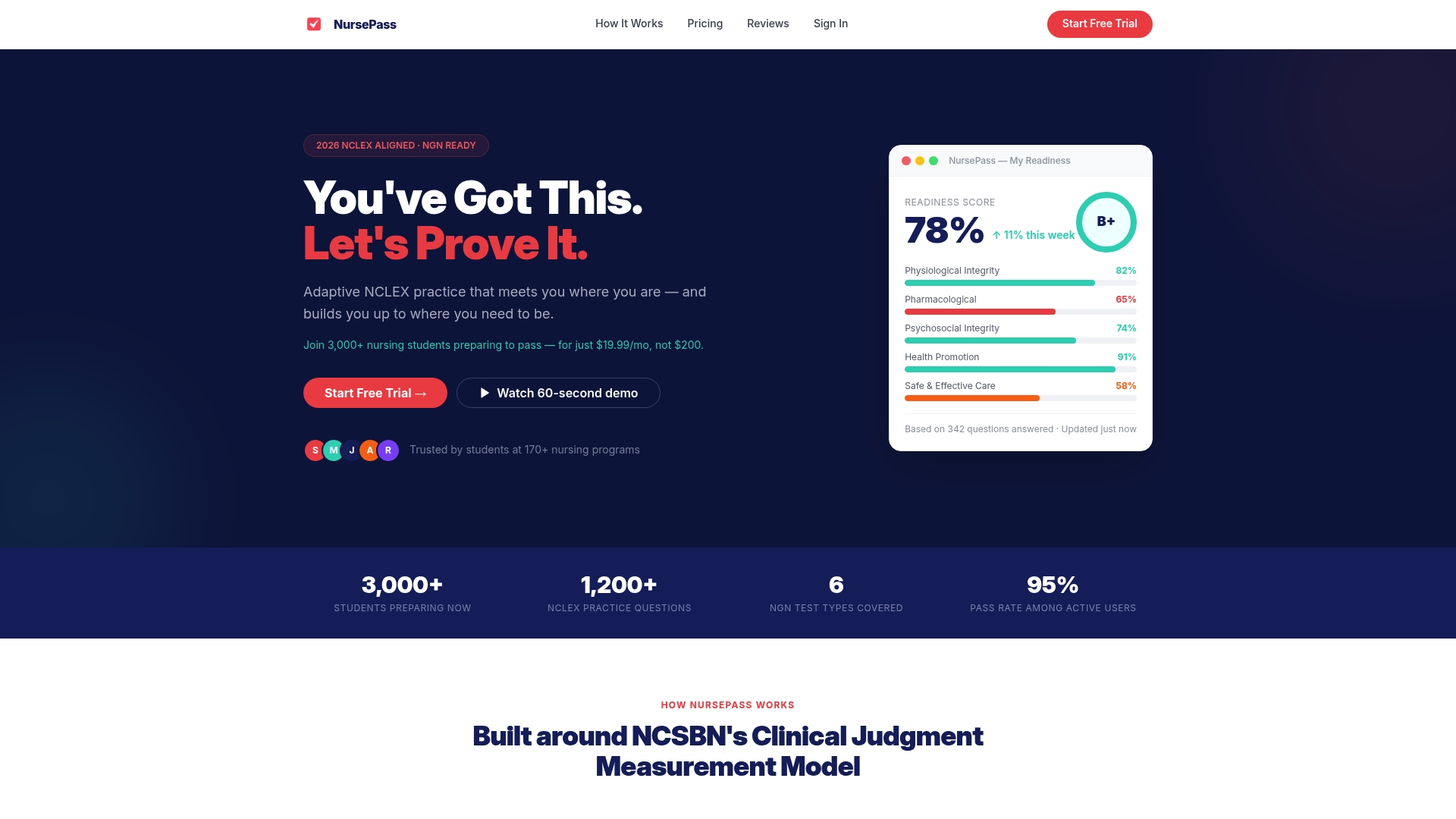
Nursepass is built specifically for independent NCLEX preparation. Its adaptive engine adjusts question difficulty to your current performance level, so every session targets your actual weak points rather than repeating what you already know. The live readiness score updates after each practice block, giving you a real-time signal of where you stand. Subcategory heat maps show your accuracy across every NCLEX content domain, so you always know where to study next. With over 1,200 NGN-aligned practice questions and a 95% pass rate among active users, Nursepass gives independent learners the structure and feedback that classroom prep used to provide. Visit Nursepass to start your self-directed NCLEX prep today.
FAQ
What is nursing prep without classroom instruction?
Nursing prep without classroom instruction is a self-directed study method that uses digital question banks, adaptive platforms, and online nursing study guides to build NCLEX readiness without attending scheduled lectures or in-person classes.
Can you prepare for the NCLEX entirely on your own?
Yes. Independent study using adaptive question banks, NGN-format practice, and structured self-study schedules is a proven path to NCLEX success, provided you practice actively and track your progress consistently.
How many questions should I practice daily for NCLEX prep?
Industry guidance recommends 50–125 questions per day with full rationale review. That volume builds clinical judgment faster than passive content review and mirrors the cognitive demands of the actual exam.
Do online nursing programs eliminate the need for in-person clinicals?
No. Every U.S. state requires 500–800 supervised clinical hours for nursing licensure. Online programs handle didactic coursework digitally, but clinical hours remain mandatory and must be completed in person.
How long before the NCLEX should I start independent prep?
Starting 1–6 months before your exam date gives you enough time to build clinical reasoning, develop testing endurance, and complete targeted remediation on weak content areas.