
Accuracy improvement techniques for nursing exams are defined as structured, evidence-based methods that increase the percentage of correct answers under real exam conditions. The most effective approach combines high-volume active practice with Clinical Judgment Measurement Model (CJMM) analysis, not passive content review. NCLEX 2026 standards require 95% statistical confidence per its Computer Adaptive Testing algorithm, meaning small accuracy gains carry outsized weight. Nursepass reports a 95% pass rate among active users on its platform, built on over 1,200 adaptive practice questions. The techniques below are research-backed and ordered by impact.
1. What are accuracy improvement techniques for nursing exams?
Active practice beats passive studying every time. The most common NCLEX failure mode is passive studying without active question answering under exam conditions. Reading notes or watching videos feels productive, but it does not train your brain to select the correct answer under pressure. Active practice does.
The Clinical Judgment Measurement Model is the framework NCLEX 2026 uses to evaluate nursing competency. CJMM breaks clinical thinking into six steps: recognize cues, analyze cues, prioritize hypotheses, generate solutions, take action, and evaluate outcomes. Studying by content category (cardiovascular, respiratory, etc.) misses this structure entirely. Studying by CJMM step trains the exact skill the exam tests.
NCLEX 2026 prep standards recommend daily practice of 50–75 questions followed by mistake analysis sorted by CJMM step rather than content area. That volume forces you to build decision speed while the CJMM sort shows you exactly which judgment step keeps tripping you up.
- Complete 50–75 questions daily in timed, exam-like conditions
- Sort every mistake by CJMM step, not by disease or body system
- Review rationales for every question, including ones you answered correctly
- Track which CJMM steps produce the most errors each week
Pro Tip: Correct answers you got right for the wrong reason are just as dangerous as wrong answers. Read every rationale, not just the ones attached to questions you missed.
2. How to use mistake analysis and structured remediation to boost accuracy
Mistake analysis is the single highest-leverage activity in nursing exam prep. Most students review wrong answers briefly and move on. Top students build a mistake log that records the question topic, the CJMM step involved, and the specific reasoning error made. That log becomes a personal weakness map.
Structured remediation takes that map and applies focused study to close the gaps. Research shows that 8 hours of targeted remediation after failing to meet a 90% drug calculation benchmark produces a 100% pass rate on retests. That result is not accidental. Eight focused hours on a specific gap outperforms 40 hours of general review.
"Remediation works because it is specific. General review spreads attention across everything. Targeted remediation concentrates it where the deficit actually lives."
Here is a four-step remediation process that mirrors what the research supports:
- Flag every question you answered incorrectly or guessed on. Guessing correctly is not mastery.
- Categorize each flagged question by CJMM step. If most errors fall under "prioritize hypotheses," that is your primary target.
- Spend focused study blocks on that CJMM step. Use case scenarios, not just content reading.
- Retest on the same question type within 48 hours. Retesting confirms whether the gap closed or just narrowed.
Structured remediation programs are superior to repeating practice questions from the same bank without focused study. Repetition without remediation just reinforces the same errors.
3. Best test-taking techniques for maintaining accuracy under exam conditions

Accuracy under exam conditions requires a different skill set than accuracy during practice. Time pressure, unfamiliar phrasing, and fatigue all introduce errors that have nothing to do with clinical knowledge. Managing these factors is a learnable skill.
Reading questions carefully and pacing yourself without rushing directly improves exam accuracy. Speed is not the goal. The goal is selecting the correct answer, and rushing is the fastest way to misread a question stem.
- Read the question stem twice before reading the answer choices. Identify what is actually being asked before you see the options.
- Identify the subject of the question. Is it asking about assessment, intervention, priority, or evaluation? The CJMM step tells you what kind of answer to look for.
- Eliminate clearly wrong answers first. Narrowing four choices to two cuts the error rate significantly.
- Commit to your answer. Changing answers without a clear reason lowers accuracy. Trust your first read unless you find a factual error in your reasoning.
- Pace by section, not by question. Know your per-question time budget and check your position at regular intervals.
Pro Tip: If a question feels impossible, use the re-reading technique: cover the answer choices, restate the question in your own words, then uncover the options. This resets your framing and cuts assumption errors.
4. Avoid the "what-if" trap to protect your answer accuracy
The "what-if" trap is one of the most common accuracy killers on nursing exams. It happens when you add information that is not in the question stem. You imagine a complication, assume a missing detail, or apply a clinical scenario from your clinical rotation that does not match the question.
Top students treat exam scenarios as locked environments, answering only based on given information without speculation. This discipline improves accuracy because it forces you to work with what the question actually tests, not what you fear it might be testing.
The fix is simple: answer only what is present in the question stem. If the patient has no stated allergy, do not assume one. If the question does not mention a deteriorating condition, do not factor one in. The question is the complete clinical picture.
Practice this discipline during your daily question blocks. After each question, ask yourself: "Did I add any information that was not in the stem?" If yes, that is a what-if error, even if you got the answer right.
5. How to interpret performance data to identify weak areas and improve precision
Gut feeling is an unreliable guide to your actual weak areas. Question bank analytics are more accurate than confidence or self-rating for identifying where your performance actually breaks down. Students consistently overestimate their strength in areas they find interesting and underestimate weakness in areas they find boring.
Performance data tells a different story. A student who feels confident about pharmacology but scores below 70% on priority-setting questions in that category has a precision problem, not a knowledge problem. The data catches that distinction. Confidence does not.
| Data point to track | What it reveals | Action to take |
|---|---|---|
| Score by CJMM step | Which judgment skill needs work | Focus remediation on that step |
| Score by topic category | Content gaps vs. judgment gaps | Separate content review from skill practice |
| First-attempt vs. retake scores | Whether remediation is closing gaps | Adjust study time if gaps persist |
| Time per question | Pacing problems under pressure | Practice timed sets to build speed |
Nursepass provides subcategory heat maps that show exactly where your accuracy drops across CJMM steps and content areas. That kind of granular feedback replaces guesswork with a clear study target. An adaptive study plan built on real performance data closes gaps faster than any fixed curriculum.
6. Tips for integrating clinical judgment into daily study routines
Clinical judgment is not a separate subject. It is the lens through which every nursing exam question is written. Recognizing cues, prioritizing hypotheses, generating interventions, and evaluating outcomes are the skills NCLEX 2026 tests directly. Building these skills requires daily, deliberate practice.
The most effective daily routine embeds CJMM thinking into every question session, not just dedicated "clinical judgment" study blocks.
- Recognize cues first. Before reading answer choices, identify the key patient data in the stem: vital signs, lab values, symptoms, and timeline.
- Prioritize by threat level. Life-threatening conditions always take priority. Practice ranking patient problems by urgency in every scenario question.
- Generate before you select. Before reading the options, mentally generate what the correct intervention should be. Then find the closest match in the answer choices.
- Evaluate outcomes in rationale review. After each question, ask whether the correct answer would actually resolve the patient's problem. This builds outcome-evaluation skill.
- Use mixed question sets. Studying only one topic at a time creates false confidence. Mixed sets force you to recognize cues without the category hint.
The NCLEX exam tests clinical judgment through a performance-based algorithm, not rote content knowledge. Students who practice CJMM thinking daily build the decision-making speed the algorithm rewards.
Key takeaways
The most effective accuracy improvement techniques for nursing exams combine daily active practice using the CJMM framework with targeted remediation based on real performance data, not self-assessment.
| Point | Details |
|---|---|
| Active practice over passive review | Answer 50–75 questions daily under timed conditions to build real exam accuracy. |
| CJMM-based mistake analysis | Sort every error by clinical judgment step, not content category, to find the real gap. |
| Targeted remediation works | Eight focused hours on a specific weakness produces measurable score improvement. |
| Avoid the what-if trap | Answer only what the question stem states; adding assumptions is the top accuracy killer. |
| Use data, not gut feeling | Question bank analytics reveal weak areas more accurately than confidence self-rating. |
Why I think most nursing students study hard but still miss the accuracy target
Most nursing students I have seen struggle with NCLEX are not struggling because they lack knowledge. They are struggling because they are studying the wrong way. Reading textbooks, rewatching lecture recordings, and highlighting notes all feel like studying. None of them train the skill the exam actually tests.
The shift that changes everything is moving from content consumption to active decision-making under pressure. When you sit down and answer 60 questions in 75 minutes, then spend 30 minutes dissecting every error by CJMM step, you are doing something fundamentally different. You are practicing the exact cognitive process the exam demands.
The data backs this up. Students who undergo structured remediation after hitting a performance wall do not just improve slightly. They close the gap entirely. That result should change how every nursing student thinks about their study time. The question is not how many hours you put in. The question is whether those hours are building the right skill.
My honest advice: pull up your last practice test results, find your three weakest CJMM steps, and spend your next five study sessions exclusively on those. You will learn more in five targeted sessions than in five weeks of general review.
— Michael
How Nursepass supports your accuracy goals
Nursepass is built specifically for nursing students who want to close accuracy gaps before exam day.
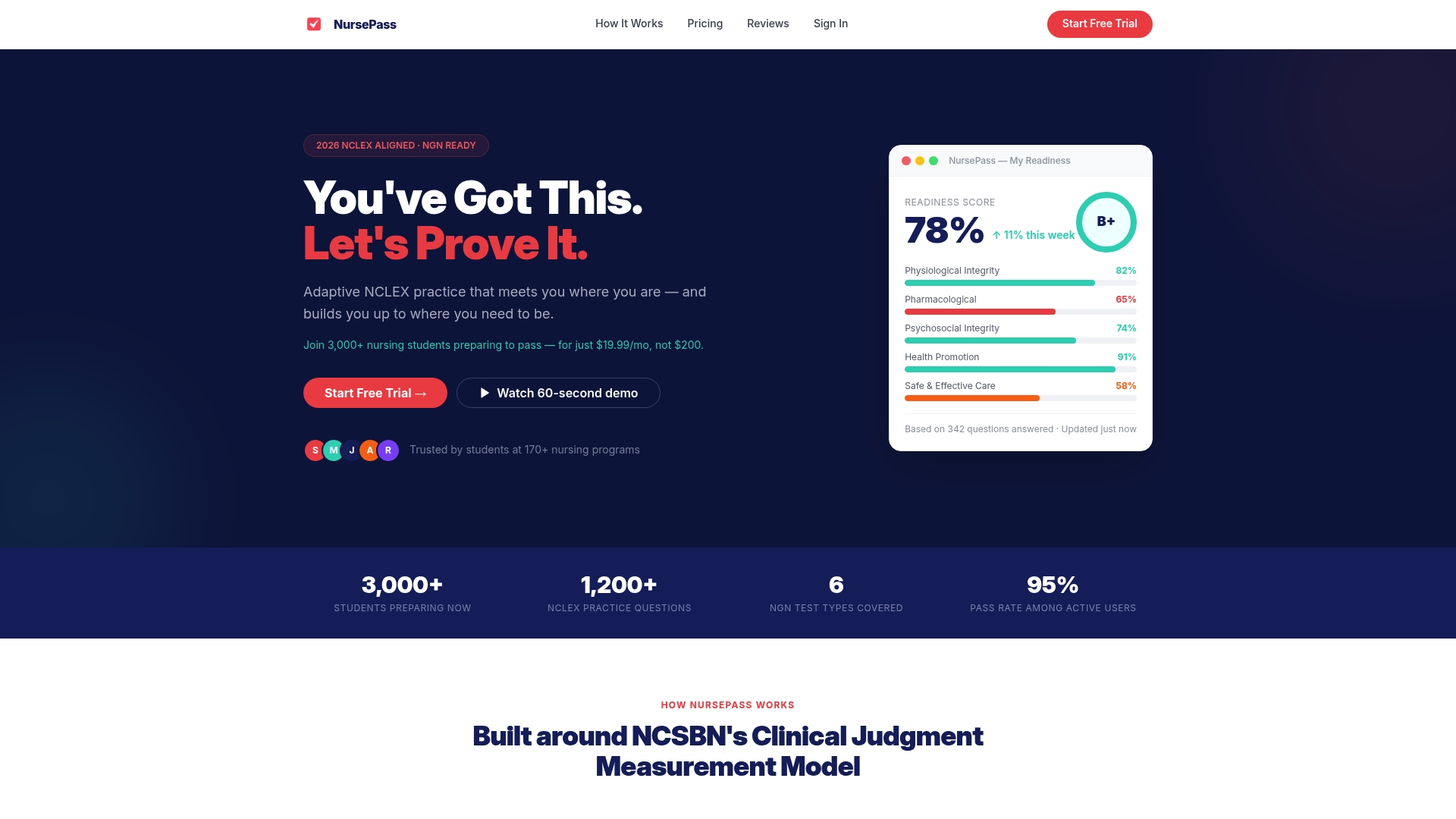
The platform's adaptive engine adjusts question difficulty to your current performance level, so you are always practicing at the edge of your competency, not coasting through easy questions or drowning in material you are not ready for. Over 3,000 nursing students use Nursepass, and the platform reports a 95% pass rate among active users. Features like a live readiness score and subcategory heat maps show you exactly where your accuracy stands across every CJMM step and content area. If you are ready to replace guesswork with a data-driven prep plan, start with Nursepass and see where your accuracy actually stands today.
FAQ
What is the most effective accuracy improvement technique for NCLEX?
Daily practice of 50–75 questions followed by CJMM-based mistake analysis is the most effective technique. This approach builds clinical judgment speed and targets the exact skills the NCLEX algorithm evaluates.
How does structured remediation improve nursing exam scores?
Students who complete 8 hours of targeted remediation after missing a performance benchmark achieve a 100% pass rate on retests. Focused remediation on specific weak areas outperforms general review every time.
What is the "what-if" trap in nursing exams?
The what-if trap occurs when students add information not present in the question stem. Answering only what the question states, without adding assumptions, directly improves accuracy on NCLEX and similar exams.
How do I find my weak areas for nursing exam prep?
Question bank analytics are more reliable than self-assessment for identifying weak areas. Track your scores by CJMM step and content category, then build your study plan around the data, not your confidence level.
How many practice questions should I do per day for NCLEX prep?
NCLEX 2026 preparation standards recommend 50–75 practice questions daily, completed under timed, exam-like conditions and reviewed by CJMM step rather than content category.