
An adaptive study plan is a data-driven, personalized learning approach that adjusts your study focus based on your current performance. For nursing students preparing for the NCLEX, this method replaces generic review schedules with targeted sessions that attack your weakest knowledge areas first. The core tools are daily NCLEX-style practice questions, spaced repetition, focused study blocks, and self-regulated learning habits. Together, these techniques build the clinical reasoning and testing stamina the NCLEX demands. This guide gives you a complete framework for building and running an adaptive study plan that actually moves your readiness score.
What are the essential components of an adaptive study plan for nursing students?
An effective adaptive study plan for nursing students rests on five core components. Each one serves a specific function. Skip one, and the whole system loses precision.
1. Daily NCLEX-style practice questions

Practicing 25–50 NCLEX-style questions daily gives you two things at once: diagnostic data and active recall. The questions reveal exactly which content categories are dragging your score down. That data becomes the input your plan uses to redirect your next study session.
2. Spaced repetition
Spaced repetition maximizes retention of high-volume nursing content far better than passive re-reading. The method works by revisiting a topic at increasing intervals, forcing your brain to reconstruct the memory each time. Digital flashcard tools built on spaced repetition algorithms handle the scheduling automatically.
3. Structured time blocks using the 45/15 rule
The 45/15 study method means 45 minutes of focused study followed by a 15-minute break. This structure prevents cognitive fatigue and keeps decision-making quality high across a full study day. Marathon sessions without breaks reduce the quality of your recall and distort your self-assessment.
4. An adaptive technology platform
Adaptive platforms detect weak subskills from your responses and recommend targeted exercises. Nursepass, for example, uses an adaptive engine that adjusts question difficulty to your current competency level, paired with a live readiness score and subcategory heat maps. Those heat maps show you at a glance which NCLEX content areas need the most attention.
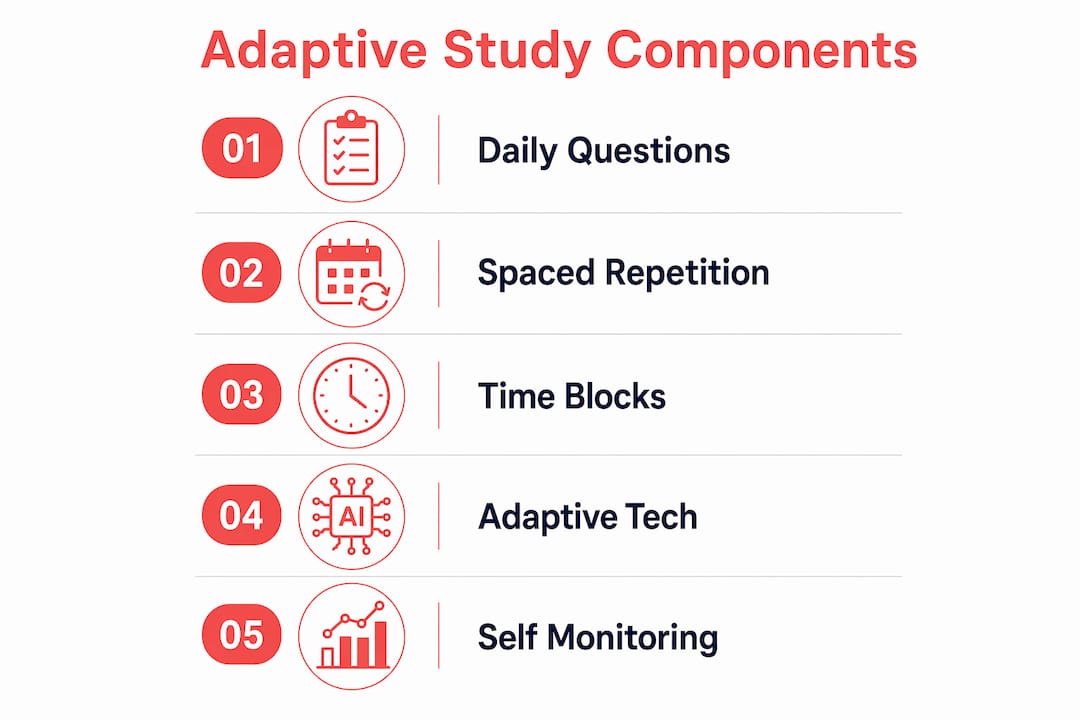
5. Self-monitoring tools
A weekly reflection log or a simple progress tracker forces you to evaluate whether your plan is working. Students who monitor their own progress and adjust strategies retain more and improve academic outcomes. This habit is the difference between a plan that evolves and one that stagnates.
Pro Tip: Keep a short daily log of your question accuracy by subcategory. After one week, you will see a clear pattern of which topics need more spaced repetition cycles.
| Component | What it does for your NCLEX prep |
|---|---|
| Daily practice questions | Diagnoses weak areas and builds active recall |
| Spaced repetition | Locks high-volume content into long-term memory |
| 45/15 time blocks | Prevents fatigue and sustains focus |
| Adaptive platform | Adjusts difficulty and tracks readiness in real time |
| Self-monitoring log | Keeps the plan current and responsive to your progress |
How do you build and implement an adaptive study plan step by step?
Building the plan takes one focused session. Running it takes daily discipline. Here is the exact sequence.
Step 1: Run a diagnostic assessment
Start with a full set of NCLEX-style practice questions across all content categories. Do not study beforehand. The goal is a clean baseline that shows your real starting point. Your NCLEX study schedule should not begin until you have this data.
Step 2: Set measurable goals from your diagnostic results
Look at your subcategory scores and rank your weakest three areas. Set a specific accuracy target for each one, such as moving from 55% to 75% on pharmacology within three weeks. Vague goals like "get better at med-surg" produce vague results.
Step 3: Schedule focused study blocks
Map your weekly calendar using 45/15 blocks. Assign your weakest topics to your highest-energy time slots, typically morning. Reserve lower-energy slots for review of stronger topics. A structured weekly study plan built around your diagnostic results is far more efficient than a generic chapter-by-chapter schedule.
Step 4: Apply spaced repetition to weak topics
After each study session on a weak topic, schedule a review of that same material for two days later, then five days later, then ten days later. This interval pattern forces retrieval and cements the content. Most adaptive platforms automate this scheduling, but you can replicate it manually with a calendar.
Step 5: Use AI-driven feedback to adjust your focus
After every practice question set, review the rationales for every wrong answer, not just the ones you flagged as uncertain. AI-enhanced platforms provide formative feedback that identifies the specific reasoning error behind each miss. That feedback is the signal your plan uses to shift resources toward the right content.
Step 6: Review and update your plan weekly
Every Sunday, check your accuracy trends by subcategory. If a weak area has crossed your target threshold, rotate a new weak area into your priority slots. Consistent, distributed studying across the week outperforms last-minute cramming by building the clinical reasoning patterns the NCLEX tests directly.
Pro Tip: Set a 10-minute "plan review" appointment on your calendar every Sunday evening. Treat it like a clinical handoff. You are passing the week's data to next week's study schedule.
What challenges do nursing students face with adaptive study plans?
Adaptive study plans require more self-awareness than passive review schedules. That is their strength and their most common failure point.
Cognitive fatigue
Nursing school content is dense. Without structured breaks, fatigue accumulates and degrades both retention and judgment. The 45/15 rule directly addresses this. Students who ignore it often report that their accuracy on practice questions drops sharply after the first 90 minutes of unbroken study.
Burnout from over-intensity
Adaptive plans can create pressure to fix every weak area at once. That pressure leads to overloaded schedules and burnout. The fix is to limit your active priority topics to two or three at a time. Depth on a few topics beats shallow coverage of many.
Over-reliance on apps
Technology platforms are tools, not teachers. Students who outsource all judgment to an app stop developing the metacognitive habits that the NCLEX actually tests. Use the platform's data as input, but make the study decisions yourself.
"Students who monitor their own progress and adjust strategies retain more and improve academic outcomes." — Research on adaptive self-regulated learning
Inconsistent habits
Skipping two or three days breaks the spaced repetition schedule and forces you to restart the interval cycle on topics you had nearly consolidated. Consistency matters more than session length. A 45-minute session every day beats a four-hour session once a week.
Pro Tip: If you miss a day, do not try to double up the next day. Simply resume the schedule as written. Doubling up creates fatigue and distorts your diagnostic data.
How do self-regulated learning and AI feedback amplify adaptive study results?
Self-regulated learning, or SRL, is the practice of monitoring your own understanding, identifying gaps, and adjusting your approach accordingly. In nursing education, SRL is not optional. It is the mechanism that makes an adaptive plan actually adapt.
A 2026 mixed-methods study with undergraduate nursing students documented statistically significant gains in motivation, metacognition, and cognitive strategy use after adaptive SRL interventions. Those gains translate directly to better performance on high-stakes exams like the NCLEX. Students who developed SRL habits were better at recognizing when their understanding was shallow and redirecting effort before exam day.
AI adds a second layer to this process. AI-enhanced adaptive models operate as a technology-driven closed loop: the system collects your response data, identifies the subskills you are missing, and feeds that information back as targeted exercises and updated progress tracking. A 2026 meta-analysis of 4 randomized controlled trials with 459 nursing students showed moderate-to-large improvements in academic performance favoring AI-driven adaptive teaching over traditional methods. That is a meaningful effect size across a controlled sample.
"Technology-driven closed loops in adaptive learning platforms provide formative assessments, tailored feedback, and updated progress tracking, facilitating effective learning." — Frontiers in Medicine, 2026
The practical implication is straightforward. Use AI feedback to surface the data, then apply SRL habits to act on it. The combination of human metacognition and machine pattern recognition is more powerful than either one alone. Nursepass builds this loop directly into its platform through its live readiness score and subcategory heat maps, giving nursing students a real-time picture of where their preparation stands.
| Study approach | Academic performance outcome |
|---|---|
| Traditional lecture-based review | Baseline performance |
| Adaptive plan without SRL habits | Moderate improvement |
| Adaptive plan with SRL and AI feedback | Moderate-to-large improvement (2026 meta-analysis) |
Key Takeaways
An adaptive study plan for nursing students works because it combines diagnostic data, spaced repetition, and self-regulated learning habits to target weak areas before they cost you on the NCLEX.
| Point | Details |
|---|---|
| Start with a diagnostic | Run a full practice question set before scheduling anything to get clean baseline data. |
| Use the 45/15 rule | Study in 45-minute blocks with 15-minute breaks to sustain focus and prevent fatigue. |
| Prioritize two or three weak areas | Depth on a few topics beats shallow coverage across many content categories. |
| Combine AI feedback with SRL | Use platform data as input, then make your own metacognitive adjustments weekly. |
| Consistency beats intensity | Daily short sessions outperform occasional marathon reviews for clinical reasoning gains. |
Why I think most nursing students are studying harder than they need to
Most nursing students I have seen struggle with NCLEX prep are not failing because they lack effort. They are failing because their effort is distributed wrong. They spend equal time on topics they already know and topics they have never mastered. That is not a study plan. That is a comfort loop.
The shift that changes outcomes is simple: stop reviewing what you already know and start attacking what you do not. That sounds obvious, but it requires a level of self-honesty that is genuinely uncomfortable. Seeing a subcategory heat map light up red on pharmacology or priority setting forces you to confront the gap directly. Most students avoid that confrontation by staying in familiar territory.
The research on adaptive self-regulated learning confirms what I have observed: the students who improve fastest are not the ones who study the most hours. They are the ones who monitor their own understanding and adjust their plan when the data tells them to. That metacognitive habit is a skill. It takes practice. But once you build it, your study time becomes genuinely efficient rather than just busy.
Start earlier than you think you need to. The students who treat NCLEX prep as a sprint almost always regret it. The ones who build a consistent, data-driven routine from the start of their final semester arrive at test day with confidence that no last-minute cramming session can manufacture.
— Michael
How Nursepass supports your personalized NCLEX prep
Nursepass is built specifically for nursing students who want a personalized, data-driven path to NCLEX success. The platform's adaptive engine adjusts question difficulty to your current competency level, so every session targets the areas where you need the most work.
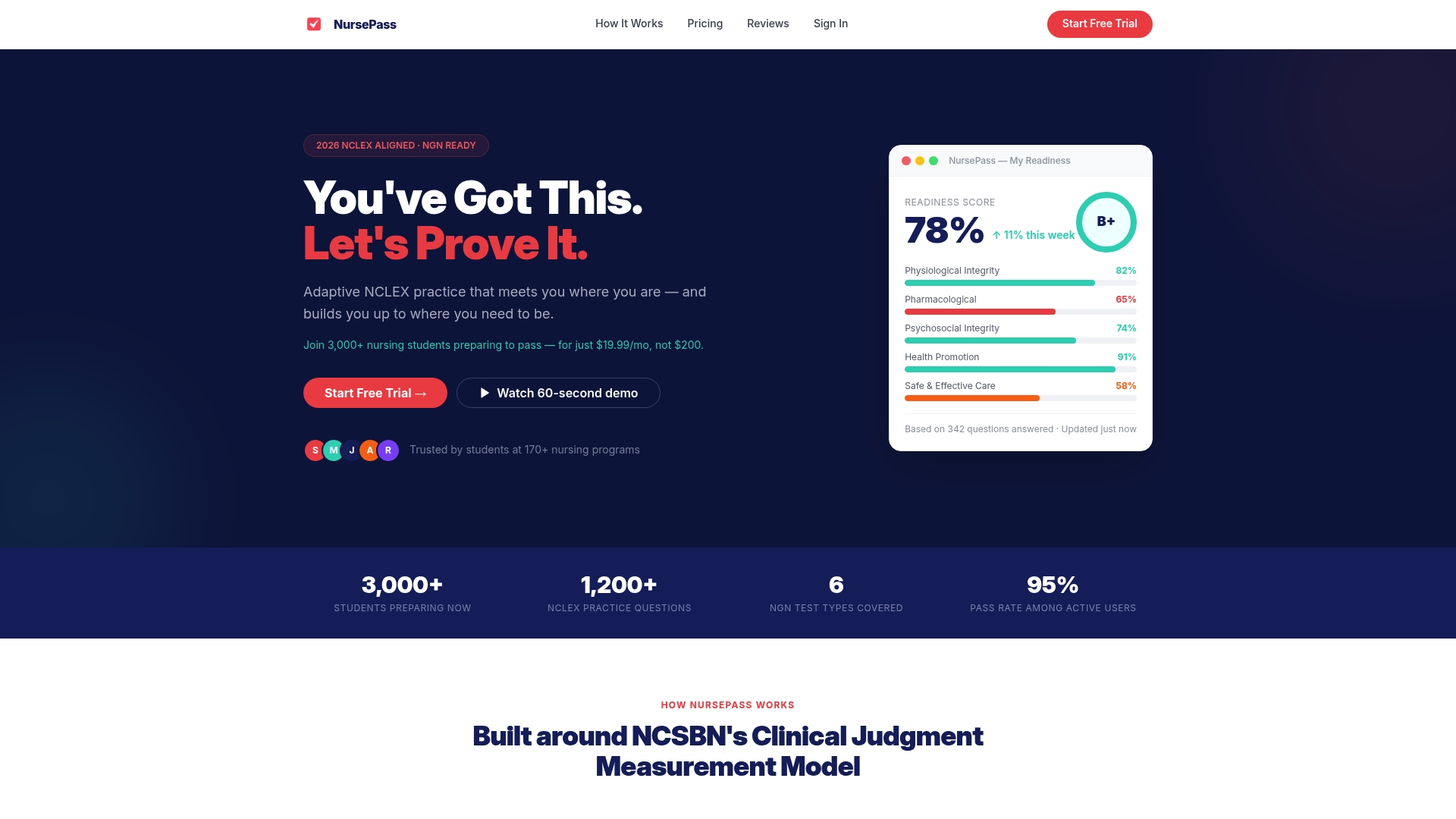
With over 1,200 NCLEX practice questions, a live readiness score, and subcategory heat maps, Nursepass gives you the diagnostic clarity that generic question banks cannot. More than 3,000 nursing students have used the platform, with a 95% pass rate among active users. If you are ready to build a custom NCLEX prep plan that actually responds to your performance, Nursepass is the place to start.
FAQ
What is an adaptive study plan for nursing students?
An adaptive study plan is a personalized, data-driven learning schedule that adjusts your study focus based on your current performance across NCLEX content categories. It uses diagnostic practice questions, spaced repetition, and regular self-assessment to target weak areas efficiently.
How many practice questions should nursing students do each day?
Practicing 25–50 NCLEX-style questions daily is the recommended range for building testing stamina and generating reliable diagnostic data about your weak content areas.
What is the 45/15 study method?
The 45/15 method means studying for 45 minutes and then taking a 15-minute break. This structure prevents cognitive fatigue and maintains the quality of recall and decision-making across a full study day.
How does AI improve NCLEX exam preparation?
AI-enhanced platforms operate as a closed feedback loop, detecting weak subskills from your responses and recommending targeted exercises. A 2026 meta-analysis of 459 nursing students showed moderate-to-large academic performance gains with AI-driven adaptive teaching compared to traditional methods.
How does Nursepass support adaptive learning for the NCLEX?
Nursepass tailors question difficulty to your current competency level and provides a live readiness score and subcategory heat maps. These features give nursing students real-time visibility into their CAT testing readiness and direct their study time toward the highest-impact content areas.