
An exam readiness indicator is a composite, objective metric that measures your likelihood of passing an exam based on multiple performance signals, not on how confident you feel. For nursing students preparing for the NCLEX, understanding this metric is the difference between scheduling your exam with data behind you and guessing based on gut instinct. Readiness indicators pull together data points like mastery, coverage, retention, pace, and consistency to give you a real picture of where you stand. Tools like Surgent ReadySCORE and platforms like Nursepass have built these indicators into their core study experience.
What is an exam readiness indicator and how is it calculated?
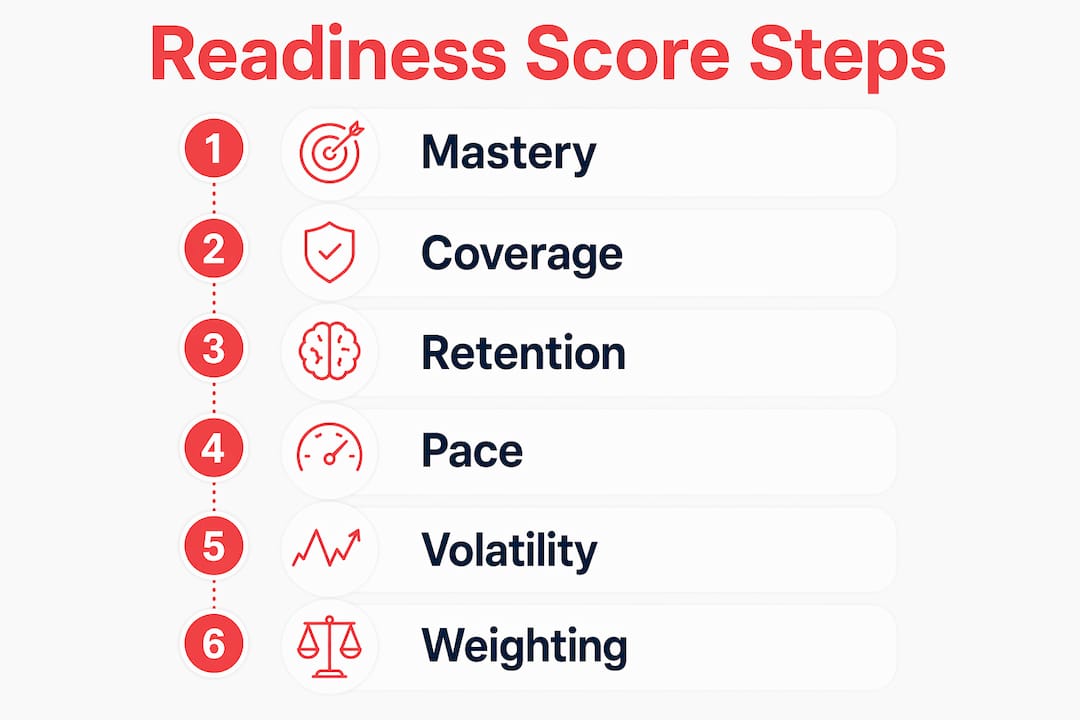
An exam readiness indicator aggregates six core performance signals: Mastery, Coverage, Retention, Pace, Volatility, and Endurance. No single signal tells the full story. A student who scores well on one topic but has never touched three others is not ready, even if their average looks decent.
Each signal carries weight based on how much that topic appears on the actual exam blueprint. This weighting matters because the NCLEX does not test all content areas equally. Pharmacology, for example, appears far more frequently than some other categories, so gaps there hit your readiness score harder.

The calculation also factors in when you answered questions correctly. Scoring well immediately after reviewing a topic is not the same as scoring well 24–48 hours later. Delayed practice test performance is a stronger signal of true retention than same-day recall.
What core signals contribute to a readiness score?
The six signals in a readiness indicator each measure a different dimension of preparation. Here is how they break down and why each one matters for NCLEX candidates.
| Signal | What it measures | Impact on readiness |
|---|---|---|
| Mastery | Accuracy rate per topic | High impact: directly reflects knowledge depth |
| Coverage | Percentage of blueprint topics attempted | High impact: untouched topics create blind spots |
| Retention | Score consistency over time | High impact: shows learning stuck, not just memorized |
| Pace | Time per question under timed conditions | Medium impact: slow pacing predicts late-section errors |
| Volatility | Score swings across sessions | Medium impact: unstable scores signal fragile knowledge |
| Endurance | Performance in the final third of a practice test | Medium impact: fatigue causes late-question errors |
Retention and Volatility are the two signals most students overlook. A student who scores 90% on Monday and 60% on Wednesday has volatile performance. That swing signals the knowledge is not stable enough to trust on exam day.
Pro Tip: Run a timed, full-length practice test at least 24 hours after your last review session on that content. The score you get then is the one that actually predicts your NCLEX result.
How do modern readiness tools measure NCLEX preparation?
The best exam readiness indicator tools do not just give you a number. They show you exactly which sub-topics are dragging your score down and why. Transparent readiness metrics that display topic-level mastery and recent performance trends are far more useful than a single composite percentage with no explanation.
Surgent ReadySCORE is one of the most cited readiness tools in certification prep. It uses adaptive weighting by exam blueprint to prioritize the topics that appear most often on the actual test. Nursepass applies a similar approach for NCLEX candidates, with a live readiness score and subcategory heat maps that update as you practice.
The features that separate strong readiness assessment tools from weak ones include:
- Live score updates that reflect your most recent performance, not a static snapshot
- Topic-level breakdowns showing mastery per NCLEX content category
- Blueprint weighting so high-frequency topics carry more influence on your score
- Trend tracking that shows whether your score is climbing, flat, or declining over time
- Timed practice integration so pace data feeds into your readiness calculation
- Minimum question thresholds per sub-topic before that topic counts as covered
Pro Tip: Avoid any readiness tool that gives you a score without explaining what drives it. A black-box percentage tells you nothing about where to study next.
What are the most common misconceptions about exam readiness?
The biggest misconception nursing students hold is that feeling ready equals being ready. Confidence built on short-term memory is not the same as confidence built on objective data. Re-reading notes and watching review videos creates familiarity, not mastery. Familiarity feels like knowledge but evaporates under exam pressure.
"Experts discourage judging readiness by feelings alone and advocate for evidence-based indicators scored 24 or more hours after study." — 5 Signs You're Actually Ready for Your Exam
A second misconception is that one strong practice test means you are ready. A single high score is a data point, not a trend. Real readiness requires statistical stability across multiple attempts, with at least 10–20 questions answered per sub-topic before that area counts as reliably assessed.
Passive study methods compound both problems. Re-reading or passive review produces a false sense of mastery because recognition feels like recall. Active retrieval, where you force yourself to answer questions without looking at notes, is the only method that builds the kind of memory that holds up on test day.
The third misconception is that untimed practice accurately reflects exam performance. Untimed quizzes inflate confidence because you have unlimited time to reason through answers. The NCLEX has a time limit. Practicing without one means your pace data is useless for predicting real performance.
How can nursing students use readiness indicators to improve their NCLEX prep?
Readiness indicators are most powerful when you treat them as diagnostic tools, not finish lines. Readiness scores reveal precise weak spots for focused study rather than serving as end-goals themselves. Here is a practical framework for using them effectively.
-
Establish a baseline early. Take a full-length timed practice test in week one of your study plan. Do not wait until you feel ready. The baseline score shows you where the real gaps are, not where you think they are.
-
Map your heat map weekly. If your readiness tool shows subcategory performance, review it every seven days. Topics that stay red or orange after two weeks of study need a method change, not more time on the same approach.
-
Prioritize by blueprint weight. Focus first on the NCLEX content categories that appear most frequently. Spending equal time on all topics is inefficient. Your readiness score should reflect the exam's actual distribution.
-
Track trend, not peak. A single session where you scored 88% means less than five consecutive sessions averaging 85% or above. Score convergence over time is the real signal that your preparation is solid.
-
Integrate pacing data. Check whether you are finishing timed practice tests without rushing the final questions. Timing stability is as important as accuracy. If you consistently run out of time, your readiness score overstates your actual preparedness.
-
Combine readiness scores with a structured schedule. A readiness indicator tells you what to study. A structured NCLEX study plan tells you when. Both together give you a complete preparation system.
If your score stagnates despite consistent study, switch methods. Score stagnation signals a need for more active, retrieval-based learning rather than more hours of the same passive review.
How do readiness scores correlate with actual exam success?
The research is clear on thresholds. Readiness scores categorize preparedness into three bands: 0–70% indicates significant gaps, 71–85% signals near-readiness that needs targeted review, and 85–90%+ indicates a high likelihood of passing. These bands are not arbitrary. They reflect the accuracy levels needed to demonstrate competency across the NCLEX blueprint.
| Score band | Readiness status | Recommended action |
|---|---|---|
| 0–70% | Significant gaps present | Reassess study method; focus on coverage first |
| 71–84% | Near ready | Target weak sub-topics; increase timed practice |
| 85–90%+ | High pass likelihood | Maintain consistency; confirm pacing is stable |
Pacing matters as much as accuracy. A student who scores 87% but rushes the last 20 questions has a weaker readiness profile than one who scores 85% with consistent timing throughout. Finishing cleanly without last-minute rushing strongly correlates with exam success.
Pro Tip: Do not schedule your NCLEX based on a single session above 85%. Wait until you have hit that threshold across three or more timed, full-length practice tests taken on separate days.
Key Takeaways
A reliable exam readiness indicator combines accuracy, coverage, retention, pace, and trend data to predict NCLEX pass likelihood far more accurately than any single practice test score.
| Point | Details |
|---|---|
| Readiness is a composite metric | Six signals, including Mastery, Retention, and Pace, combine to form a reliable readiness score. |
| 85%+ is the target threshold | Scoring 85–90%+ across multiple spaced practice tests signals a high likelihood of passing the NCLEX. |
| Trend beats peak | Consistent scores across several timed sessions matter more than one high-scoring outlier. |
| Passive study creates false confidence | Active retrieval and timed practice are the only methods that build stable, testable knowledge. |
| Pacing is a readiness signal | Finishing timed exams without rushing late sections is as predictive as accuracy alone. |
What I've learned from watching students misread their readiness
Most nursing students I have seen struggle with the NCLEX share one pattern. They confuse activity with progress. They log hours, complete question banks, and watch review videos, then feel ready because they have been busy. Their readiness score tells a different story.
The students who pass consistently are the ones who treat their readiness indicator like a coach, not a judge. They check it weekly, not to feel good or bad about a number, but to find out exactly where to go next. When their score on respiratory pharmacology stays flat for two weeks, they do not study harder. They study differently, switching from passive review to active recall drills.
The other pattern I see is over-reliance on a single strong session. One 90% practice test does not mean you are ready. It means you had a good day. Readiness tracked as a trend across multiple sessions is the only version of readiness worth trusting.
My honest advice: set a rule for yourself. Do not schedule your NCLEX until you have hit 85% or above on three separate full-length timed tests, taken on different days, with no cramming the night before. That rule removes the guesswork and replaces it with data you can actually trust.
— Michael
Nursepass and your NCLEX readiness score
Nursepass is built specifically for nursing students who want more than a question bank. It offers a live readiness score that updates after every practice session, plus subcategory heat maps that show exactly which NCLEX content areas need attention.
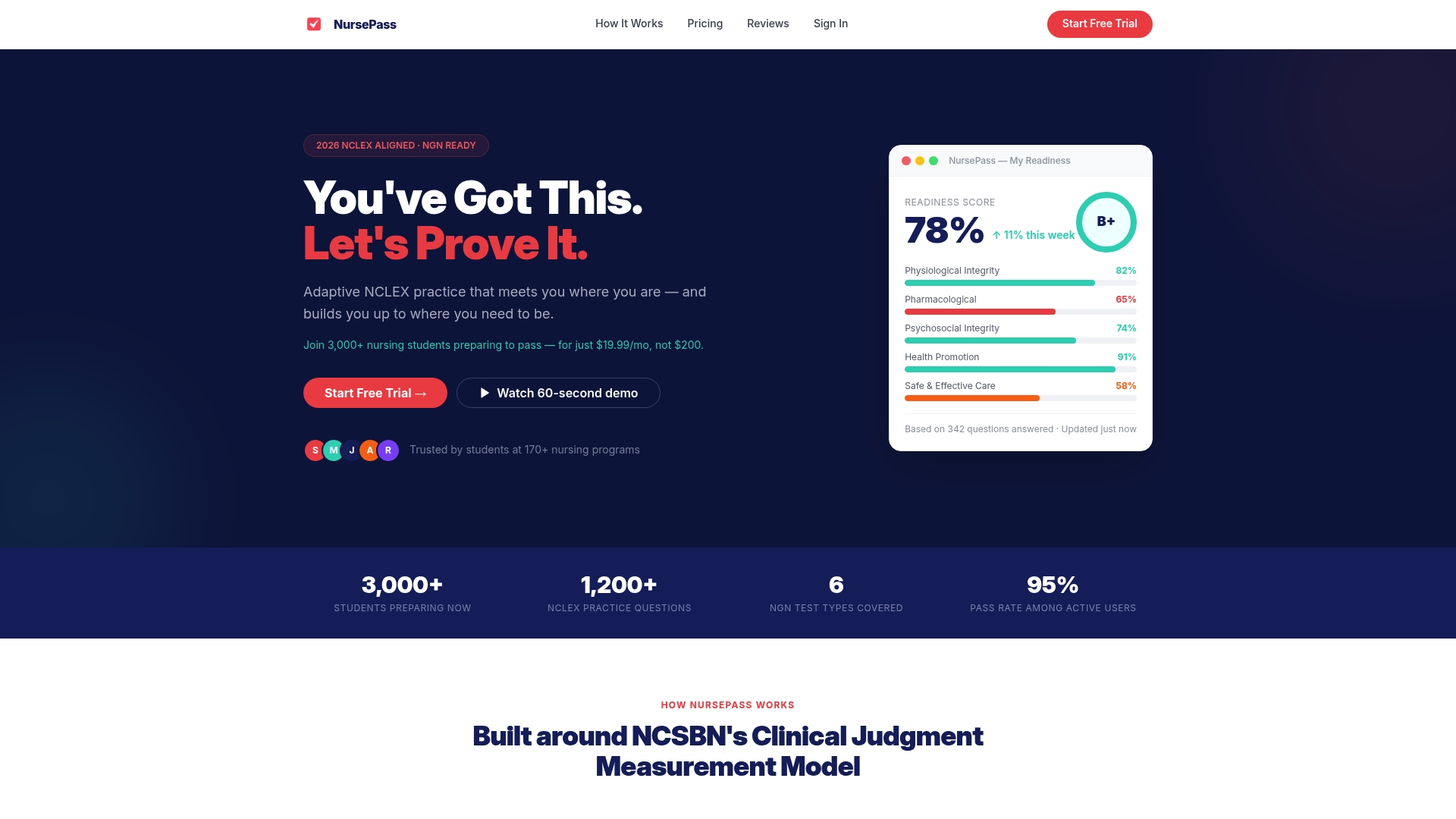
More than 3,000 nursing students use Nursepass, and the platform reports a 95% pass rate among active users. Its adaptive engine adjusts question difficulty based on your current performance, so you are always working at the right level. With over 1,200 NCLEX practice questions weighted by the exam blueprint, Nursepass gives you the personalized NCLEX prep that generic question banks cannot match. If your readiness score matters to you, Nursepass is where to track it.
FAQ
What is an exam readiness indicator?
An exam readiness indicator is a composite metric that aggregates multiple performance signals, including mastery, retention, pace, and coverage, to objectively measure how prepared you are to pass an exam.
What score indicates NCLEX readiness?
A score of 85–90%+ on spaced, timed practice tests taken 24–48 hours after review strongly indicates readiness for the NCLEX.
Why is feeling ready not enough?
Confidence built on recent review reflects short-term memory, not stable knowledge. Objective metrics scored 24 or more hours after study are a far more reliable readiness gauge.
How many practice questions do I need per topic?
Completing at least 10–20 questions per sub-topic is the minimum needed before that area can be considered reliably assessed in your readiness score.
How is Nursepass different from other NCLEX prep tools?
Nursepass provides a live readiness score and subcategory heat maps that update in real time, giving nursing students a transparent, data-driven view of their preparation progress across all NCLEX content areas.