
Video lessons are a critical educational tool that measurably improve nursing students' understanding, skill mastery, and exam readiness for the NCLEX. The role of video lessons in nursing prep goes beyond passive watching. Research published in 2026 confirms that video-assisted instruction produces statistically significant gains in clinical knowledge and psychomotor skills compared to traditional methods. For Generation Z nursing students, who learn best through visual formats, video content designed around Mayer's Cognitive Theory of Multimedia Learning delivers faster comprehension and stronger retention than lectures or textbooks alone. This guide breaks down what the evidence says and how you can apply it.
How video lessons improve clinical skills and knowledge retention
Video-assisted instruction produces measurable results in clinical skill development. Studies with 66–78 nursing students showed statistically significant gains (p < 0.05) in skills like central venous catheter care and range of motion exercises when video instruction replaced or supplemented traditional teaching. That finding matters because NCLEX preparation is not just about memorizing facts. It requires building the kind of procedural confidence that comes from watching correct technique repeatedly.
Video lessons solve a real problem with live demonstrations. In a clinical lab, students at the back of the room miss details. A video can be paused, rewound, and replayed until every step is clear. Repeated viewing allows students to control the pace of their own learning, which is especially valuable when mastering multi-step procedures under time pressure.
Integration with traditional instruction produces the best outcomes. Video works best as a complement to hands-on practice, not a replacement. Students who watched skill demonstration videos before lab sessions arrived better prepared and required less instructor correction during practice.
Key benefits of video-assisted clinical learning:
- Repeatability: Students can review complex steps as many times as needed without scheduling lab time.
- Standardization: Every student sees the exact same correct technique, eliminating variation from different instructors.
- Self-pacing: Generation Z learners benefit from controlling playback speed to match their comprehension level.
- Visibility: Close-up camera angles show procedural details that live demos cannot always deliver.
Pro Tip: Watch skill videos at 0.75x speed the first time through. Slowing the playback forces you to notice steps you would normally skim past at normal speed.
What types of video lessons are most effective for nursing prep?
Not all nursing videos deliver the same learning outcomes. The format you choose directly affects how much you retain and how motivated you stay.
| Video type | Primary benefit | Best used for |
|---|---|---|
| Scenario-based animation | Boosts motivation and clinical reasoning | Pathophysiology, disease progression |
| Skill demonstration | Builds procedural accuracy | CVC care, wound dressing, ROM exercises |
| Interactive tutorial | Promotes active recall and deeper learning | Pharmacology, NCLEX-style rationales |
| Lecture capture | Efficient content delivery | Foundational concepts, anatomy review |
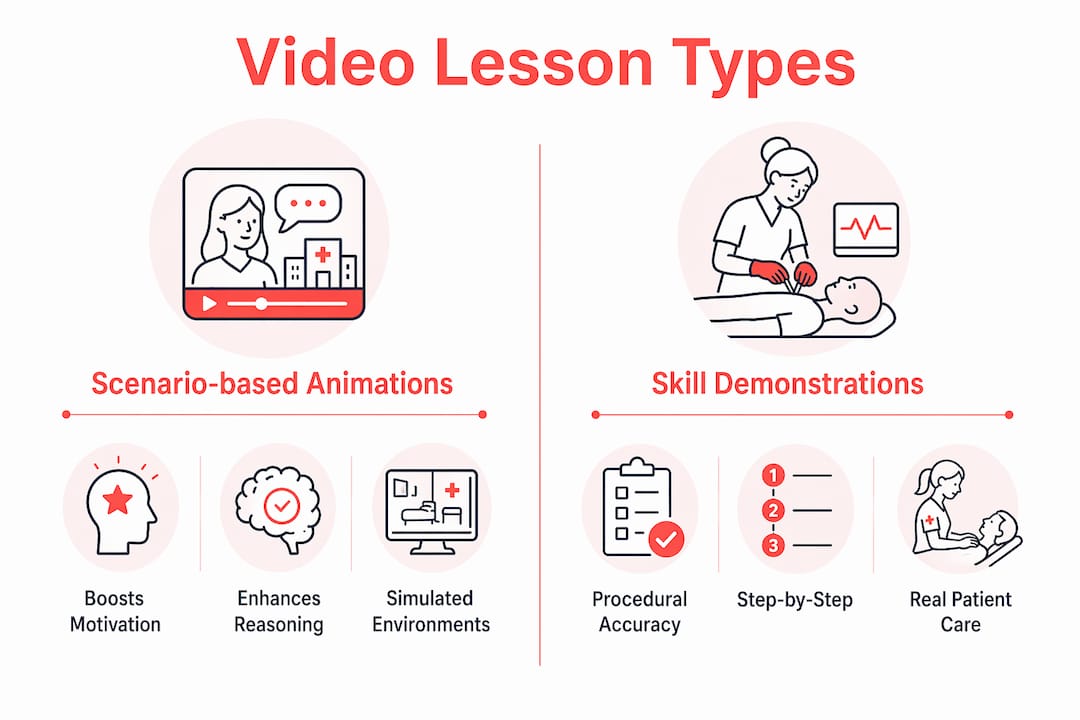
Scenario-based animation videos stand out in the research. 3D animations simulating hospital environments increase nursing students' motivation and produce more positive attitudes toward learning than routine skill videos. The reason is straightforward. When a video places you inside a realistic clinical scenario and asks you to follow a patient's deterioration, you engage your clinical reasoning rather than just your memory.
Interactive videos take that engagement one step further. These formats embed questions, branching decisions, or short quizzes directly into the video timeline. Students who encounter a question mid-video must answer before continuing. That friction is intentional. It forces retrieval practice, which is one of the most evidence-backed methods for locking information into long-term memory.
Skill demonstration videos remain the workhorse of nursing education. They are straightforward, efficient, and directly tied to the psychomotor competencies tested in clinical evaluations and reflected in NCLEX client needs categories. Pairing a self-study plan with targeted skill videos keeps your preparation structured and measurable.
Pro Tip: Rotate video types across your study week. Use scenario-based animations on Monday for clinical reasoning, skill demos on Wednesday before lab, and interactive tutorials on Friday for NCLEX-style practice.
How to use video lessons actively to maximize exam readiness
Passive watching is the single biggest mistake nursing students make with video content. Sitting through a 20-minute pharmacology video without engaging produces little lasting retention. Active viewing strategies change that outcome completely.
Follow these steps to get maximum value from every video session:
- Preview the topic first. Read your NCLEX test plan categories for the subject before pressing play. Knowing what to look for primes your brain to notice key information.
- Pause and recall. Stop the video every 3–5 minutes and explain what you just watched in your own words. This pause-and-recall technique aligns directly with Mayer's multimedia learning principles and significantly boosts retention.
- Use synchronized transcripts. Many video platforms provide transcripts. Keyword searching in transcripts lets you jump to the exact moment a concept is explained without rewatching the entire video. This is especially useful during last-minute NCLEX review.
- Build a cheat sheet as you watch. Write down three to five key points per video in your own words. Do not copy the screen. Translating information into your own language is a form of active processing that deepens understanding.
- Follow every video with an NCLEX-style question. Test whether you can apply what you just watched. If you cannot answer a question about the content, rewatch that specific segment before moving on.
- Space your video sessions. Do not binge six videos in one sitting. Spaced repetition, reviewing content across multiple sessions over days, produces far stronger long-term retention than massed practice.
- Combine videos with your adaptive study plan. Align video topics with your current weak areas so every session targets a real gap in your knowledge.
The goal is to treat every video as a conversation, not a lecture. You are not an audience member. You are a student actively building clinical knowledge.
What are the limitations of video lessons for NCLEX prep?
Video lessons are powerful, but they do not solve every preparation challenge. Understanding where they fall short helps you build a more complete study strategy.
The most significant limitation is anxiety. 2026 randomized controlled trials found no statistically significant reduction in NCLEX-related anxiety following video instruction alone. Watching a video about a clinical procedure does not replicate the pressure of performing it in a real or simulated environment. Anxiety reduction requires different tools.
Supplementary strategies that address what video cannot:
- Reflective journaling: Writing about what you learned and where you still feel uncertain builds metacognitive awareness. It also surfaces knowledge gaps that passive video watching tends to hide.
- Peer discussion: Talking through clinical scenarios with classmates activates a different kind of reasoning than solo video viewing. Collaborative learning enhances reflective practice and problem-solving in ways video alone cannot replicate.
- Timed practice exams: Simulating NCLEX test conditions with a clock running builds the pacing confidence that video lessons do not address. Check your exam readiness regularly with full-length practice sets.
- Self-assessment tools: Platforms that track your performance by subcategory show you exactly where your video study is working and where it is not.
Immersive virtual reality offers an interesting comparison point. RCT data with 78 students showed that VR produced equivalent clinical reasoning outcomes to standard video, but increased engagement and reflective learning. VR is not yet widely accessible, but the finding confirms that active engagement, not the technology itself, drives learning outcomes.
Key takeaways
Video lessons improve NCLEX preparation most when students use active viewing techniques, choose the right video format for each topic, and combine video study with practice questions and peer discussion.
| Point | Details |
|---|---|
| Video improves clinical skills | Studies show statistically significant gains in psychomotor skills when video supplements traditional instruction. |
| Format matters | Scenario-based animations build clinical reasoning; skill demos build procedural accuracy; interactive videos build retention. |
| Active viewing is required | Pause-and-recall and transcript searching produce far stronger retention than passive watching. |
| Video does not reduce anxiety | Supplement video study with timed practice exams and peer discussion to address NCLEX test anxiety. |
| Combine with adaptive tools | Pairing video lessons with a performance-tracking platform targets your real knowledge gaps. |
Why I think most nursing students are using video lessons wrong
After spending years watching how nursing students prepare for the NCLEX, one pattern stands out clearly. Students treat video lessons like Netflix. They queue up a playlist, watch for two hours, and feel productive. They are not.
The research on Mayer's Cognitive Theory of Multimedia Learning is unambiguous. Your brain processes visual and auditory information through separate channels, and both channels have limits. A 45-minute pharmacology video watched straight through overloads both channels and leaves little in long-term memory. The students who actually retain what they watch are the ones who stop the video constantly, argue with it, and test themselves before moving on.
I also think nursing students underestimate scenario-based animation. Most students gravitate toward straightforward skill demos because they feel more directly testable. But the NCLEX does not ask you to list steps. It asks you to make decisions under clinical pressure. Scenario-based videos that put you inside a deteriorating patient situation train exactly that skill. They are uncomfortable to watch because they require you to think. That discomfort is the learning.
The other mistake I see is treating video as a standalone strategy. Video lessons are a delivery mechanism, not a complete study system. The students who pass the NCLEX on their first attempt combine video with practice questions, self-assessment, and honest tracking of their weak areas. Video gets you to the starting line. Active practice and honest self-evaluation get you across the finish.
— Michael
Nursepass: video-aligned NCLEX prep that tracks your progress
Nursing students who want their video study to connect directly to NCLEX performance need a platform that closes the loop between watching and testing.
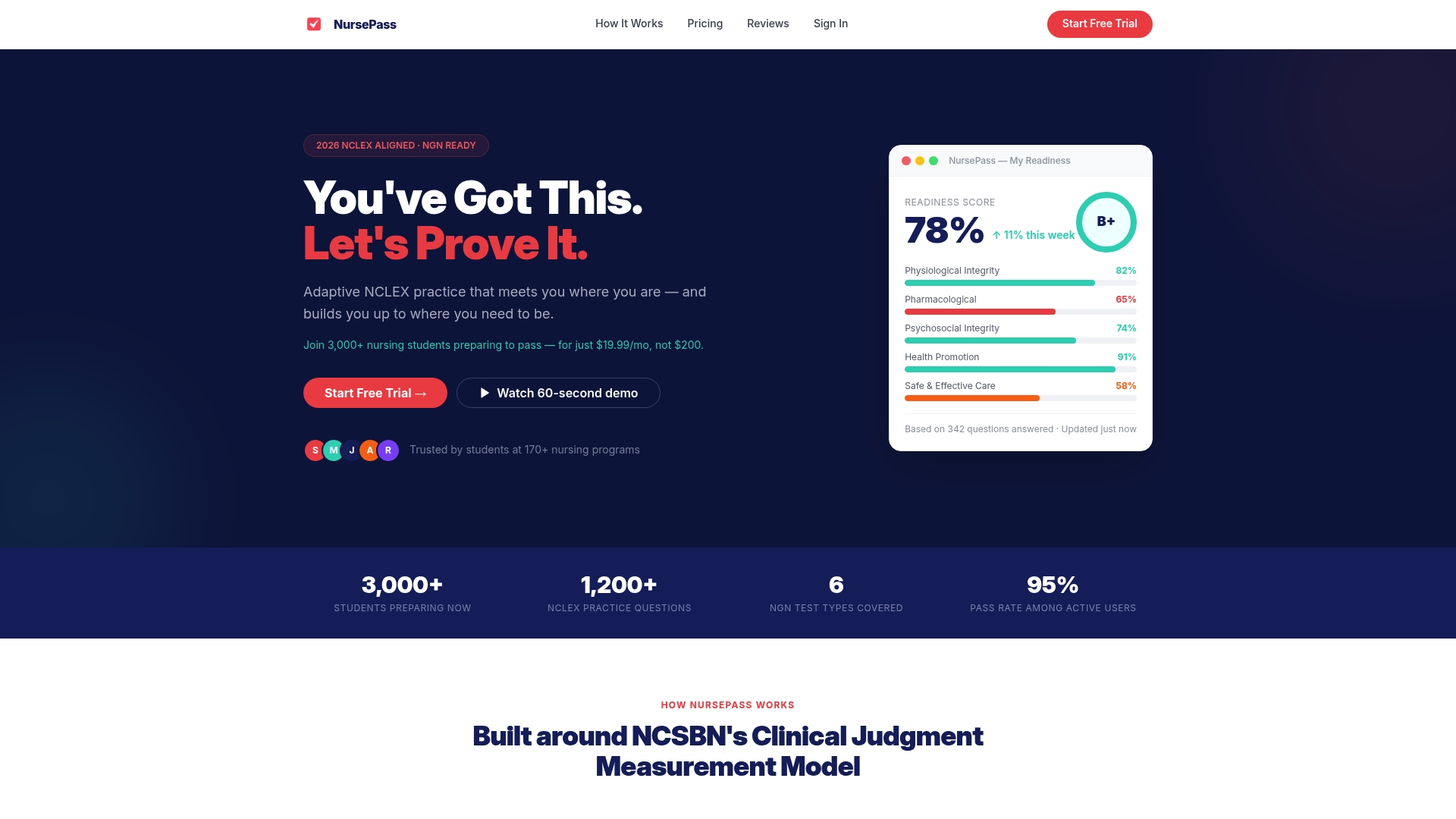
Nursepass pairs adaptive practice questions with a live readiness score and subcategory heat maps, so you always know which topics your video study has strengthened and which still need work. More than 3,000 nursing students use Nursepass, and active users report a 95% pass rate. With over 1,200 NCLEX-style questions calibrated to your current competency level, Nursepass turns your video sessions into measurable progress rather than hours logged.
FAQ
What is the role of video lessons in nursing prep?
Video lessons improve clinical knowledge, psychomotor skill acquisition, and engagement by delivering repeatable, self-paced instruction. Research confirms statistically significant learning gains when video supplements traditional nursing education.
What video format works best for NCLEX preparation?
Scenario-based animations build clinical reasoning, while skill demonstration videos build procedural accuracy. Interactive videos that embed questions mid-playback produce the strongest retention for NCLEX-style content.
Do video lessons reduce NCLEX exam anxiety?
No. 2026 randomized controlled trials found that video instruction alone does not significantly reduce exam anxiety. Timed practice exams and peer discussion are more effective for managing test anxiety.
How should nursing students watch videos actively?
Pause every 3–5 minutes, explain the content in your own words, and follow each session with NCLEX-style questions. Using synchronized transcripts for keyword searches also speeds up last-minute review.
How do video lessons combine with adaptive study tools?
Pairing video lessons with an adaptive platform like Nursepass lets you target video study toward your weakest subcategories, track improvement over time, and measure your readiness with a live score.