
An NCLEX readiness assessment is a timed, adaptive practice test designed to estimate your preparedness for the NCLEX-RN by replicating exam conditions and measuring your ability against the NCLEX passing standard. The NCLEX-RN passing standard is set at 0.00 logits, a unit that compares your estimated ability to question difficulty rather than counting raw correct answers. That distinction matters more than most nursing students realize. A readiness assessment does not grade you like a classroom exam. It predicts your probability of passing by tracking your ability estimate across adaptive questions, giving you data you can actually act on before exam day.
How does NCLEX adaptive scoring and readiness assessment work?
The NCLEX does not score you on the percentage of questions you answer correctly. It uses ability estimates in logits to compare your demonstrated competency against the difficulty of each question you receive. The passing standard of 0.00 logits is upheld through march 31, 2026, and is reviewed every three years by the NCSBN. That means your score is always relative, not absolute.
How adaptive testing updates your ability estimate
Every question you answer shifts your ability estimate up or down. The exam delivers a harder question when you answer correctly and an easier one when you do not. This process continues until the system has enough confidence that your true ability is clearly above or below the passing standard. A readiness assessment replicates this same algorithm, which is why it produces a probability of passing rather than a letter grade.

Readiness assessments simulate adaptive scoring mechanics to give you a realistic picture of where your ability estimate sits right now. The result is one data point, not a verdict. Your score carries a confidence interval, meaning there is a range of ability values consistent with your performance. A single assessment cannot collapse that range to a single number with certainty.
Why trends matter more than single scores
Tracking your results across multiple assessments reveals whether your ability estimate is rising, flat, or falling after remediation. A single readiness exam is insufficient for reliable self-benchmarking. Watching for upward movement after targeted study is the signal that your preparation is working. Nursepass builds this trend tracking directly into its live readiness score feature, so you see your trajectory at a glance rather than hunting through old test reports.
Pro Tip: Take at least three full readiness assessments spaced one to two weeks apart before your exam date. The trend line across those results is far more predictive than any single score.
- Ability estimates update after every question, not at the end of the exam.
- The passing standard is 0.00 logits, not a percentage threshold.
- Readiness assessments produce a pass probability, not a grade.
- Confidence intervals mean one low score does not define your readiness.
- Trend analysis across multiple assessments is the most reliable self-evaluation method.
What tools are needed for an effective NCLEX readiness workflow?
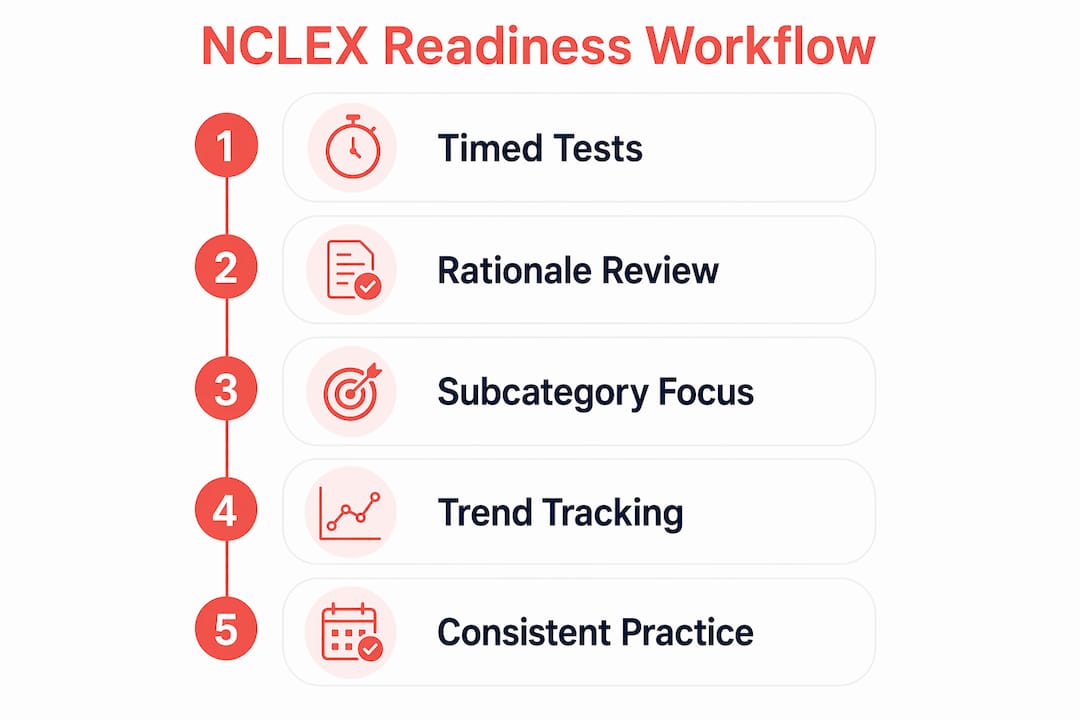
Effective NCLEX exam preparation requires more than a stack of flashcards. Recommended tools include timed CAT-style exams, content review materials aligned with the official NCLEX test plan, and performance tracking systems that log your results over time. Each tool serves a distinct purpose in your workflow.
| Tool | Purpose | Usage tip |
|---|---|---|
| Timed adaptive practice tests | Simulate real NCLEX conditions and generate ability estimates | Complete under exam conditions: no notes, no interruptions |
| Rationale review system | Explains why answers are correct or incorrect | Read every rationale, even for questions you answered correctly |
| Performance tracking software | Logs scores and identifies weak subcategories over time | Review trends weekly, not just after each individual test |
| NCLEX test plan content review | Aligns study content with official exam domains | Cross-reference weak areas from assessments with test plan categories |
| Subcategory heat maps | Visualize which content areas need the most attention | Use after each assessment to prioritize next study session |
Nursepass provides all five of these tools in one platform, including over 1,200 NCLEX practice questions and subcategory heat maps that show exactly where your knowledge gaps are concentrated. More than 3,000 nursing students use Nursepass, and the platform reports a 95% pass rate among active users.
Consistency across your tool use matters as much as the tools themselves. Recurring readiness testing paired with rationale engagement produces more reliable self-benchmarking than sporadic high-volume cramming. Candidates who score 50–60% on difficult NCLEX-style questions typically show reasonable readiness. Scores above 65% on the same question difficulty indicate strong readiness. Those benchmarks only hold when the questions genuinely match NCLEX difficulty, which is why question quality matters as much as quantity.
Step-by-step guide to using readiness assessments to improve your study plan
A structured approach to readiness assessments turns raw data into a focused NCLEX study guide. The goal is not to take as many practice tests as possible. The goal is to extract specific, repeatable feedback and act on it between each assessment.
-
Set exam conditions every time. Take each readiness assessment timed, without notes, and in a quiet space. Simulating real conditions produces ability estimates that reflect your actual exam performance, not your best-case performance.
-
Review your rationale for every question. Engaging with rationales is the single most effective way to convert a wrong answer into retained knowledge. Do not skip rationales on questions you answered correctly. Understanding why a correct answer is correct deepens your reasoning, which is exactly what the NCLEX tests.
-
Identify your three weakest subcategories. Use your performance report to find the content areas where your accuracy is lowest. Do not try to fix everything at once. Targeting three subcategories per study cycle keeps your effort focused and measurable.
-
Study those subcategories before your next assessment. Use content review materials aligned with the NCLEX test plan to address each weak area. Spend at least two to three study sessions on each subcategory before retesting.
-
Retake a readiness assessment and compare trends. Look for upward movement in your ability estimate, not just a higher percentage score. A rising trend after remediation confirms your study approach is working.
-
Adjust your plan based on new results. Each assessment cycle reveals new information. Subcategories that were weak may improve while others surface. Treat each cycle as a calibration, not a final judgment.
Pro Tip: Build your self-study plan around assessment cycles rather than calendar dates. Study what your data tells you to study, not what feels comfortable.
Common mistakes when interpreting NCLEX readiness results
Misreading readiness scores is one of the most common reasons nursing students feel unprepared even when their actual ability is close to the passing standard. The mistakes below are specific and fixable.
"A single readiness score is not a pass or fail prediction. It is one data point in a trend. Treat it accordingly." — NCLEX preparation principle grounded in adaptive testing research.
Focusing on percentage correct instead of ability estimates. The NCLEX does not pass or fail you based on how many questions you answer correctly. Misinterpretation of readiness scores often comes from applying classroom test logic to an adaptive exam. A 60% score on hard adaptive questions may reflect stronger readiness than a 75% score on easier ones.
Treating one bad result as a final verdict. Ability estimates carry confidence intervals. One low score does not mean you will fail. It means your estimate has uncertainty, which is normal. The fix is to take another assessment after targeted remediation and watch whether the trend improves.
Ignoring the adaptive nature of the exam. Students who skip rationale review and simply retake tests without studying between them see flat or declining trends. Tracking test result trends only produces useful information when you change your study behavior between assessments.
Plateauing scores without changing your approach. A flat trend across three or more assessments signals that your current study method is not moving your ability estimate. The solution is not more practice questions. The solution is deeper engagement with rationales and content review in your specific weak subcategories.
- Do not compare your percentage score to a classmate's. Adaptive tests adjust difficulty per individual.
- Do not schedule your NCLEX based on one strong readiness result. Look for consistent upward trends.
- Do not ignore subcategory data. Overall scores hide the specific areas pulling your estimate down.
Key takeaways
A reliable NCLEX readiness assessment requires multiple timed adaptive tests, rationale engagement, and trend analysis across results rather than any single score.
| Point | Details |
|---|---|
| Logits define passing, not percentages | The NCLEX-RN passing standard is 0.00 logits, so ability estimates matter more than raw scores. |
| Trends beat single scores | Track your ability estimate across multiple assessments to see whether remediation is working. |
| Rationale review drives improvement | Reading every explanation, right or wrong, converts practice questions into retained clinical reasoning. |
| Target weak subcategories specifically | Focus each study cycle on your three lowest-performing content areas before retesting. |
| Consistency produces reliable benchmarks | Recurring assessments under exam conditions give you data you can trust and act on. |
What I've learned from using readiness assessments the right way
The most common mistake I see nursing students make is treating a readiness assessment like a school exam. They take one test, see a number, and either feel confident or panicked. Neither reaction is useful without context.
What actually works is running assessment cycles. Take a test, read every rationale, study your weakest subcategories for two weeks, then take another test. The trend across three or four cycles tells you far more than any single result. I have seen students with discouraging early scores build consistent upward trends and pass on their first attempt. I have also seen students with strong early scores plateau because they stopped engaging with rationales and assumed they were ready.
The other thing worth saying plainly: your percentage correct is not your NCLEX score. Students who understand logits and ability estimates stop chasing a magic percentage and start focusing on whether their estimate is moving in the right direction. That shift in thinking reduces anxiety and produces better study decisions. Combine your quantitative trend data with an honest qualitative check. Ask yourself whether you can explain your reasoning on clinical judgment questions, not just whether you selected the right answer. That combination is what exam day actually demands.
— Michael
Nursepass and your NCLEX readiness assessment
Nursing students who want a structured, data-driven path to exam day will find that Nursepass is built around exactly the workflow described in this article.
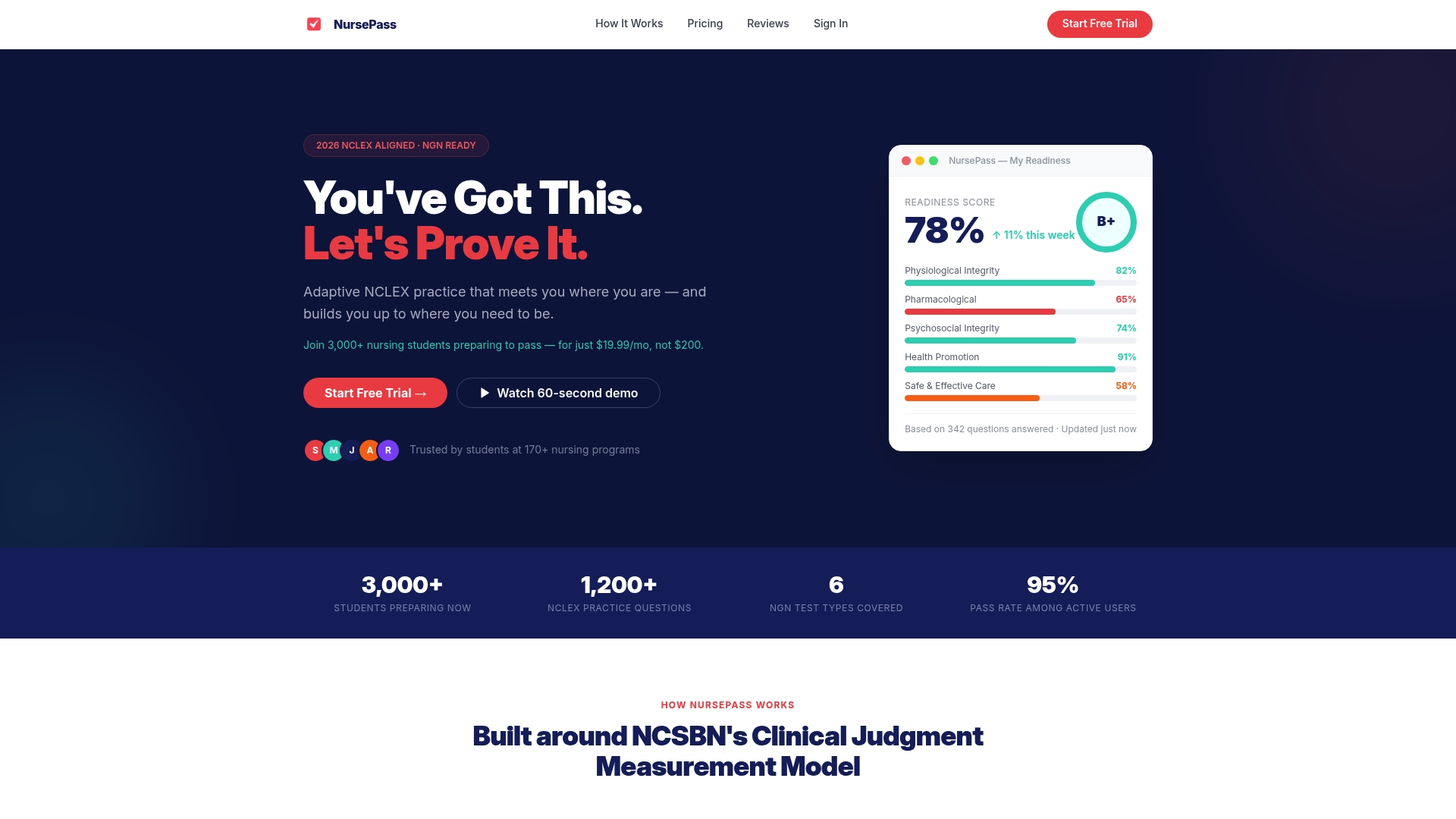
Nursepass delivers over 1,200 adaptive NCLEX practice questions calibrated to real exam difficulty, a live readiness score that updates as you study, and subcategory heat maps that show your weakest content areas at a glance. The platform aligns with 2026 NCLEX standards and tracks your ability estimate trends over time so you always know whether your preparation is moving in the right direction. More than 3,000 nursing students have used Nursepass, with a reported 95% pass rate among active users. If you are ready to replace guesswork with data, Nursepass gives you the tools to do it.
FAQ
What is an NCLEX readiness assessment?
An NCLEX readiness assessment is a timed, adaptive practice test that estimates your probability of passing the NCLEX-RN by measuring your ability relative to the 0.00 logit passing standard set by the NCSBN.
How is the NCLEX readiness score calculated?
The readiness score uses an adaptive algorithm to update your ability estimate after each question, then compares that estimate to the NCLEX passing standard expressed in logits rather than percentage correct.
How many readiness assessments should I take before the NCLEX?
Take at least three full readiness assessments spaced one to two weeks apart. A single score is insufficient; the trend across multiple results is what reliably predicts your exam readiness.
What does a low readiness score mean?
A low score means your current ability estimate is below the passing standard, not that you will fail. Use the subcategory data to identify weak areas, study those specifically, and retest to see whether your trend improves.
What is the difference between percentage correct and a readiness score?
Percentage correct counts right answers regardless of question difficulty. A readiness score measures your ability estimate relative to question difficulty using logits, which is how the actual NCLEX determines pass or fail.