
Tracking NCLEX readiness over time is defined as the practice of regularly measuring your performance on standardized, NCLEX-style assessments to build a data-driven picture of your exam preparedness. A single strong practice score tells you almost nothing. What predicts passing is a consistent pattern of high scores across multiple assessments taken at the right intervals. Tools like Archer Review, UWorld Predictor, and NCLEX Bootcamp each offer readiness metrics that go beyond raw scores, giving you trend data you can actually act on.
What tools and assessments are best for tracking NCLEX readiness over time?
The most effective NCLEX readiness trackers share three features: adaptive question delivery, predictive scoring, and detailed performance breakdowns by content category. Without all three, you are flying blind between study sessions.
Archer Review is widely used for its readiness assessments that categorize performance as "low," "medium," "high," or "very high." Its predictive scoring is grounded in real pass/fail outcome data. UWorld offers a Predictor exam that estimates your probability of passing the NCLEX based on your performance relative to other test-takers. NCLEX Bootcamp focuses on high-yield content and provides structured readiness checkpoints throughout its program.

Here is how the top readiness trackers compare:
| Tool | Adaptive testing | Predictive score | Category breakdown | Best for |
|---|---|---|---|---|
| Archer Review | Yes | Yes | Yes | Readiness trend tracking |
| UWorld | Yes | Yes | Partial | Question volume and analytics |
| NCLEX Bootcamp | Partial | No | Yes | Structured content review |
| Nursepass | Yes | Yes (live score) | Yes (heat maps) | Real-time readiness monitoring |
When selecting a tracker, match it to your study timeline and goals. A tool with a live readiness score and subcategory heat maps, like Nursepass, lets you see exactly which content areas are dragging your score down rather than guessing.
Key features to prioritize when evaluating any readiness tracker:
- Adaptive engine: Questions should adjust to your current performance level, not stay static.
- Trend visualization: You need to see score movement across sessions, not just a single result.
- Category-level data: Overall scores hide weak spots. Subcategory breakdowns reveal them.
- Exam-condition simulation: Timed, uninterrupted sessions that mirror the real NCLEX environment.
Pro Tip: Always take readiness assessments in exam-like conditions: timed, uninterrupted, and after adequate rest. Anything less skews your data and gives you false confidence.
How often should you take readiness assessments to accurately monitor progress?
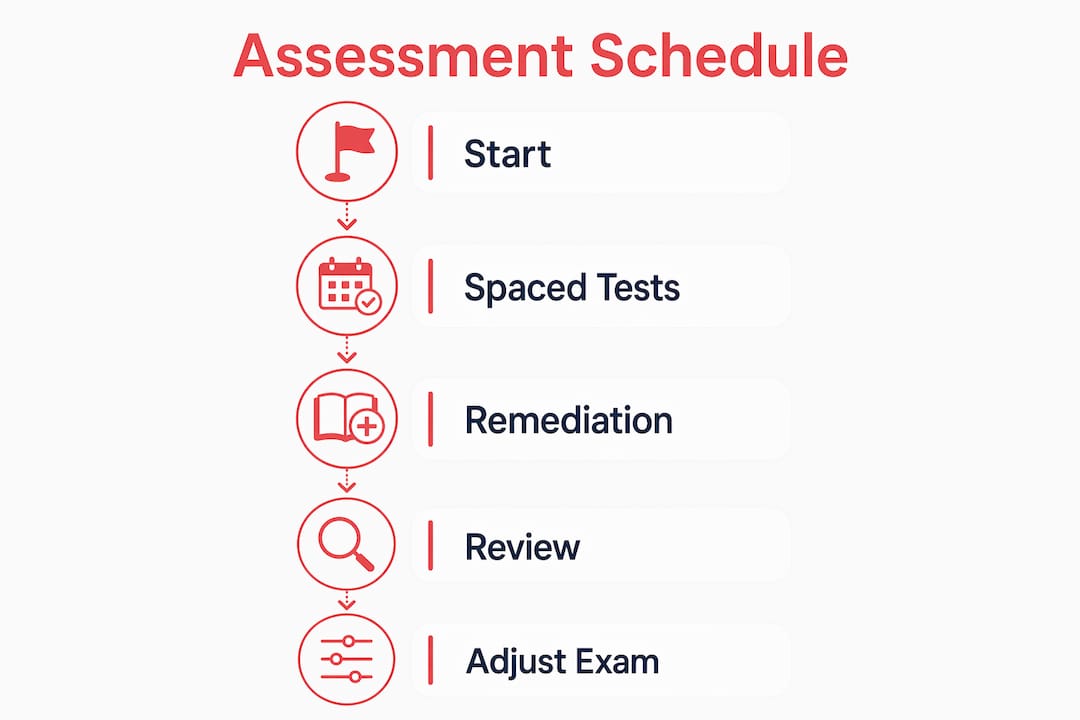
Timing your assessments correctly is as important as taking them at all. Readiness assessments should begin only after you have completed 60–70% of your question bank. Taking them earlier does not advance your knowledge. It only confirms you are not ready yet.
Once you start, follow this sequence:
- Complete 60–70% of your question bank before your first readiness assessment. This baseline gives you a meaningful starting score.
- Space assessments 3–5 days apart. Use the time between tests for targeted remediation in your weakest categories. Back-to-back testing does not improve readiness or predictive accuracy.
- Aim for 4–8 total assessments across your prep period. Most students need this range to confirm consistent performance, though the exact number depends on your baseline and study plan duration.
- Look for four consecutive "high" or "very high" scores. That pattern, not a single peak, is what signals genuine readiness.
- Schedule your final assessment 2–3 days before exam day. After that, rest and do light review only. Taking assessments immediately before the NCLEX increases stress and lowers performance.
The most common mistake students make is testing too frequently. Daily readiness tests feel productive but generate noise, not signal. Your brain needs time to consolidate what you studied before a new assessment can accurately measure your growth.
Pro Tip: Treat each gap between assessments as a targeted study sprint. Review your weakest subcategories first, then do a focused practice session before your next test. This is how scores move upward consistently.
How to analyze and interpret your readiness assessment scores over time?
A single high score is not a green light. Consecutive high scores reduce exam-day anxiety and failure risk far more than any one-off result. The goal is to see your scores stabilize at "high" or "very high" across multiple sessions.
When you review your results after each assessment, focus on these signals:
- Score direction: Is the trend moving upward, staying flat, or dropping? A flat trend after three assessments means your study approach needs to change, not just your effort level.
- Category gaps: Which content areas consistently score below your average? Pharmacology and prioritization are the most common weak spots for NCLEX candidates.
- Score variance: Wide swings between assessments suggest inconsistent preparation. Consistent scores, even if not yet "high," show that your knowledge base is stabilizing.
- Fluke detection: One strong score after a bad week is a fluke. Two strong scores in a row start to look like a trend. Four in a row confirm it.
"Confidence does not equal competence. Students should rely on objective readiness data rather than subjective feelings about how prepared they feel."
This matters because many students overestimate their readiness before their first practice exam. The NCLEX passing standard is not about knowing the most content. It is about demonstrating consistent clinical judgment under pressure. Your score trend is the closest proxy you have for that before exam day.
Use your category-level data to build a weekly remediation list. If your Archer Review or Nursepass heat map shows red in "infection control" and "fluid and electrolytes," those categories get priority study time before your next assessment. This is how monitoring NCLEX preparation turns raw scores into a real study plan.
How to integrate tracking into your overall NCLEX study plan and schedule?
Readiness tracking only works when it is built into a structured timeline, not treated as an afterthought. Whether you are on an 8-week or 12-week plan, your schedule should have three distinct phases.
| Phase | Weeks | Focus | Assessment activity |
|---|---|---|---|
| Foundation | Weeks 1–4 | Content review, question bank start | No readiness assessments yet |
| Building | Weeks 5–8 | Complete 60–70% of question bank | First readiness assessment at week 6 |
| Confirmation | Weeks 9–12 | Targeted remediation, full practice | Assessments every 3–5 days |
Nursing educators recommend treating study like a professional job: consistent daily hours, scheduled rest days, and no cramming. Burnout is the single biggest threat to a long prep timeline. A student who studies six focused hours a day for ten weeks outperforms one who studies twelve chaotic hours a day for five weeks.
Rest days are not wasted days. Spacing testing with consistent practice and rest maximizes cognitive retention and readiness measurement accuracy. Build at least one full rest day per week into your schedule from the start.
Your readiness data should also tell you when to adjust your exam date. If your scores are trending upward but have not yet hit four consecutive "high" results, extend your prep by one to two weeks rather than testing prematurely. If your scores have been consistently "very high" for two weeks, you may be ready sooner than your original timeline suggested.
Pro Tip: Use a self-study plan template to map your question bank completion rate against your assessment schedule. When you can see both on the same calendar, it is much easier to spot gaps and adjust before they become problems.
Key Takeaways
Tracking NCLEX readiness over time requires consistent, well-spaced assessments, objective score analysis, and a structured study plan that adjusts based on real performance data.
| Point | Details |
|---|---|
| Start assessments at the right time | Begin readiness tests only after completing 60–70% of your question bank. |
| Space tests 3–5 days apart | Use the gap for targeted remediation, not more assessments. |
| Four consecutive high scores predict passing | A 98.98% pass rate is linked to four consecutive "high" or "very high" results. |
| Analyze trends, not single scores | Consistent upward movement matters more than any one strong result. |
| Rest before exam day | Schedule your final assessment 2–3 days out, then rest and review lightly. |
What I have learned from watching students track their readiness
The students who pass on their first attempt almost always share one habit: they trust their data more than their feelings. I have seen students with strong clinical instincts convince themselves they were ready after one good Archer Review score, only to struggle on exam day. I have also seen students with shaky confidence grind through eight assessments, watch their scores climb steadily, and walk into the NCLEX with a calm that comes from actual evidence.
The psychological shift that happens when you see four consecutive "high" scores is real. It is not overconfidence. It is earned certainty. That is a very different mental state to carry into a high-stakes exam.
The hardest thing to teach is patience with the process. Students want to test constantly because it feels like progress. But readiness assessments are diagnostic tools, not study methods. Taking them before you are ready just confirms what you already know: you need more time. Save them for when they can actually measure something meaningful.
My honest advice is to build your schedule around the data, not around your anxiety. If your scores say you need two more weeks, take two more weeks. The exam will still be there. Passing it the first time is worth the wait.
— Michael
How Nursepass supports your NCLEX readiness tracking
Nursepass is built specifically for nursing students who want to monitor their exam preparation with real data, not guesswork.
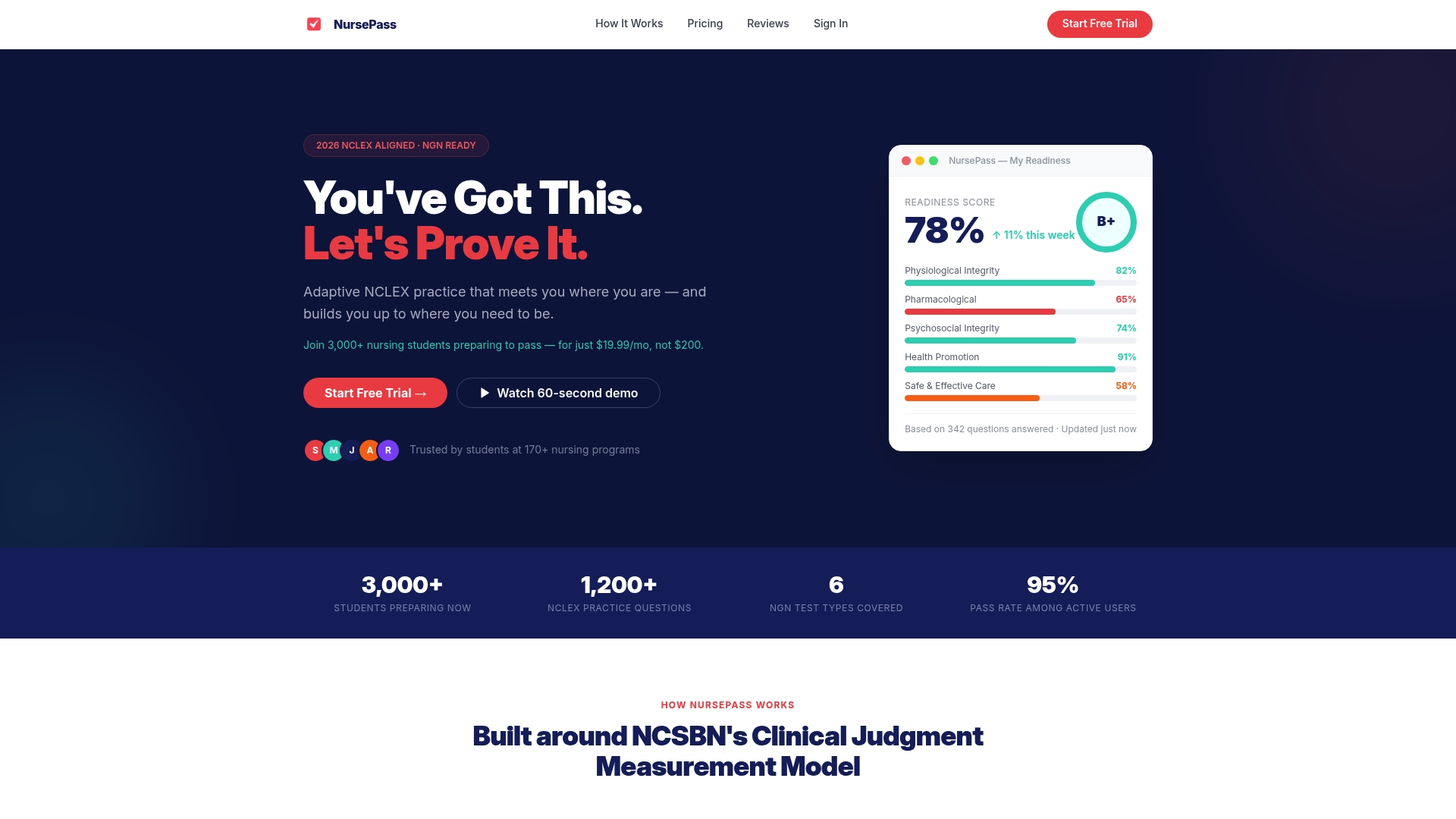
Nursepass offers over 1,200 adaptive NCLEX practice questions that adjust to your current competency level. Its live readiness score updates as you practice, so you always know where you stand. The subcategory heat maps show exactly which content areas need attention, making it easy to prioritize your study time between assessments. More than 3,000 nursing students have used the platform, with a reported 95% pass rate among active users. If you are ready to track your progress with a tool built for the NCLEX, start with Nursepass today.
FAQ
What is a readiness assessment for the NCLEX?
A readiness assessment is a standardized, NCLEX-style practice exam that predicts your likelihood of passing based on your performance. Tools like Archer Review and UWorld Predictor are the most widely used options.
When should I start taking NCLEX readiness assessments?
Start readiness assessments only after completing 60–70% of your question bank. Taking them earlier confirms unpreparedness rather than measuring genuine progress.
How many readiness assessments do I need before the NCLEX?
Most students need 4–8 readiness assessments during their prep period. The goal is four consecutive "high" or "very high" scores, which are linked to a 98.98% pass rate.
How far apart should I space my readiness assessments?
Space assessments 3–5 days apart and use the time between them for targeted remediation. Back-to-back testing does not improve your readiness or the accuracy of your results.
Should I take a readiness assessment the day before my NCLEX?
No. Your final readiness assessment should be 2–3 days before exam day. Testing immediately before the NCLEX increases stress and can lower your performance on the actual exam.