
An online nursing exam self-study plan is a structured, test plan-aligned approach that uses targeted practice questions, systematic remediation, and scheduled review to prepare nursing students for the NCLEX. The 2026 NCLEX test plan introduces updated question formats, including Next Generation NCLEX (NGN) case studies, that demand a different kind of preparation than older methods. Platforms like UWorld, Blueprint Nursing, and Nursepass have built their question banks specifically around these updated standards. A well-built self-study plan does not just expose you to more questions. It closes knowledge gaps faster, builds clinical judgment, and puts you in the exam room with real confidence.
What does an online nursing exam self-study plan require?
Before you write a single study schedule, you need the right foundation. Skipping this step is the most common reason self-study plans fall apart within two weeks.
The non-negotiable starting points:
- The 2026 NCLEX test plan. Download it directly from the NCLB website. Study resources aligned to the current test plan are critical. Outdated materials waste your time and teach you content the exam no longer emphasizes.
- A question bank with NGN-format items. Standard multiple-choice banks are not enough. You need NGN case studies that mirror the clinical judgment measurement model used on the actual exam.
- A remediation tool. Every missed question needs a rationale review and a follow-up retest. Without this loop, you repeat the same mistakes.
- Free supplementary resources. Library-based nursing resources from institutions like Hibbing Community College offer care plan databases, quizzes, and practice exams at no cost. These work well alongside paid prep courses.
- A dedicated study environment. A consistent space with minimal distractions trains your brain to shift into study mode faster. Treat it like a clinical shift.
Pro Tip: Set up a simple error log in a Google Sheet or a notebook from day one. Track every missed question by topic, date, and the reason you got it wrong. This single habit separates students who improve steadily from those who plateau.
Your schedule matters as much as your materials. Block out specific study windows rather than studying "when you have time." Nursing students who treat study sessions like scheduled clinical rotations build consistency faster than those who rely on motivation alone.

How to build a step-by-step nursing exam study plan
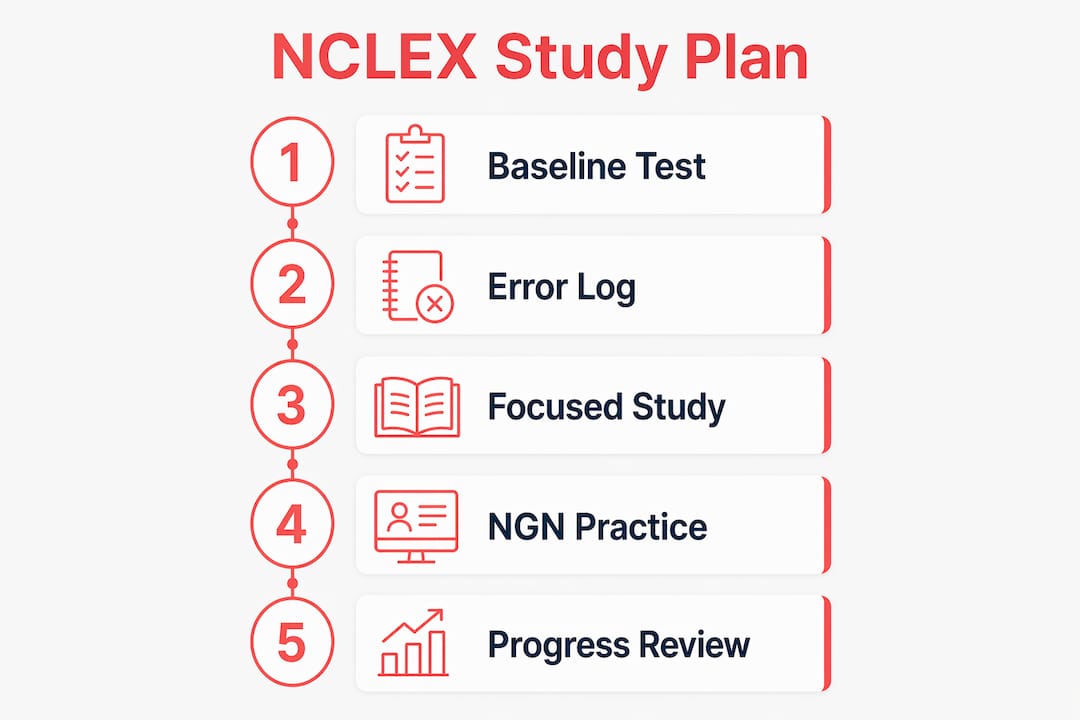
A structured study plan for the NCLEX follows a clear sequence. Each phase builds on the last.
-
Take a baseline practice test. Before studying anything, complete a full-length baseline practice test under timed conditions. This identifies your strongest and weakest Client Needs categories before you invest a single study hour.
-
Map your study time to Client Needs categories. The 2026 NCLEX-RN test plan weights Pharmacology and Management of Care heavily. Allocate more weekly hours to these categories based on your baseline results, not based on what feels comfortable.
-
Study one category at a time. Complete a focused 30-question block on a single category. Read every rationale, whether you answered correctly or not. Correct answers with wrong reasoning are just as dangerous as wrong answers.
-
Run the error-log remediation loop. After each block, log every missed question. Review the rationale, identify the concept gap, and remediate it through your textbook, a video lecture, or a targeted mini-quiz. Remediation over volume is the most efficient path to NCLEX readiness.
-
Practice NGN case studies weekly. Schedule at least two NGN case study sessions per week. Weekly NGN practice builds the clinical judgment reasoning skills the exam now measures directly. Treat each case study as a real patient scenario, not a quiz.
-
Retest weak categories every two weeks. Return to your lowest-scoring categories with a fresh question block. Track your score change. If a category does not improve after two remediation cycles, adjust your approach. Try a different resource format, such as video instead of text.
-
Enter a taper phase 48–72 hours before test day. Stop introducing new content. Avoiding new questions near test day reduces cognitive overload and protects your confidence. Spend this window reading your error log, reviewing key rationales, and resting.
Pro Tip: Build your weekly schedule in 45-minute blocks with a 10-minute break between sessions. Shorter, focused blocks produce better retention than marathon sessions, and they are easier to protect when life gets busy.
What are the most common NCLEX self-study challenges?
Self-study works, but it comes with predictable obstacles. Knowing them in advance lets you plan around them.
Test anxiety is the most reported barrier among NCLEX candidates. The fix is not relaxation techniques alone. It is repeated exposure to realistic exam conditions. Simulate the actual test environment by using timed practice blocks, sitting at a desk, and removing your phone. Anxiety drops when the exam format feels familiar.
Resource overload is the second most common trap. Nursing students often collect five question banks, three textbooks, and a dozen YouTube channels, then use none of them consistently. Pick two primary resources aligned to the 2026 NCLEX test plan and commit to them completely. Depth beats breadth every time.
Inconsistent study sessions destroy momentum. Marathon study days followed by three days of nothing do not build retention. Short, daily sessions outperform irregular long ones. A 45-minute daily session six days a week produces more durable learning than a single six-hour Saturday session.
"The students who pass are not the ones who studied the most hours. They are the ones who studied the right content, reviewed every mistake, and showed up consistently." This pattern holds across every NCLEX prep community and is backed by how interactive quizzes and NGN case studies build clinical judgment over time.
Accountability gaps hit hardest around weeks three and four of self-study. Form a small study group of two or three people. Meet once a week to compare error logs and quiz each other on weak categories. You do not need a formal study partner. You need someone who will notice if you go quiet.
How do you evaluate and adjust your nursing exam prep?
Tracking your progress is not optional. Without data, you are guessing about what to study next.
The most reliable tracking method combines three inputs: practice test scores by category, your error log, and weekly retest results. Together, these three sources tell you exactly where your knowledge is solid and where it still has gaps.
| Tracking method | What it tells you | How often to use it |
|---|---|---|
| Category score report | Which Client Needs areas need more time | After every practice block |
| Error log review | Specific concepts and question types you miss repeatedly | Daily, at the end of each session |
| Weak category retest | Whether remediation is actually closing the gap | Every two weeks per category |
| Full-length practice exam | Overall readiness and stamina under timed conditions | Once every three to four weeks |
Score trends matter more than single scores. One bad practice test means nothing. A downward trend over three sessions in the same category means your current approach is not working and needs to change.
Pro Tip: Color-code your error log by category using red, yellow, and green. Red means you missed it twice or more. Yellow means you missed it once. Green means you got it right after remediation. This visual system shows your real readiness at a glance.
Adjust your study time allocation every two weeks based on your data. If Pharmacology improves from 48% to 67%, shift some of that time toward a weaker category. A self-study plan that never changes is not a plan. It is a routine.
Key Takeaways
A successful NCLEX self-study plan requires baseline testing, category-focused study, weekly NGN practice, and consistent error-log remediation to close knowledge gaps before exam day.
| Point | Details |
|---|---|
| Start with a baseline test | Identify your weakest Client Needs categories before allocating any study time. |
| Align resources to the 2026 test plan | Use question banks and case studies built for the current NGN format, not older versions. |
| Remediate every missed question | Review rationales and retest weak categories rather than increasing total question volume. |
| Practice NGN case studies weekly | Clinical judgment skills require repeated simulation, not just content memorization. |
| Taper 48–72 hours before the exam | Stop new content and review your error log to protect confidence and reduce cognitive overload. |
What I have learned from watching students prepare for the NCLEX
Most nursing students I have worked with make the same mistake. They treat NCLEX prep as a content review problem when it is actually a clinical reasoning problem. They read chapters, watch videos, and do hundreds of questions, but they never stop to ask why they got something wrong. That gap is where most failures happen.
The students who pass consistently are the ones who treat their error log like a clinical chart. They document every mistake, identify the pattern, and fix the root cause before moving on. Volume without reflection is just noise.
I have also seen students burn out two weeks before their exam because they never built a taper phase into their plan. They keep adding new questions right up to test day, which creates confusion and erodes the confidence they spent weeks building. Stopping new content 48–72 hours before the exam is not giving up. It is the final, necessary step in a well-built plan.
The NGN format genuinely changed what good preparation looks like. Students who practice clinical judgment case studies weekly arrive at the exam thinking like nurses. Students who skip NGN practice arrive thinking like test-takers. The exam now rewards the former.
One more thing: do not wait until you feel ready to start. Start now, take the baseline test, and let the data tell you what to do next. Readiness is built, not felt.
— Michael
How Nursepass supports your NCLEX preparation
Nursepass is built specifically for nursing students who want a focused, data-driven path to passing the NCLEX. The platform offers over 1,200 NCLEX practice questions aligned to the 2026 test plan, including NGN-format items that mirror what you will see on exam day.
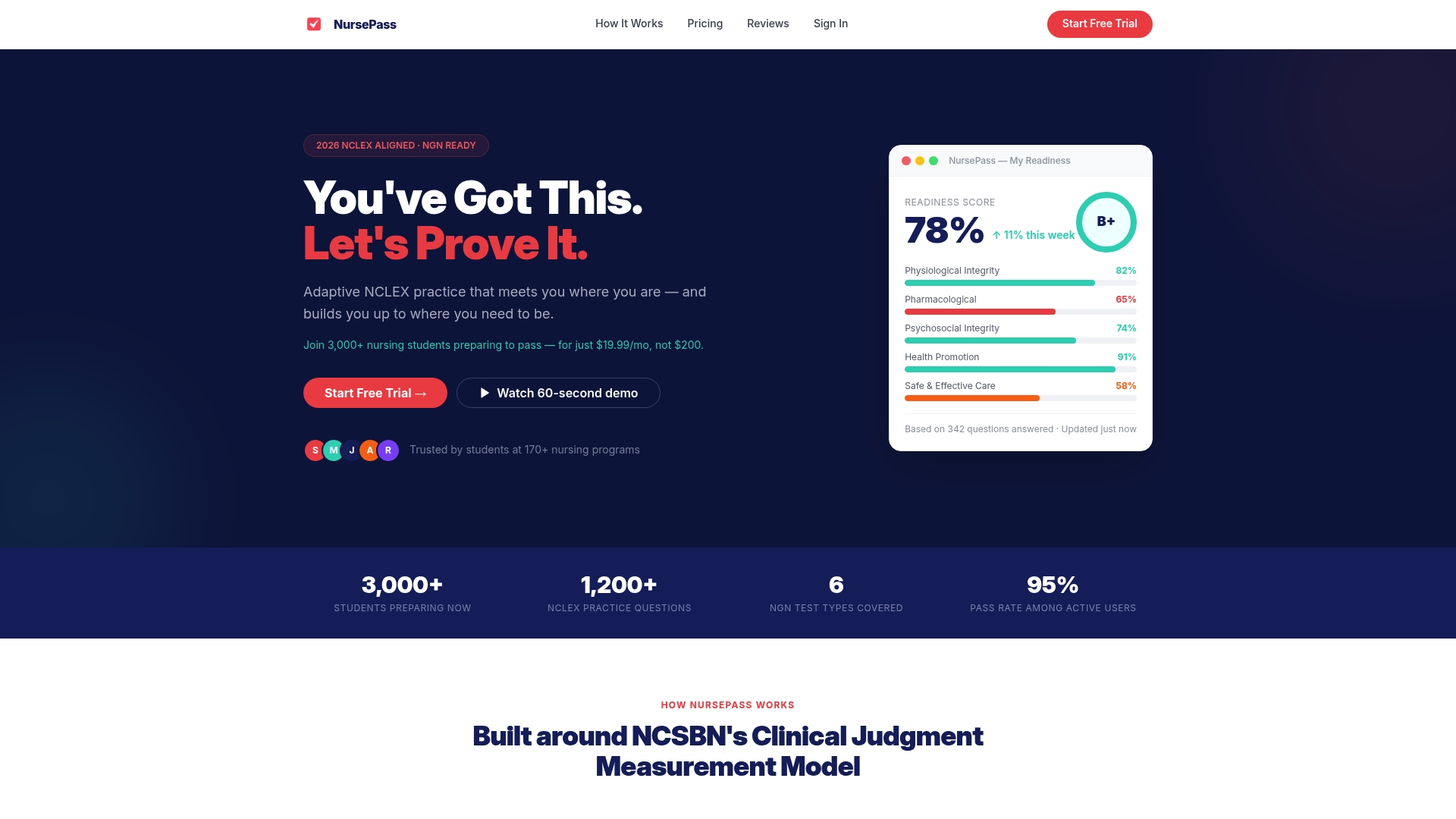
What sets Nursepass apart is its adaptive engine. Questions adjust to your current competency level, so you are never wasting time on content you have already mastered. The live readiness score and subcategory heat maps show you exactly where you stand at any moment. More than 3,000 nursing students have used Nursepass for NCLEX prep, and the platform reports a 95% pass rate among active users. If you want a self-study plan backed by real performance data, Nursepass gives you the tools to build one.
FAQ
What is an online nursing exam self-study plan?
An online nursing exam self-study plan is a structured study schedule that uses NCLEX-aligned practice questions, NGN case studies, and error-log remediation to prepare nursing students independently for the NCLEX exam.
How long should I study for the NCLEX each day?
Daily 45-minute focused study blocks with short breaks produce better retention than marathon sessions. Consistency across six days per week outperforms irregular long study days.
What are the most important NCLEX categories to study in 2026?
Pharmacology and Management of Care carry the heaviest weight in the 2026 NCLEX-RN test plan and should receive the most study time, especially if your baseline scores in these areas are below 60%.
How do NGN case studies help with NCLEX preparation?
NGN case studies train clinical judgment by simulating multi-step patient scenarios. Weekly NGN practice builds the reasoning skills the exam now directly measures, which standard multiple-choice practice alone cannot develop.
When should I stop studying before the NCLEX exam?
Stop introducing new content 48–72 hours before your exam. Use that window to review your error log and key rationales. Avoiding new questions near test day reduces cognitive overload and protects the confidence you have built.