
The NCLEX passing standard is the minimum ability level a nursing candidate must demonstrate to prove safe, entry-level nursing competency. The National Council of State Boards of Nursing (NCSBN) Board of Directors sets this criterion-referenced standard, meaning your result is measured against a fixed benchmark, not against other test takers. With the 2026 Test Plan now in effect, understanding the NCLEX passing standard explained in full is the clearest path to walking into the exam with confidence. This guide covers how the standard works, how the exam decides your result, and how to use that knowledge to prepare smarter.
What is the NCLEX passing standard?
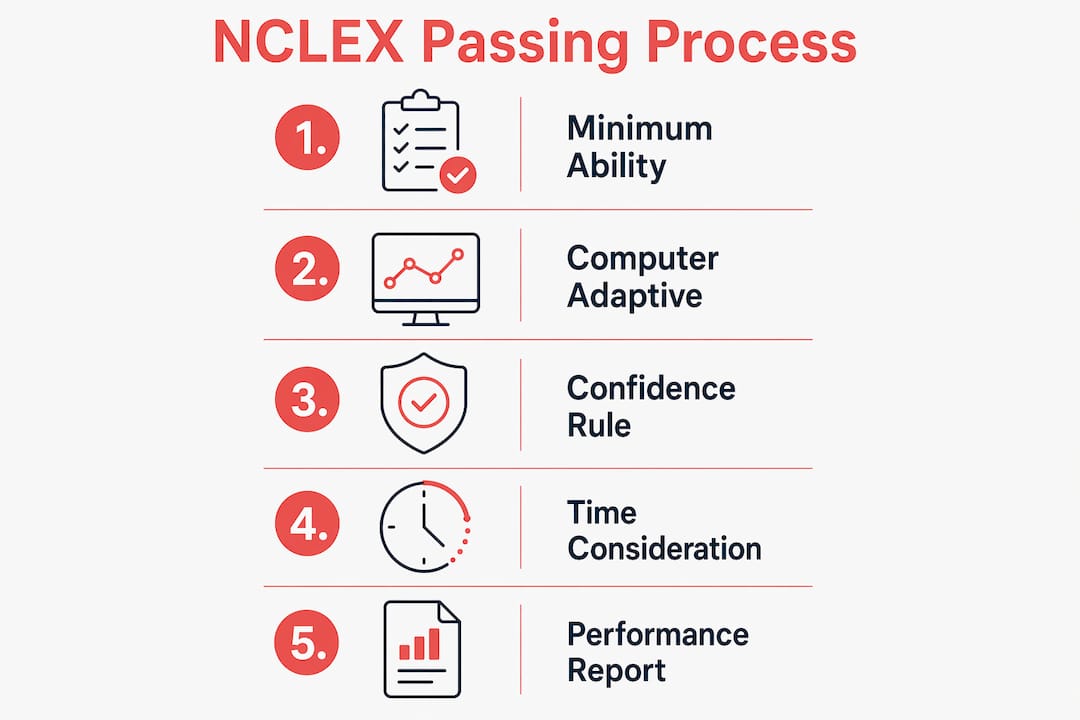
The NCLEX passing standard is defined as the ability level representing minimal competency for safe, entry-level nursing practice. The NCSBN Board of Directors sets this threshold, and it applies uniformly to every candidate who sits for the exam. The standard is re-evaluated every three years using psychometric analyses and feedback from educators and employers. That cycle keeps the standard aligned with what actual nursing practice requires at any given time.
One critical point: the NCLEX is not norm-referenced. Your result does not depend on how other candidates perform. The passing standard is criterion-referenced, which means every candidate is measured against the same fixed competency level. You either meet it or you do not, regardless of how the rest of the testing population scores on a given day.
How does computerized adaptive testing determine your result?
Computerized adaptive testing (CAT) is the engine behind every NCLEX result. The exam does not deliver a fixed set of questions. Instead, it selects each question based on your estimated ability at that moment. Answer correctly, and the next question gets harder. Answer incorrectly, and the difficulty adjusts downward. The system constantly recalculates your ability estimate as you progress.

The test stops when it reaches 95% confidence that your true ability is either above or below the passing standard. That confidence threshold is the actual stopping rule, not a fixed question count. The exam delivers a minimum of 85 questions and a maximum of 150 questions. Reaching 150 questions does not mean you failed. It means the system needed more data points to reach that 95% confidence level.
Here is what the CAT process looks like in practice:
- Ability estimation: After each answer, the system recalculates where your ability sits relative to the passing standard.
- Question selection: The next question targets your current estimated ability level to gather the most useful information.
- Confidence threshold: The exam ends when the algorithm is 95% confident your ability is above or below the cut score.
- Variable length: Some candidates finish in 85 questions; others reach 150. Both outcomes can result in a pass.
Pro Tip: Do not try to guess your result based on how many questions you answered. A short test and a long test can both end in a pass. Focus on each question individually rather than tracking your count.
What are the specific NCLEX passing criteria?
The passing standard for the NCLEX-RN is set at 0.00 logits. A logit is a unit of measurement used in psychometrics to place both candidate ability and question difficulty on the same scale. Think of it as a number line. Questions above 0.00 are harder than the passing threshold. Candidates whose ability estimate sits above 0.00 logits at the point the test stops have passed. The logit scale makes it possible to compare your ability directly to question difficulty in a mathematically consistent way.
Three stopping rules govern when the exam ends:
- Confidence rule: The system reaches 95% confidence that your ability is above or below the passing standard. This is the most common stopping point.
- Maximum question rule: You reach 150 questions. At that point, your final ability estimate determines the result.
- Run-out-of-time rule: You exhaust the allotted time before the confidence rule triggers. Under this rule, the system reviews your last 60 ability estimates. If every one of those 60 estimates sits above the passing standard, you pass. If any fall below, you fail.
| Stopping rule | Trigger | Pass condition |
|---|---|---|
| Confidence rule | 95% certainty reached | Ability estimate above 0.00 logits |
| Maximum questions | 150 questions answered | Final ability estimate above standard |
| Run-out-of-time | Time expires | All last 60 estimates above standard |
Scoring also varies by question format. Partial credit scoring applies to questions with multiple correct answers. Methods include plus/minus scoring, zero/one scoring, and rationale scoring depending on the item type. Each method affects how your responses contribute to the ability estimate the system builds throughout the exam.
Pro Tip: If you run out of time, the outcome depends entirely on your last 60 ability estimates. Pacing matters. Practice under timed conditions so you never reach the time limit without having answered confidently.
After results are released, candidates who do not pass receive a Candidate Performance Report. This report breaks the exam into content areas and shows whether your performance was above, near, or below the passing standard in each area. It is the most direct feedback tool available for planning a retake.
What are the biggest misconceptions about NCLEX passing scores?
The most persistent myth is that there is a fixed percentage of questions you must answer correctly to pass. There is no such percentage. Passing is based on your estimated ability surpassing the passing standard, not on a raw score or a percentage correct. Two candidates can answer the same number of questions correctly and get opposite results if they answered different difficulty levels of questions.
Several other misconceptions trip up nursing students:
- "More questions means I failed." False. A longer exam means the system needed more evidence to reach 95% confidence. Candidates who answer all 150 questions can and do pass.
- "I need to outscore other candidates." False. The NCLEX is not competitive. Your result has nothing to do with how anyone else performs.
- "The passing standard never changes." False. The NCSBN re-evaluates the standard every three years. The 2026 Test Plan reflects the most recent update.
- "Harder questions mean I am doing well." Partially true. Harder questions suggest your ability estimate is rising, but the exam is constantly recalibrating. One wrong answer does not tank your result.
The passing standard itself is expressed as a logit score, which is a statistical unit, not a percentage. Candidates pass by maintaining an ability estimate above that cut score at the point the test stops. Two candidates with very different question counts can both pass because the CAT system gathered enough evidence about each of them at different rates.
How does knowing the passing standard improve your prep?
Understanding the NCLEX passing criteria changes how you study. Broad, unfocused review is the least efficient approach. The CAT system targets your weak areas automatically during the exam, so your preparation should do the same before you sit down.
Start with your Candidate Performance Report if you are retaking the exam. The report identifies which content areas fell below the passing standard. Those areas deserve the most study time, not equal distribution across all topics. For first-time candidates, use practice exams that report performance by content category to build the same picture.
Practical preparation steps that align with how the passing standard works:
- Prioritize weak content areas. Demonstrated weakness in a domain during the exam pulls your ability estimate down. Fix those gaps before test day.
- Practice with adaptive question sets. Static question banks do not replicate CAT mechanics. Adaptive practice tools adjust difficulty the way the real exam does.
- Study the 2026 Test Plan. The NCSBN publishes the test plan, and it outlines every content area and the weight each carries. Use it as your study map.
- Manage time deliberately. The run-out-of-time rule is a real risk. Practice under timed conditions consistently.
- Understand the retake rule. Candidates who do not pass must wait 45 days before retaking the exam. Use that window with a focused, data-driven plan.
Pro Tip: Use the NCLEX test plan as a checklist. Every content area listed is a potential exam domain. Knowing the weight of each area tells you where to invest your study hours.
Key takeaways
The NCLEX passing standard is a fixed, criterion-referenced ability threshold set by the NCSBN, and understanding how it works is the single most effective way to prepare for the exam.
| Point | Details |
|---|---|
| Criterion-referenced standard | Your result is measured against a fixed ability threshold, not other candidates' scores. |
| CAT stops at 95% confidence | The exam ends when the system is 95% certain your ability is above or below the passing standard. |
| No fixed pass percentage | Passing depends on your estimated ability surpassing 0.00 logits, not on answering a set percentage correctly. |
| Run-out-of-time rule | If time expires, all of your last 60 ability estimates must sit above the passing standard to pass. |
| Use your performance report | The Candidate Performance Report identifies weak content areas and should drive your retake study plan. |
The part most candidates get wrong about the passing standard
Most nursing students walk into the NCLEX focused on question count. They track how many questions they have answered, panic when the test keeps going, or feel falsely confident when it stops early. That focus is misplaced. The number of questions tells you almost nothing about your result.
What actually matters is whether your ability estimate stayed above the passing standard at the point the test stopped. That is a function of how consistently you performed across the difficulty levels the CAT system served you. I have seen candidates who answered 85 questions fail and candidates who answered 150 questions pass. The pattern is not in the count. It is in the consistency.
The other mistake I see constantly is treating the Candidate Performance Report as a report card rather than a study plan. If you did not pass, that report is the most valuable document you have. It tells you exactly where your ability fell short. Candidates who ignore it and study everything equally waste the 45-day retake window. Candidates who treat it as a targeted remediation map use that time well.
My honest advice: learn the mechanics of the passing standard before you study a single content area. When you understand that the exam is measuring your ability against a fixed threshold, not ranking you against peers, the entire preparation process becomes clearer and less stressful.
— Michael
How Nursepass supports your NCLEX preparation
Nursepass is built specifically for nursing students who want to prepare with the same logic the NCLEX uses. The platform's adaptive engine adjusts question difficulty to your current competency level, mirroring how CAT works on the real exam.
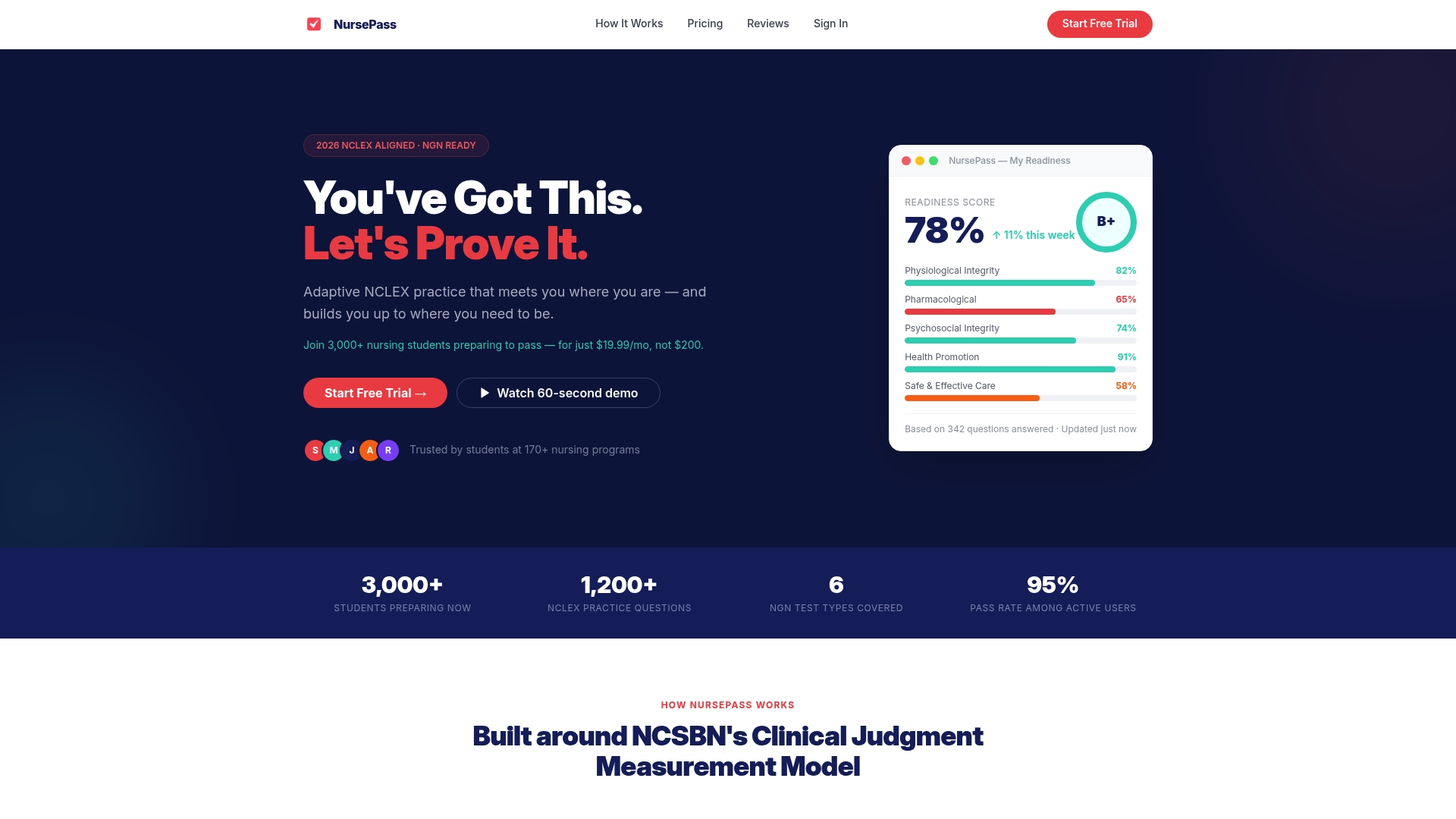
Nursepass offers over 1,200 NCLEX practice questions, a live readiness score that updates as you study, and subcategory heat maps that show exactly where your performance sits relative to the passing standard. More than 3,000 nursing students have used the platform, and active users report a 95% pass rate. If you want a focused NCLEX prep experience that reflects how the actual exam scores you, Nursepass is the place to start.
FAQ
What is the NCLEX passing standard?
The NCLEX passing standard is the minimum ability level set by the NCSBN Board of Directors that a candidate must meet to demonstrate safe, entry-level nursing competency. It is criterion-referenced, meaning it is a fixed threshold applied equally to every candidate.
Is there a fixed percentage of questions you must get right to pass?
No. Passing the NCLEX is based on your estimated ability surpassing the passing standard, not on answering a specific percentage of questions correctly. Candidates with different raw scores can pass or fail depending on the difficulty of the questions they answered.
How many questions do you have to answer on the NCLEX?
The NCLEX delivers a minimum of 85 questions and a maximum of 150 questions. The exam stops when the system reaches 95% confidence in a pass or fail decision, so the exact number varies by candidate.
What happens if you run out of time on the NCLEX?
If time expires before the confidence rule triggers, the system reviews your last 60 ability estimates. You pass only if every one of those 60 estimates sits above the passing standard. If any fall below, the result is a fail.
How often does the NCLEX passing standard change?
The NCSBN re-evaluates the passing standard every three years using psychometric analyses and input from nursing educators and employers. The 2026 Test Plan reflects the most recent update to both the content framework and the passing criteria.