
Re-reading nursing exam questions is defined as the deliberate, structured review of practice questions to deepen comprehension and strengthen recall. Most nursing students treat it as passive review, but that approach is one of the least effective strategies for NCLEX preparation. The re-reading questions nursing exam technique only works when it involves active engagement: covering answers, recalling rationale, and writing down what you learned. Research by Roediger and Karpicke established that active retrieval outperforms passive re-reading by approximately 50% on delayed tests. Tools like Qbanks with detailed rationales, Anki for spaced repetition, and structured error logs transform re-reading from a passive habit into a high-yield study method.
Why is passive re-reading ineffective for the NCLEX?
Passive re-reading creates a false sense of familiarity. You recognize the question, feel confident, and move on. But recognition is not recall, and the NCLEX tests recall under pressure.
"Re-reading generates a false sense of knowing, so test-yourself methods, though harder, yield better outcomes for NCLEX prep." — NCLEX Strategic Study Plan
The cognitive science behind this is clear. Active recall is 2–3 times more effective than passive review methods like re-reading textbooks for high-stakes exam prep. That gap matters enormously when you are preparing for a computer-adaptive test that shifts difficulty based on your performance.
Spaced repetition and rationale journaling are the two most effective complements to active recall. Spaced repetition, built into tools like Anki, forces you to retrieve information at increasing intervals. Rationale journaling requires you to write out why each answer option is right or wrong, which locks in the reasoning rather than just the answer letter.
The study loop that produces the best NCLEX outcomes dedicates over 60% of study time to practice questions and rationale review rather than passive content reading. That is a significant shift from how most students naturally study.
Pro Tip: Break any re-reading session longer than 30 minutes with a 5-minute self-test. Cover the rationale, recall the reasoning, then check. This one habit converts passive review into active retrieval.
How do you re-read nursing exam questions effectively?
Effective question review follows a repeatable loop. Each step builds on the last, and skipping any one of them reduces the return on your study time.
- Read the question stem thoroughly. Identify the subject (patient, nurse, situation), the action required, and any time or priority cues before looking at the answer choices.
- Cover all answer options. Attempt to recall the correct answer before you see the choices. This forces retrieval rather than recognition.
- Select your answer, then read every option. Even if you are confident, read all four. Understanding why three options are wrong is as valuable as knowing why one is right.
- Read the full rationale. Do not stop at "correct." Read the explanation for every option, including the distractors.
- Write a one-line takeaway. In your error log or journal, note the core concept the question tested and why you got it right or wrong.
- Flag weak areas for spaced repetition. If a question exposed a knowledge gap, add that topic to your Anki deck or flagged review queue.
Rationale journaling enhances understanding and retention by requiring you to articulate the reasoning behind correct and incorrect options. Writing it out in your own words is the key. Copying the rationale verbatim does not produce the same effect.
A realistic daily target is 75–125 questions with full rationale review. That volume gives you enough exposure to patterns while keeping the review process thorough rather than rushed.

Pro Tip: After every 10 questions, pause and write a one-sentence summary of the most important concept you encountered. This micro-reflection takes 60 seconds and significantly improves retention by the end of the session.
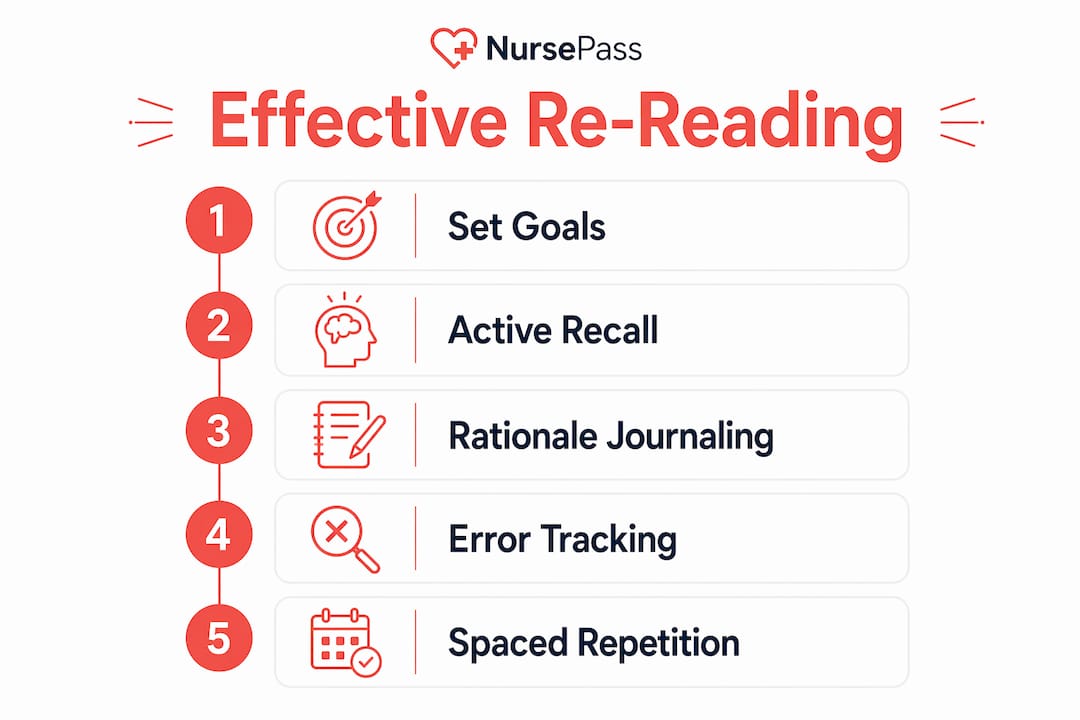
Passive vs. active re-reading: what the difference looks like
| Approach | Method | Outcome |
|---|---|---|
| Passive re-reading | Read question and correct answer only | False familiarity, poor recall under test conditions |
| Active re-reading | Cover answers, self-test, read all rationales | Genuine recall, stronger pattern recognition |
| Rationale journaling | Write why each option is right or wrong | Deep comprehension, targeted weak-area identification |
| Spaced repetition review | Revisit flagged questions at increasing intervals | Long-term retention of high-yield concepts |
What are the most common re-reading mistakes nursing students make?
Most students make the same handful of errors when reviewing practice questions. Recognizing them in your own study habits is the first step to correcting them.
- Reading only the correct answer. Skipping the rationale for wrong options leaves you unable to eliminate distractors on test day. Every option teaches you something.
- Re-reading without self-testing. Going through a question set a second time without covering the answers first is recognition practice, not recall practice. The NCLEX does not show you the question twice.
- Ignoring repeated wrong answers. If you miss the same type of question three times, that is a content gap, not bad luck. An error log makes these patterns visible.
- Multitasking during review. Reviewing questions while watching TV or checking your phone fragments attention and reduces encoding. Re-reading requires focused cognitive effort.
- Skimming question stems. The NCLEX embeds critical details in the stem: patient age, time since surgery, medication dose. Skimming trains you to miss those details.
Focused 25–50 minute blocks with breaks improve retention compared to lengthy uninterrupted passive reading sessions. The Pomodoro technique, which alternates 25 minutes of focused work with 5-minute breaks, maps directly onto this research.
Pro Tip: Keep a physical or digital error log organized by NCLEX category (pharmacology, management of care, safety). Review it weekly. Patterns in your errors tell you exactly where to spend your next study block.
Which tools best support active question review for NCLEX?
The right tools make the difference between a re-reading session that builds knowledge and one that wastes time. The tools below are chosen specifically because they support active retrieval, rationale review, and error tracking.
Qbanks with detailed rationales
Saunders and UWorld are the two most widely used Qbanks for NCLEX preparation. Both provide detailed rationale explanations for every answer option, not just the correct one. Qbanks with rationales and error logs improve targeted re-reading effectiveness by helping you identify and revisit weak content areas systematically.
UWorld's performance tracking shows your percentile ranking by category, which tells you where your re-reading focus should go. Saunders organizes questions by content area, making it easier to do focused review sessions on pharmacology or maternal-newborn nursing.
Spaced repetition with anki
Spaced repetition via flashcards is essential for sustainable memorization of complex pharmacology and high-yield concepts discovered during question review. Anki's algorithm schedules cards based on how well you recalled them last time. Cards you struggle with appear more frequently. Cards you know well appear less often. This is the opposite of passive re-reading, where you spend equal time on everything regardless of mastery.
The most effective Anki workflow for NCLEX prep is to create a new card every time your question review reveals a knowledge gap. Do not download pre-made decks as your primary resource. Building cards yourself reinforces encoding.
Tool comparison for active re-reading support
| Tool | Rationale Depth | Error Tracking | Spaced Repetition | Best For |
|---|---|---|---|---|
| UWorld | Detailed, with images | Yes, by category | No | High-yield question practice |
| Saunders | Thorough, content-organized | Limited | No | Content-area focused review |
| Anki | User-created | No | Yes | Pharmacology and weak-area memorization |
| Nursepass | Detailed, adaptive | Yes, heat maps | Via adaptive engine | Personalized NCLEX readiness |
Nursepass stands out in this comparison because its adaptive engine adjusts question difficulty based on your current competency. That means your re-reading sessions are automatically directed toward the areas where you need the most work, rather than cycling through questions you already know.
Key takeaways
Active re-reading of nursing exam questions requires self-testing, rationale journaling, and error tracking to produce genuine recall rather than false familiarity.
| Point | Details |
|---|---|
| Active recall beats passive review | Students using retrieval practice outperform passive re-readers by approximately 50% on delayed tests. |
| Rationale journaling builds comprehension | Writing why each answer option is right or wrong deepens understanding beyond memorizing correct answers. |
| Error logs reveal content gaps | Tracking repeated wrong answers by NCLEX category shows exactly where to focus re-reading sessions. |
| Focused blocks improve retention | Study in 25–50 minute sessions with breaks rather than long uninterrupted passive reading periods. |
| Tools should force active retrieval | Qbanks like UWorld, Saunders, and platforms like Nursepass outperform textbook re-reading for NCLEX prep. |
Re-reading is a skill, not a habit
Most students I have observed treat question review as a completion task. They finish a block, check the score, glance at the rationale for the ones they missed, and move on. That approach feels productive. It is not.
The students who improve fastest treat every question review session as a diagnostic. They are not trying to confirm what they know. They are hunting for what they do not know. That mental shift changes everything about how you interact with a practice question.
The uncomfortable truth about re-reading is that it feels harder when you do it correctly. Covering the answers before you read them, writing out rationale in your own words, logging every error by category. These steps slow you down. They are supposed to. Difficulty during study is a signal that encoding is happening.
I have also seen students burn out by doing 200 questions a day without any rationale review. Volume without reflection is just exposure. The NCLEX rewards students who understand the reasoning behind clinical decisions, not students who have seen the most questions. Sixty questions reviewed thoroughly beats 150 questions skimmed every time.
Build your study loop around three phases: attempt questions under timed conditions, review every rationale actively, and update your error log. Repeat that loop daily. Mental stamina for long question blocks comes from doing long question blocks consistently, not from reading about how to do them.
— Michael
How Nursepass supports your question review practice
Mastering the re-reading questions nursing exam technique requires more than a question bank. You need a platform that tracks your performance, adapts to your gaps, and makes rationale review central to the experience.
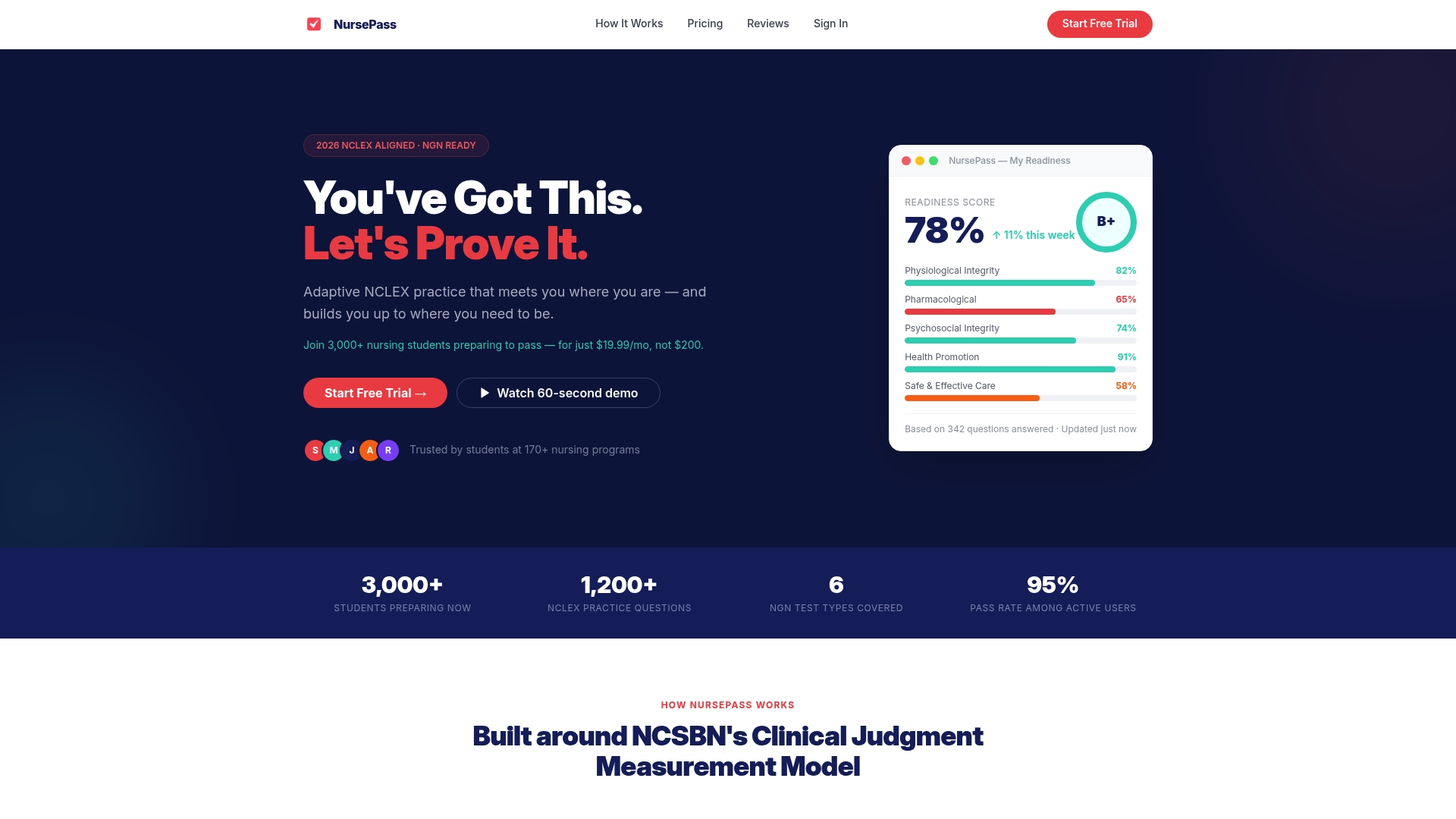
Nursepass offers over 1,200 NCLEX practice questions with detailed rationale explanations built for active review. Its adaptive engine adjusts question difficulty to your current competency level, so every session targets your real weak areas. Subcategory heat maps show you exactly where your knowledge gaps are, replacing guesswork with data. More than 3,000 nursing students use Nursepass, and active users report a 95% pass rate. If you are ready to turn re-reading into a high-yield study method, Nursepass gives you the structure to do it.
FAQ
What is the re-reading questions nursing exam technique?
The re-reading questions nursing exam technique is the structured, active review of practice questions using self-testing, rationale analysis, and error logging to build genuine recall rather than passive familiarity.
How many practice questions should i review per day for NCLEX?
The recommended daily target is 75–125 questions with full rationale review, dedicating over 60% of total study time to practice questions rather than passive content reading.
Why does passive re-reading fail for nursing exams?
Passive re-reading creates false familiarity instead of genuine recall. Active recall methods are 2–3 times more effective than passive review for high-stakes exams like the NCLEX.
What is rationale journaling and why does it matter?
Rationale journaling means writing out why each answer option is correct or incorrect after every question. It deepens comprehension and identifies weak content areas for targeted follow-up review.
Which tools support active question review for NCLEX prep?
UWorld, Saunders, Anki, and Nursepass each support active re-reading through detailed rationales, error tracking, or adaptive question delivery. Anki is specifically valuable for spaced repetition of pharmacology and weak-area concepts.