
Nursing competency assessment is a structured evaluation process that measures a nurse's ability to safely perform clinical roles by demonstrating integrated knowledge, skills, and judgment. Unlike a written exam, it captures observable performance rather than knowledge alone. Frameworks like the AACN Essentials, QSEN competencies, and validated tools like the Nurse Competence Scale give educators and employers a consistent standard to measure against. Whether you are preparing for the NCLEX, an OSCE, or a workplace skills check, understanding what nursing competency assessment involves puts you ahead before you walk into the room.
What is nursing competency assessment and why does it matter?
Nursing competency assessment gathers evidence that a nurse can consistently apply knowledge, skills, values, and clinical judgment in observable practice settings. The key word is "consistently." A single skills checkoff does not prove competence. Repeated, formative assessment tracks your progression from novice to safe, independent practice.
The stakes are high. Competency assessment is the driving force behind competency-based education. Without deliberate, repeated evaluation, competency-based nursing programs risk becoming superficial. A nurse who passes one observed procedure but cannot replicate it under pressure has not demonstrated true competence.
Competency assessment also protects patients. When a hospital or nursing board confirms that a nurse meets defined proficiency standards, that confirmation is grounded in structured evidence, not a supervisor's gut feeling. That distinction matters every time a nurse makes a clinical decision at the bedside.

What components and domains make up a competency evaluation?
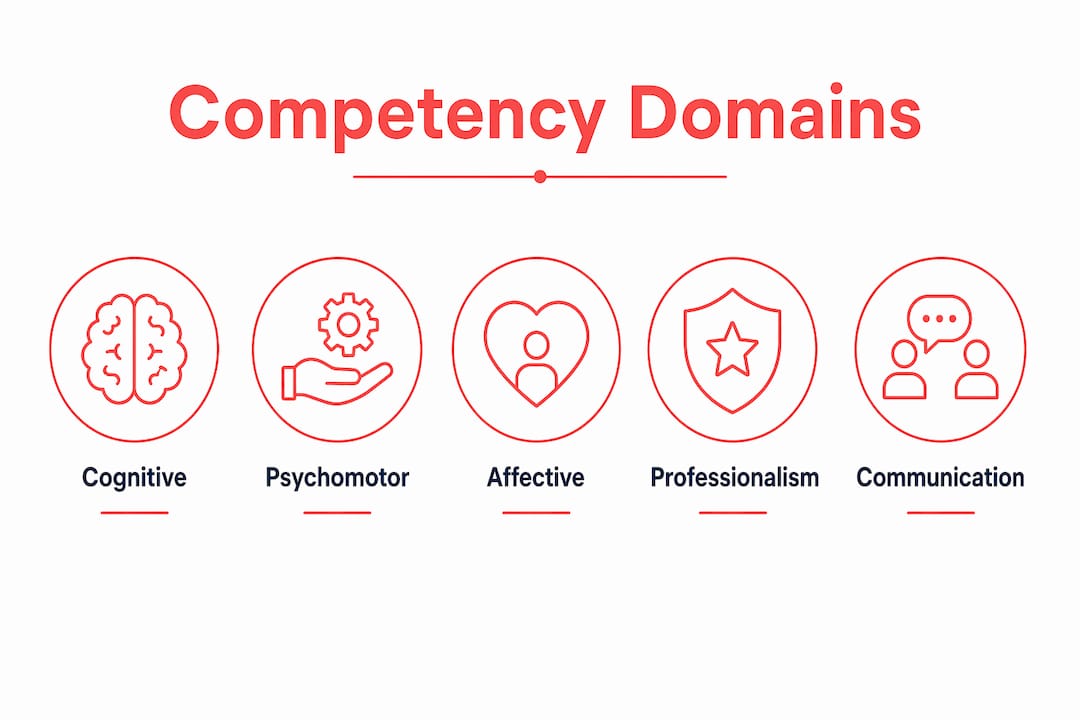
Nursing competency frameworks assess three core domains: cognitive (knowledge and clinical reasoning), psychomotor (hands-on technical skills), and affective (attitudes, values, and professional behavior). No single domain tells the full story. A nurse who knows the steps of a sterile dressing change but fumbles under observation, or who performs the skill correctly but communicates poorly with the patient, has gaps that a written test alone would never catch.
Validated instruments break these domains into specific, measurable dimensions. The Chinese Nursing Core Competence Scale, for example, uses eight domains and 62 validated items to assess tertiary hospital nurses. That level of specificity reflects a core principle: a general score is less useful than domain-level feedback that tells you exactly where to improve.
Common competency dimensions across major frameworks include:
- Professional skills: Clinical procedures, medication administration, patient monitoring
- Communication: Patient education, handoff reporting, interdisciplinary collaboration
- Leadership and management: Prioritization, delegation, resource coordination
- Self-management: Reflective practice, continuing education, ethical conduct
- Critical thinking: Clinical reasoning, evidence-based decision making
The Professional Nurse Competence Scale (PNCS) captures a similar range and distinguishes between underlying capability and actual observed performance. That distinction matters because a nurse may have the knowledge to act correctly but fail to demonstrate it under real conditions. Assessment must capture both.
| Domain | What it measures |
|---|---|
| Cognitive | Clinical reasoning, pharmacology knowledge, care planning |
| Psychomotor | Procedure accuracy, equipment handling, physical assessment |
| Affective | Professionalism, empathy, ethical decision making |
| Communication | Patient education, team reporting, documentation |
| Leadership | Delegation, prioritization, quality improvement participation |
Which methods are used to assess nursing competence?
Assessment methods in nursing range from direct observation to structured simulation. Each method captures a different slice of competence, which is exactly why programmatic assessment combines multiple approaches rather than relying on one.
The most widely recognized methods are:
- Objective Structured Clinical Examination (OSCE): Nurses rotate through standardized stations, each testing a specific skill or clinical scenario. OSCE is reliable, valid, and fair compared to traditional methods. Students report it as motivating and educational, though it can trigger significant anxiety.
- Virtual OSCE (VOSCE): A remote version of the OSCE format, increasingly used since 2020. It preserves structure while removing geographic barriers.
- Skills lab evaluation: Direct observation of a specific procedure in a controlled environment. The Pennsylvania NNAAP Skills Evaluation requires candidates to successfully demonstrate 5 skills within 30 minutes. That format tests both accuracy and time management under pressure.
- Clinical simulation: High-fidelity mannequins or standardized patients allow nurses to practice complex scenarios without risk to real patients. Simulation captures decision making in real time.
- Direct clinical observation: Supervisors or preceptors observe performance during actual patient care. This method reflects real-world conditions but introduces variability based on the observer.
- Reflective exercises and portfolios: Written or verbal reflections on clinical experiences assess the affective domain and professional growth over time.
Pro Tip: If you are preparing for an OSCE, practice each station skill to the point of automaticity. When anxiety spikes during the exam, automatic muscle memory carries you through steps your conscious mind might skip.
The OSCE format has one well-documented limitation: student stress. OSCE-related anxiety can suppress performance and produce results that underestimate actual competence. Good preparation and familiarity with the format reduce this effect significantly.
How do educators design fair and effective competency assessments?
Fair assessment does not happen by accident. Effective competency evaluation requires three linked components: a competency framework that defines expectations, an observation or scoring tool for consistent evaluation, and decisional criteria that indicate readiness to progress or practice safely.
Without all three, progression decisions default to subjective judgment. That is a problem. A student who performs well for one evaluator and poorly for another has not received a valid assessment. They have received two different assessments shaped by two different standards.
Best practices for fair assessment design include:
- Use structured rubrics: Rubrics replace vague impressions with observable, scorable behaviors. A rubric for IV insertion, for example, lists each step and rates execution on a defined scale.
- Assign multiple assessors: Single-observer assessments carry higher bias risk. Multiple evaluators viewing the same performance produce more reliable results.
- Separate formative from summative assessment: Formative assessment gives feedback during learning. Summative assessment makes a final judgment. Mixing the two in the same encounter confuses students and distorts results.
- Standardize the environment: Inconsistent setups or insufficient evaluator briefing distort performance and compromise assessment accuracy. Every candidate should face the same equipment, space, and instructions.
- Align standards to recognized frameworks: The AACN Essentials and Next Generation NCLEX (NGN) clinical judgment model give programs a defensible, nationally recognized benchmark.
Pro Tip: If you are a nursing student facing a competency check, ask your instructor which rubric or scoring tool they use. Reviewing the exact criteria before your evaluation removes ambiguity and focuses your preparation.
Continuous observation across multiple clinical encounters produces stronger evidence than a single high-stakes checkoff. One observation captures a moment. A pattern of observations captures competence.
How can nursing students prepare for competency assessments?
Preparation for a competency assessment starts with understanding the specific framework and format you will be evaluated against. The NCLEX uses the NGN clinical judgment model. Hospital credentialing uses facility-specific competency checklists. Knowing which standard applies tells you exactly what to practice.
Effective preparation strategies include:
- Review the competency framework: Read the AACN Essentials or your program's competency checklist before you study. These documents tell you what the evaluator is looking for, not just what the textbook covers.
- Practice in simulation: Skills labs and simulation centers let you rehearse procedures until they feel natural. Repetition under low-stakes conditions builds the confidence that holds up under high-stakes evaluation.
- Study the evaluation criteria: For structured exams like the NNAAP Skills Evaluation, the scoring criteria are often publicly available. Knowing that you must complete five skills in 30 minutes changes how you pace your practice.
- Combine self-assessment with external feedback: Self-assessment alone is insufficiently reliable. Studies show a weak correlation between how nurses rate their own skills and how they perform on objective tests. Seek feedback from instructors, preceptors, or peers.
- Manage exam anxiety: OSCE-style assessments are particularly stress-inducing. Breathing techniques, timed mock stations, and familiarity with the physical setup all reduce anxiety on exam day.
Nursepass supports this preparation process directly. Its adaptive engine tailors practice questions to your current competency level, and its subcategory heat maps show you exactly which clinical domains need more attention. More than 3,000 nursing students use the platform, and Nursepass reports a 95% pass rate among active users. That kind of targeted feedback is what separates efficient preparation from generic studying.
Key Takeaways
Nursing competency assessment is most effective when it combines multiple methods, structured frameworks, and repeated observation to produce defensible evidence of safe, capable practice.
| Point | Details |
|---|---|
| Definition of competency assessment | It measures integrated knowledge, skills, attitudes, and judgment through observable performance, not knowledge alone. |
| Core domains assessed | Cognitive, psychomotor, and affective domains each capture a different dimension of nursing competence. |
| Common assessment methods | OSCEs, clinical simulation, direct observation, and skills evaluations each serve a distinct purpose in a complete program. |
| Fair assessment design | Structured rubrics, multiple assessors, and standardized environments reduce bias and produce defensible results. |
| Preparation strategy | Combine framework review, simulation practice, and external feedback. Self-assessment alone is not reliable enough. |
What I have learned from watching nurses get assessed
The most common mistake I see nursing students make before a competency assessment is studying content when they should be practicing performance. Knowing the steps of a procedure in your head is not the same as executing them under observation with a timer running and an evaluator watching your hands.
The shift from knowledge testing to integrative performance assessment is the most significant change in nursing education over the past decade. Programs built around the AACN Essentials and the NGN model are asking students to demonstrate clinical judgment in context, not just recall facts. That is a harder thing to prepare for, and it requires a different kind of study.
What I find most underappreciated is the role of repeated, low-stakes practice. Students who visit the skills lab three times a week for a month outperform students who cram the week before an OSCE. Competence is built through repetition, not review. The research on this is clear: competency assessment must be longitudinal, not a single event.
The other issue I keep seeing is the gap between self-perception and actual performance. Nurses who feel confident often overestimate their skill level on objective measures. The fix is simple: get external feedback early and often. Find a preceptor, use a simulation lab, or work with a platform that gives you objective data on where you actually stand.
Competency assessment frameworks also need to evolve as healthcare changes. A tool validated in 2015 may not capture the clinical demands of 2026. Programs that update their frameworks regularly produce graduates who are ready for current practice, not the practice of a decade ago.
— Michael
Nursepass and your competency preparation
Preparing for a nursing competency assessment means knowing your weak spots before the evaluator finds them. Nursepass gives you that advantage with over 1,200 NCLEX practice questions, a live readiness score, and subcategory heat maps that show your performance by clinical domain.
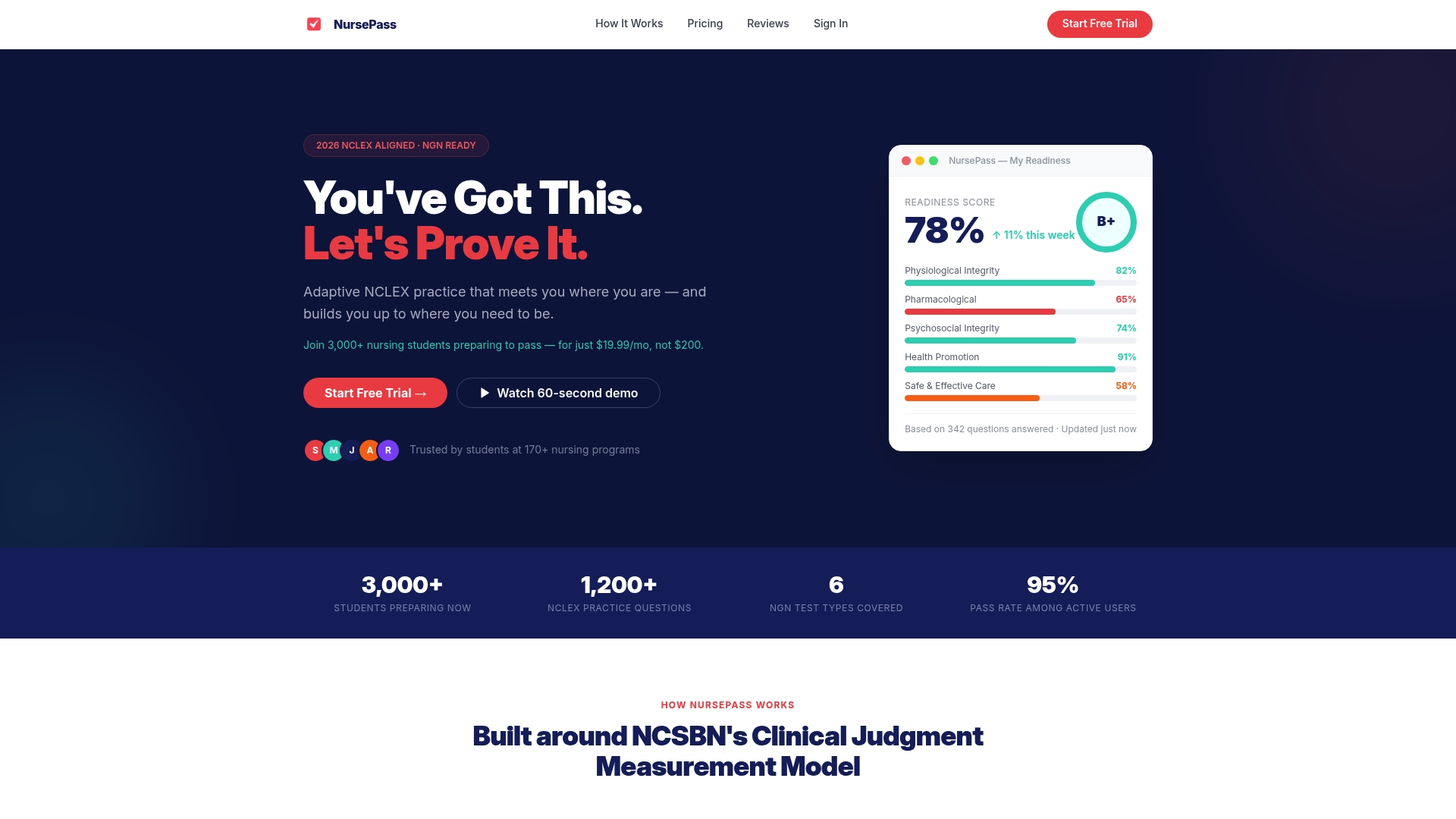
The adaptive engine adjusts question difficulty based on your current competency level, so you spend time on the areas that actually need work. Whether you are preparing for the NCLEX or a clinical skills evaluation, start your preparation with a platform built around the same competency-based principles your program uses. With a 95% pass rate among active users, Nursepass turns assessment preparation into a targeted, measurable process.
FAQ
What is nursing competency assessment in simple terms?
Nursing competency assessment is a structured process that evaluates whether a nurse can safely apply knowledge, skills, and judgment in real clinical situations. It goes beyond written tests by measuring actual observed performance.
What is the difference between competence and competency in nursing?
Competence refers to a nurse's underlying ability to perform a role. Competency refers to the specific, observable behaviors that demonstrate that ability in a defined context.
How is an OSCE used in nursing competency assessment?
An OSCE places nurses through standardized clinical stations where each station tests a specific skill or scenario. It is considered reliable and valid for structured clinical judgment assessment, though it can cause student anxiety.
Why is self-assessment not enough for nursing skills evaluation?
Studies show a weak correlation between self-rated skill levels and objective test performance. External observation and standardized criteria are required for a valid competence evaluation.
Which frameworks guide nursing competency standards in the United States?
The AACN Essentials and the Next Generation NCLEX (NGN) clinical judgment model are the primary frameworks guiding nursing competency standards in the United States. Programs align their assessment tools to these benchmarks for national consistency.