
Computerized Adaptive Testing (CAT) in nursing is an exam format that selects each question based on your previous answer, measuring your competency with precision that fixed exams cannot match. The NCLEX uses this system as its core delivery method. Understanding what is cat testing nursing means understanding that the exam is not random. It is a real-time calibration engine. Every answer you give narrows the system's estimate of your ability, and the test ends the moment it reaches statistical certainty. This guide explains exactly how that process works, why it feels harder than traditional tests, and how to prepare for it.
What is CAT testing in nursing?
CAT testing in nursing, formally known as Computerized Adaptive Testing, is a method where the exam software selects each question based on your performance on the previous one. The National Council Licensure Examination (NCLEX), administered by the National Council of State Boards of Nursing (NCSBN), uses this format for both the RN and PN versions of the exam. Unlike a paper test where every candidate answers the same 100 questions, CAT builds a unique exam path for each test-taker.
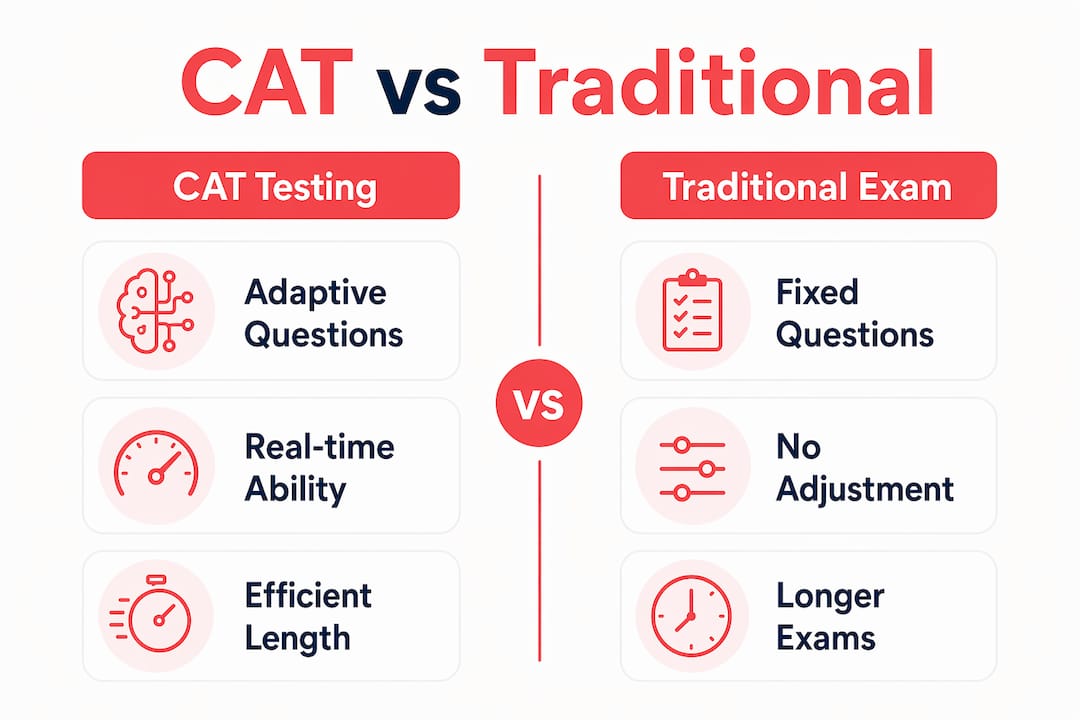
The core purpose of the nursing CAT assessment is accuracy. Traditional fixed exams waste time asking questions that are either too easy or too hard for a given candidate. CAT eliminates that waste by targeting questions near your current estimated ability level. The result is a shorter, more precise measurement of whether you meet the passing standard.
The system works by estimating your ability after every single response. If you answer correctly, the next question gets harder. If you answer incorrectly, the next question gets easier. This back-and-forth continues until the algorithm reaches 95% confidence in its estimate of your ability.

How does CAT testing operate during the NCLEX?
The mechanics of the CAT algorithm follow a clear sequence, even if the experience feels unpredictable. Here is how the process unfolds from the moment you sit down:
- You answer the first question. The system starts with a question near the passing standard difficulty level.
- The algorithm updates its ability estimate. Your response shifts the system's model of where your competency sits.
- The next question is selected. The software pulls a question calibrated to your updated ability estimate, not a random pick from a pool.
- This cycle repeats. Every answer refines the estimate further, narrowing the confidence interval around your ability score.
- The test ends. Once the system reaches 95% statistical confidence that your ability is clearly above or below the passing standard, the exam stops.
The NCLEX has a minimum of 85 questions and a maximum of 150. Reaching 150 questions does not mean you failed. It means your performance was close enough to the passing line that the system needed more data to make a confident determination. That is a measurement issue, not a performance verdict.
You will also notice that question difficulty can seem to jump suddenly mid-exam. This is the algorithm recalibrating in real time as it zeroes in on your competency level. It is expected behavior, not a sign that you are failing.
Pro Tip: Do not try to track your performance by gauging question difficulty. You cannot accurately interpret the algorithm's signals in the moment, and attempting to do so creates anxiety that hurts your focus.
Why does CAT feel so hard psychologically?
The biggest challenge of the cat test in nursing is not the content. It is the absence of familiar feedback. Traditional exams give you a percentage score. You know where you stand. CAT gives you nothing during the test. No score. No progress bar. No indication of whether you are passing.
Candidates accustomed to standard grading metrics experience increased anxiety because CAT removes those percentage-based performance indicators entirely. This is one of the most documented psychological hurdles in nursing exam preparation. The discomfort is real, and it is worth taking seriously.
Here are the most common anxiety triggers CAT creates and how to counter each one:
- "The questions feel impossibly hard." This means the system is working. Feeling challenged is evidence the algorithm has placed you near your ability ceiling, which is exactly where it should be.
- "I got a question wrong, so I must be failing." One wrong answer shifts the estimate slightly. It does not define your outcome. The system uses patterns across many questions.
- "The exam stopped early, so I must have failed." Early termination means the system reached confidence. That confidence can be above or below the passing standard.
- "The difficulty keeps changing, so something is wrong." Sudden difficulty shifts reflect real-time recalibration, not a malfunction.
"The primary challenge of CAT is psychological. The test is designed to keep candidates near their ability level, which may feel more difficult but signifies correct functioning." — Lecturio NCLEX Research
Pro Tip: Practice answering one question at a time without reviewing your previous answers. This trains your brain to stay present rather than spiral into pattern analysis during the real exam.
CAT vs. traditional fixed exams: what changes for nurses?
The difference between CAT and a fixed exam goes beyond format. It changes how you should prepare, how you experience the test, and how your results are interpreted.
| Feature | CAT (NCLEX Format) | Traditional Fixed Exam |
|---|---|---|
| Question selection | Adaptive, based on your answers | Same for every candidate |
| Number of questions | Variable (85–150 for NCLEX) | Fixed for all test-takers |
| Difficulty progression | Adjusts in real time | Predetermined sequence |
| Performance feedback | None during the exam | Often visible (section scores) |
| Measurement accuracy | Higher for borderline candidates | Lower near the passing threshold |
| Preparation focus | Conceptual depth over volume | Volume and coverage |
Adaptive testing increases accuracy compared to traditional fixed exams by targeting questions to your ability level. This means you spend less time on questions that do not actually measure your competency. For nursing students, this has a direct implication: studying to recognize patterns across hundreds of memorized questions is less effective than building genuine clinical reasoning skills.
The importance of cat testing in nursing also shows up in how borderline candidates are evaluated. A fixed exam might pass or fail someone based on a handful of questions that happened to cluster in one content area. CAT keeps probing until it has enough data to be confident. That is a fairer system, even if it feels more stressful in the moment.
How to prepare effectively for a cat-based nursing exam
Preparation for the NCLEX requires a different approach than studying for a fixed exam. The cat testing procedure nursing students face rewards clinical reasoning, not memorization. Here is what actually moves the needle:
- Use adaptive practice tests. Static question banks do not replicate the CAT experience. Adaptive practice tests that adjust difficulty based on your responses train both your knowledge and your psychological tolerance for the format.
- Study your analytics, not just your score. Performance data by content category tells you where your ability estimate is weakest. Focus your study hours on those gaps, not on areas where you are already strong.
- Build your clinical reasoning process. CAT questions test your ability to apply knowledge, not recall it. Practice walking through the nursing process (assessment, diagnosis, planning, implementation, evaluation) for every question you attempt.
- Simulate exam conditions. Timed practice sessions without the ability to review previous answers train you to commit to each response and move forward. This is a skill that requires deliberate practice.
- Focus on one question at a time. Practical exam guidance consistently points to this as the single most effective behavioral strategy. Trust the test design and resist the urge to self-analyze patterns mid-exam.
- Address test anxiety directly. Breathing techniques, visualization, and pre-exam routines are not soft skills. They are performance tools. Build them into your preparation before exam day.
The NCLEX is not a test you pass by knowing everything. It is a test you pass by demonstrating consistent clinical judgment above the passing standard. CAT is designed to find that threshold efficiently.
Key takeaways
CAT testing in nursing is a precision measurement system, and understanding how it works is the most direct path to performing confidently on the NCLEX.
| Point | Details |
|---|---|
| CAT adapts in real time | Each question is selected based on your previous answer, not a fixed sequence. |
| 95% confidence ends the test | The exam stops when the algorithm is statistically certain of your ability level. |
| Difficulty signals correct function | Harder questions mean the system is calibrating accurately, not that you are failing. |
| Adaptive practice is non-negotiable | Practice tests that mirror CAT conditions build both knowledge and psychological readiness. |
| Analytics guide smarter study | Performance data by subcategory shows exactly where to focus your preparation time. |
What i've learned watching students misread the CAT
Most students I work with make the same mistake. They walk into the NCLEX treating it like a traditional exam where more correct answers equals a better outcome. CAT does not work that way, and that misunderstanding costs people their confidence at exactly the wrong moment.
The students who perform best are the ones who accept the discomfort early. They practice with adaptive tools, they get used to not knowing how they are doing, and they learn to trust the process. That sounds abstract, but it is a trainable skill. You can condition yourself to stay calm when questions get harder by deliberately exposing yourself to that experience during preparation.
The other thing I tell every nursing student: stop trying to count your questions. Whether your exam ends at 85 or 150 tells you almost nothing about your result. I have seen students pass at 85 and fail at 85. I have seen students pass at 150 and fail at 150. The number is not the signal. Your consistent clinical reasoning across every question you answered is the signal.
Embrace the adaptive format as the advantage it actually is. It is built to find your true ability level, not to trick you. If you have the knowledge and the clinical judgment, the system will find it.
— Michael
How Nursepass supports your NCLEX CAT preparation
Preparing for a CAT-based exam requires tools that actually replicate the format. Nursepass is built specifically for this.
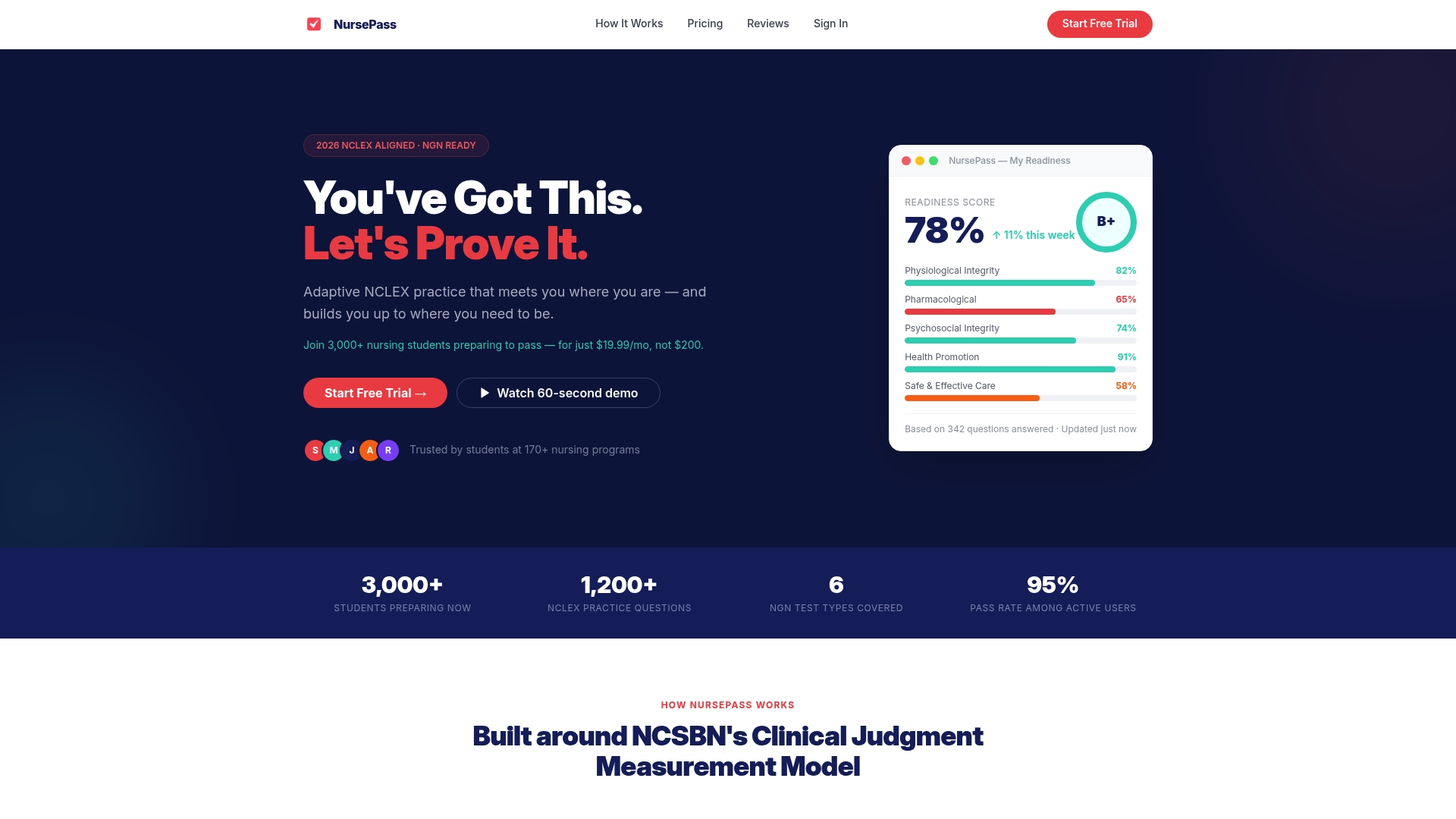
Nursepass offers over 1,200 NCLEX practice questions delivered through an adaptive engine that adjusts to your current competency level, the same way the real exam does. The platform's live readiness score updates as you practice, so you always know where your ability estimate stands. Subcategory heat maps show you exactly which content areas need attention, so you study smarter rather than longer. More than 3,000 nursing students have used Nursepass, with 95% of active users passing the NCLEX. If you want to prepare for CAT the right way, Nursepass is where to start.
FAQ
What is CAT testing in nursing?
CAT testing in nursing is Computerized Adaptive Testing, a format used by the NCLEX where each question is selected based on your answer to the previous one. The exam ends once the system reaches 95% confidence in its estimate of your ability level.
Does getting harder questions mean i'm passing the NCLEX?
Harder questions mean the CAT algorithm is functioning correctly and has placed you near your ability ceiling. They do not confirm a pass or a fail on their own.
Why did my NCLEX stop at 85 questions?
The exam stopped because the algorithm reached 95% confidence that your ability is clearly above or below the passing standard. Early termination can indicate either a pass or a fail.
Does reaching 150 questions mean i failed?
No. Reaching the maximum of 150 questions means your performance was close to the passing line and the system needed additional data to make a confident determination. Candidates who answer 150 questions can still pass.
How should i prepare differently for a CAT exam?
Use adaptive practice tests that adjust difficulty based on your responses, study your performance analytics by content category, and practice committing to one question at a time without reviewing previous answers.