
A knowledge gap in NCLEX preparation is defined as a specific content area where your understanding is insufficient to answer exam questions correctly and consistently. Identifying knowledge gaps in your nursing exam study plan is the single most effective way to stop wasting study hours and start building real readiness. Most nursing students study broadly, covering everything equally, and that approach hides weak spots until test day. The NCLEX measures safe, competent nursing practice, not general recall. Targeted gap identification, combined with disciplined error analysis, is what separates students who pass on the first attempt from those who do not.
How to use practice questions to identify nursing knowledge gaps
Practice questions are the most direct tool for detecting gaps in nursing knowledge. A wrong answer tells you exactly where your understanding breaks down. A right answer with shaky reasoning tells you the same thing.

Experts recommend allocating 60–70% of study time to practice questions and 30–40% to content review. That ratio exists because passive reading does not expose what you do not know. Only answering questions under test conditions forces your brain to retrieve information, and retrieval failure is the clearest signal of a gap.
Work through questions organized by content area rather than in random mixed sets. When you finish a set on Pharmacological and Parenteral Therapies, for example, your score in that category tells you something specific. A score below 70% in that area signals a gap worth addressing before moving on.
- Answer a focused set of 20–30 questions in one content area.
- Record your score and flag every question you got wrong or guessed on.
- Read every rationale, including the ones for questions you answered correctly. Reviewing all rationales reinforces clinical reasoning and catches gaps hidden behind lucky guesses.
- Note the topic of each missed question. Group them by subcategory, such as medication safety, fluid balance, or infection control.
- Return to content review only for the specific subcategories flagged. Then retest with a fresh question set in that area.
Pro Tip: Run short sets of 10–20 questions daily rather than saving all your practice for full-length exams. Frequent small sets give you faster feedback loops and make gap patterns visible within days, not weeks.
Candidates who complete fewer than 2,000 practice questions before test day face higher fail rates. Volume matters, but only when paired with deliberate rationale review.
How do you tell a knowledge gap from a clinical judgment error?
The most common mistake in NCLEX preparation is treating every wrong answer as a content problem. Conflating content gaps with clinical judgment errors leads to the wrong remediation and wasted study time.
A knowledge gap means you did not know the fact. You could not recall the normal potassium range, the mechanism of a drug, or the signs of a specific complication. A clinical judgment error means you knew the facts but chose the wrong action. You recognized the cues but misread their priority. You selected a reasonable intervention but not the safest one.
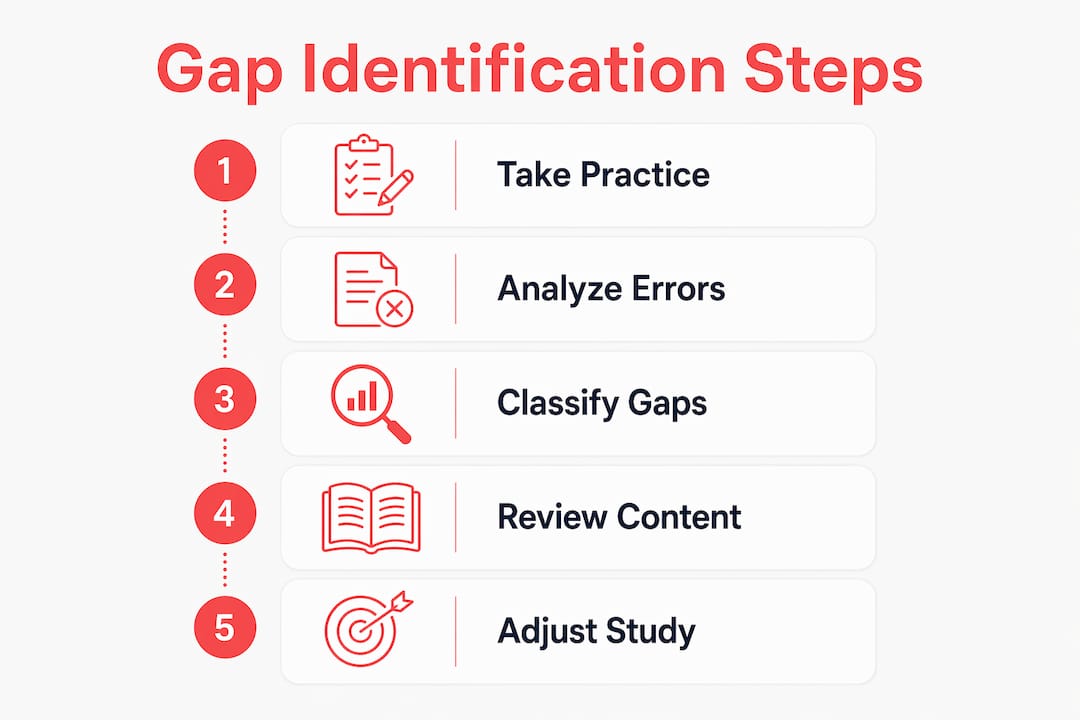
These two error types require completely different fixes.
Signs of a knowledge gap:
- You had no idea what the question was asking about
- The correct answer introduced a term or concept you did not recognize
- You could not eliminate any of the four options confidently
Signs of a clinical judgment error:
- You knew the topic but second-guessed yourself
- You chose an action that was correct in isolation but not the priority
- You missed which client was most at risk or which symptom was most urgent
After each practice set, sort your missed questions into one of these two categories. Categorizing errors by type dramatically improves study efficiency because it points you toward the right fix immediately.
For knowledge gaps, go back to your textbook or a focused content review resource. For clinical judgment errors, practice more questions using the NCLEX Client Needs framework and the Next Generation NCLEX (NGN) cognitive skill categories: recognize cues, analyze cues, prioritize hypotheses, generate solutions, take action, and evaluate outcomes.
Pro Tip: After finishing a practice set, write one sentence for each wrong answer: "I missed this because I did not know X" or "I missed this because I prioritized Y over Z." That single sentence forces you to classify the error and makes your next study step obvious.
What does balanced readiness across NCLEX content areas look like?
Balanced readiness means scoring consistently well across all NCLEX content categories, not just the ones you enjoy. A student who scores 90% on Psychosocial Integrity but 55% on Physiological Adaptation has a serious hidden gap. That imbalance will show up on test day.
Achieving consistent 70% scores across all NCLEX content areas is the benchmark that signals balanced readiness. One strong category cannot compensate for a weak one because the NCLEX draws questions from the full test plan.
The NCLEX Test Plan organizes content into Client Needs categories. Each category carries a defined percentage of exam questions. Studying the NCLEX test plan categories tells you exactly how much weight each area carries and where gaps cost you the most.
| Performance pattern | What it signals | Study focus |
|---|---|---|
| High scores in 2–3 areas, low in others | Hidden gaps in neglected categories | Redirect time to low-scoring areas |
| Scores clustered around 65–69% everywhere | Broad shallow knowledge | Deepen content review across all areas |
| Scores above 70% but wrong on priority questions | Clinical judgment gaps, not content gaps | Practice NGN frameworks and priority-setting |
| Inconsistent scores in the same category | Retention problems or question fatigue | Shorter, more frequent practice sets |
The Candidate Performance Report (CPR), available to students who have taken the NCLEX, pinpoints deficits by category with precision. Students retaking the exam should treat the CPR as their primary study document. Nursepass provides subcategory heat maps that serve the same function during preparation, showing exactly where your performance is strong and where it drops below threshold.
Tracking your readiness over time across categories is what separates students who study hard from students who study well.
A step-by-step plan to close the gaps you find
Finding a gap is only useful if you act on it systematically. Here is a practical framework for remediating weak areas once your nursing exam knowledge assessment reveals them.
- Rank your weak categories by score. Start with the lowest-scoring content area, not the one that feels most familiar or comfortable.
- Spend two to three focused study sessions on content review in that area. Use your textbook, clinical notes, or a structured content guide. Keep sessions to 60–90 minutes to maintain concentration.
- Return to practice questions in that category. Answer at least 20 new questions you have not seen before. Do not reuse questions you already answered, because memory of the answer distorts your score.
- Compare your new score to your baseline. If you have moved above 70%, shift focus to the next weakest category. If not, repeat the content review and retest cycle once more before moving on.
- Run a full mixed-category set every two weeks. This confirms that improvements in one area have not come at the cost of slipping in another.
Active question practice builds clinical reasoning far better than passive review. Reading a chapter does not tell you whether you can apply the information under exam conditions. Only answering questions does.
Overconfidence is a real risk. Question bank analytics frequently expose areas where students feel confident but score poorly. Feeling comfortable with a topic is not the same as performing well on it. Let your scores, not your feelings, guide your study plan.
Pro Tip: Align your remediation plan with the NCLEX Client Needs categories and the NGN cognitive skill framework. Studying by cognitive skill, such as practicing only "prioritize hypotheses" question types, often yields faster improvement than reviewing an entire content chapter.
Key Takeaways
Systematic gap identification using practice questions and error classification is the most direct path to NCLEX readiness.
| Point | Details |
|---|---|
| Use practice questions as diagnostics | Allocate 60–70% of study time to questions and review rationales for every answer. |
| Classify every error | Separate content knowledge gaps from clinical judgment errors before choosing a remediation method. |
| Aim for 70% across all categories | Consistent performance across NCLEX content areas matters more than high scores in a few. |
| Use performance data, not feelings | Analytics and category scores reveal gaps that self-assessment misses. |
| Retest after remediation | Verify improvement with fresh questions before moving to the next weak area. |
Why active gap identification changes everything
Most nursing students I have seen struggle with the NCLEX share one habit: they study what they already know. It feels productive. The pages turn, the notes fill up, and the hours accumulate. But comfort is not competence, and that distinction costs people their first attempt.
The students who pass efficiently do something different. They treat every wrong answer as a data point, not a failure. They classify the error, find the root cause, and fix the specific thing that broke. That process is uncomfortable because it forces you to sit with what you do not know. But it is also the fastest way to move forward.
The Candidate Performance Report is one of the most underused tools in NCLEX preparation. Students who have taken the exam and received a CPR often set it aside because it is hard to read. That report is a precise map of your weakest areas. Reading it carefully and building your next study plan around it is the highest-return action a retaker can take.
One more thing worth saying directly: high performers on the NCLEX are not the students who memorized the most facts. They are the students who practiced clinical reasoning until it became automatic. Studying by cognitive skill frameworks rather than content category alone is what gets you there. The NCLEX is testing whether you can think like a safe nurse, not whether you can recall a textbook.
— Michael
How Nursepass helps you find and fix your weak spots
Nursepass is built around the exact problem this article addresses: knowing where you stand across every NCLEX content area, not just the ones you have been studying.
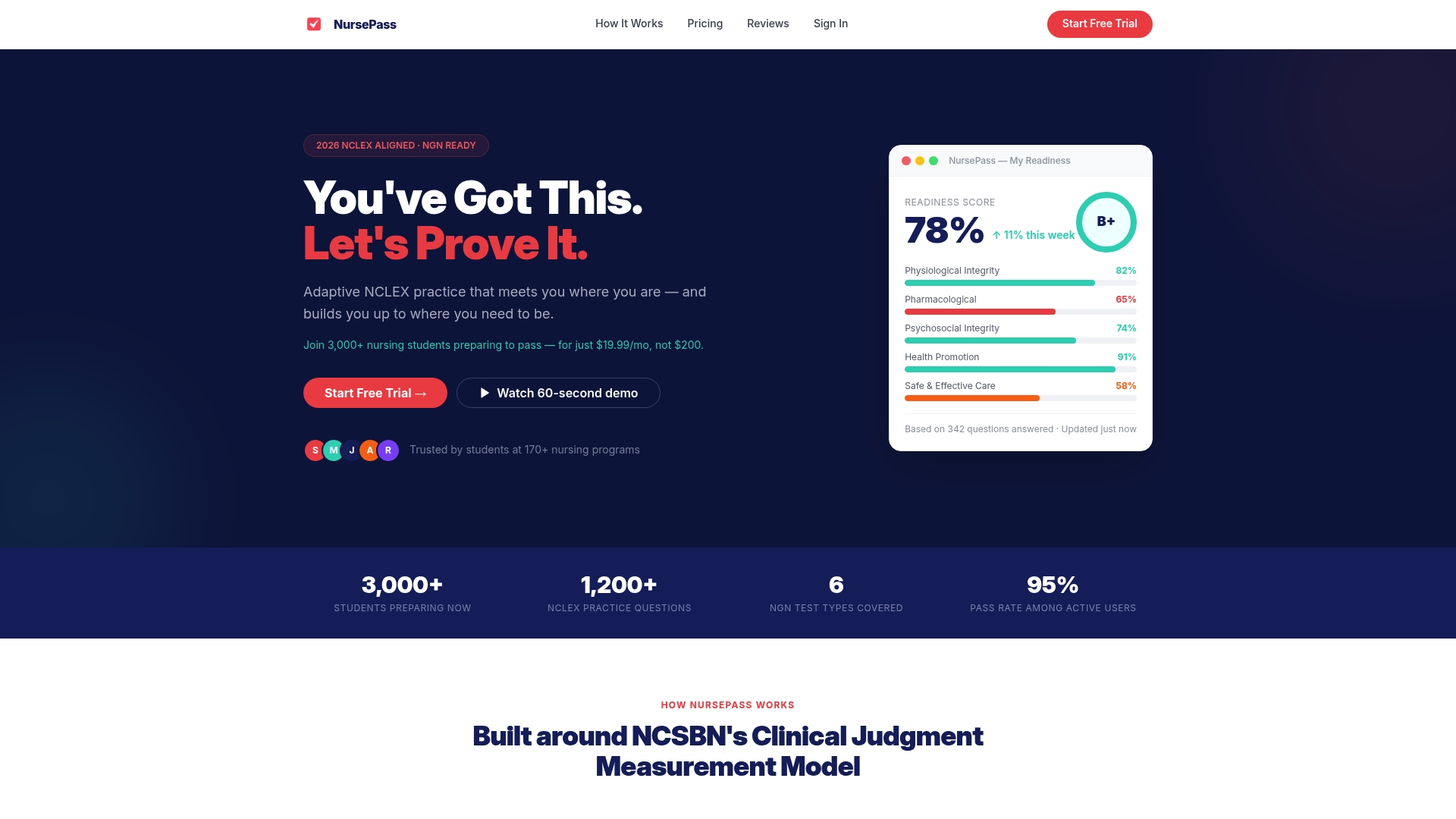
The platform's subcategory heat maps show your performance by content area at a glance, so you can see weak spots without digging through spreadsheets. Its adaptive engine adjusts question difficulty based on your current competency, which means every session targets the level where you are most likely to have gaps. With over 1,200 NCLEX practice questions and a live readiness score, Nursepass gives you the data you need to study with direction. More than 3,000 nursing students have used it, and active users report a 95% pass rate. Start your assessment and find out exactly where to focus next.
FAQ
What is a knowledge gap in NCLEX preparation?
A knowledge gap is a specific content area where your understanding is too weak to answer related exam questions correctly and consistently. It differs from a clinical judgment error, which involves knowing the content but choosing the wrong nursing action.
How many practice questions should I complete before the NCLEX?
Candidates who complete fewer than 2,000 practice questions before test day face higher fail rates. Volume combined with rationale review is what builds the clinical reasoning the NCLEX tests.
What score should I aim for across NCLEX content categories?
A consistent score of 70% or above across all NCLEX content areas signals balanced readiness. One strong category cannot compensate for a weak one on the actual exam.
How do I use the Candidate Performance Report to close gaps?
The Candidate Performance Report identifies your weakest NCLEX categories by name. Use it to rank your deficits, then build a focused study plan that addresses the lowest-scoring areas first before retesting.
Is passive studying effective for closing nursing knowledge gaps?
Passive methods like reading and watching videos are the least efficient way to close gaps. Active practice with immediate rationale review builds clinical reasoning and retention far faster than passive review alone.