
The NCLEX exam is defined as the National Council Licensure Examination, the mandatory standardized test every nursing graduate must pass to practice as a registered nurse (RN) or practical nurse (PN) in the United States and Canada. Administered by the National Council of State Boards of Nursing (NCSBN), the exam serves as the national benchmark for entry-level nursing competence. Two versions exist: the NCLEX-RN for registered nurses and the NCLEX-PN for practical or vocational nurses. Since april 2023, the exam has used the Next Generation NCLEX (NGN) format, which centers on clinical judgment rather than rote memorization. The 2026 test plan refresh, effective april 1, 2026, updated entry-level nursing standards to reflect current practice demands.
What is the NCLEX exam format and structure?
The NCLEX uses computerized adaptive testing, known as CAT, to adjust question difficulty in real time based on your performance. The exam does not deliver a fixed set of questions. Instead, the algorithm selects each new question based on how you answered the previous one, continuously estimating your ability level.
The question count varies between 85 and 150 items, and the exam ends once the system reaches a statistically confident pass or fail decision. The maximum testing time is 5 hours. That time limit applies regardless of how many questions you have answered.
The NGN format introduced several new question types that go beyond traditional multiple-choice:
- Case studies: Extended patient scenarios requiring multiple related decisions across several questions
- Bowtie questions: Require you to identify a patient condition, select nursing actions, and predict outcomes simultaneously
- Matrix/grid questions: Assess multiple data points within a single patient scenario
- Multi-response select-all-that-apply: Expanded versions that test nuanced clinical reasoning
- Trend questions: Track changes in patient status over time and require you to interpret the shift
These item types simulate real clinical situations. The goal is to measure how you think through a patient problem, not just whether you memorized a fact.
Pro Tip: When you encounter a case study block, read the patient history carefully before answering any question in the set. The details planted early in the scenario often determine the correct answer several questions later.

What is the purpose of the NCLEX and what does it measure?
Passing the NCLEX is the legal requirement for nursing licensure. State boards of nursing use the result as the national standard for determining whether a candidate is safe to practice at the entry level. No passing result means no license and no legal authority to practice nursing.
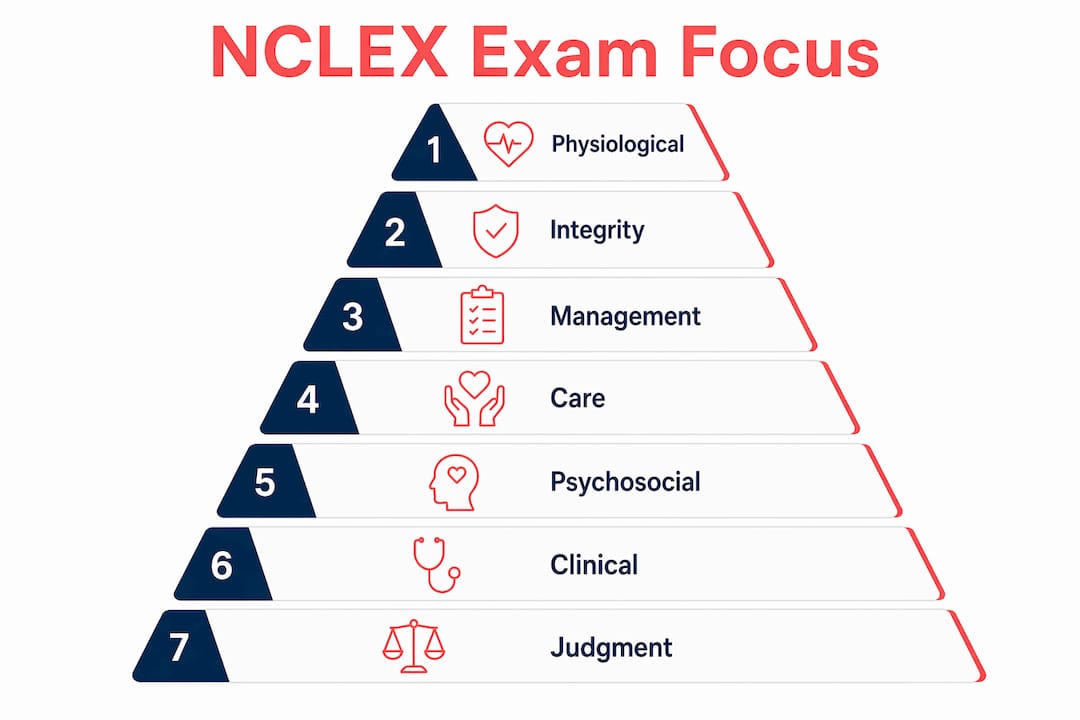
The exam measures competence across four major client needs categories:
- Safe and effective care environment: Management of care and safety
- Health promotion and maintenance: Prevention, early detection, and health education
- Psychosocial integrity: Mental health, coping, and therapeutic communication
- Physiological integrity: Basic care, pharmacology, and physiologic adaptation
The NCLEX blueprint weights physiological integrity heaviest among these categories. Management of care and psychosocial integrity also carry significant weight. That distribution tells you exactly where to concentrate your study hours.
Clinical judgment is the central competency the exam tests. The NCSBN built the Clinical Judgment Measurement Model (CJMM) to define and measure this skill. The CJMM breaks clinical decision-making into six cognitive steps: recognize cues, analyze cues, prioritize hypotheses, generate solutions, take action, and evaluate outcomes. Every NGN question maps to one or more of these steps. Nursing students who understand the CJMM framework answer NGN questions with a clear mental process rather than guessing.
The passing standard is not a percentage score. The NCSBN sets a logit-based passing threshold that reflects the minimum competence level required for safe practice. That threshold is reviewed and updated with each test plan revision.
How should nursing students prepare for the NCLEX exam?
Effective NCLEX preparation requires treating study like a scheduled professional commitment, not an activity you fit in when time allows. Scheduled study blocks focused on clinical judgment outperform passive review every time. Set specific daily hours, protect them, and stick to the schedule.
Here is a preparation framework that works:
- Assess your baseline. Take a full-length diagnostic practice test before you study anything. Your results reveal which content areas need the most attention and which are already solid.
- Study by client needs category. Work through physiological integrity first, since it carries the most exam weight. Then move to management of care, psychosocial integrity, and health promotion.
- Practice with case-based scenarios. Use NGN-style questions that mirror the bowtie and case study formats. Answering traditional multiple-choice questions alone will not prepare you for the current exam.
- Apply active recall daily. After reading a concept, close the material and explain it out loud or in writing. This technique builds retention far faster than re-reading notes.
- Review every wrong answer analytically. Do not just note that you got a question wrong. Identify which CJMM step you failed at and why. That analysis directs your next study session.
- Build test endurance. Sit for full-length timed practice sessions at least twice per week. The 5-hour exam demands sustained concentration, and you need to train for that physically and mentally.
Pro Tip: Top preparation programs recommend scheduling your most demanding study sessions during your peak cognitive hours, whether that is morning or afternoon, and building in short breaks every 45–60 minutes to prevent mental fatigue.
One myth worth correcting: receiving more questions does not mean you are failing. Reaching the maximum question count simply means the algorithm needed more data to reach a confident decision. Candidates pass and fail at 85 questions and at 150 questions equally. Do not let question count distract you mid-exam.
Use a structured self-study plan to organize your preparation timeline. Candidates who follow a written schedule consistently outperform those who study reactively.
What are the key changes in the 2026 NCLEX NGN format?
The NGN rollout began in april 2023 and replaced the traditional multiple-choice-heavy exam with a clinical judgment-centered model. The 2026 test plan refresh, effective april 1, 2026, updated the content to reflect current entry-level nursing standards across all practice settings.
The most significant structural change is the introduction of partial credit scoring for complex multi-response items. Under the traditional format, you either answered a question fully correctly or received no credit. Under NGN scoring, nuanced clinical reasoning earns partial credit. This rewards candidates who demonstrate sound thinking even when they do not select every correct option.
| Feature | Traditional NCLEX | NGN Format (2026) |
|---|---|---|
| Primary question type | Multiple choice | Case studies, bowtie, matrix |
| Scoring model | All-or-nothing | Partial credit for complex items |
| Core competency tested | Knowledge recall | Clinical judgment (CJMM) |
| Question count | 75–145 | 85–150 |
| Scenario depth | Single-question items | Multi-question patient scenarios |
The shift to NGN reflects a nationwide move in nursing education away from memorization and toward applying knowledge under realistic clinical pressure. Candidates who prepare using only traditional question banks will find the NGN format disorienting. The solution is deliberate practice with NGN-style items and a working knowledge of the CJMM steps.
Mastering the CJMM is not optional for 2026 candidates. Every case study block on the exam traces back to one or more of the six cognitive steps. Candidates who can name the step a question is testing answer it with a clear framework rather than instinct.
Check the NCLEX passing standard explained guide for a detailed breakdown of how the logit threshold translates to real exam performance.
Key Takeaways
The NCLEX exam is a clinical judgment test, not a knowledge recall test, and every preparation strategy must reflect that distinction.
| Point | Details |
|---|---|
| NCLEX is mandatory for licensure | No passing result means no legal authority to practice nursing in the U.S. or Canada. |
| CAT adjusts to your performance | Question count (85–150) and difficulty shift in real time based on your answers. |
| NGN tests clinical judgment | The CJMM framework defines six cognitive steps that every NGN question maps to. |
| Partial credit rewards reasoning | Complex multi-response items now award partial credit, so sound thinking always counts. |
| Passive study is the top failure mode | Active recall, case-based practice, and performance analytics outperform re-reading every time. |
What I have learned from watching nursing students approach the NCLEX
Most nursing students walk into NCLEX preparation with the same instinct: read more, memorize more, cover more ground. That instinct is wrong, and it costs people their first attempt.
The NCLEX does not reward the student who memorized the most drug names. It rewards the student who can look at a deteriorating patient scenario and correctly identify what is happening, what matters most, and what to do first. Those are three separate cognitive moves, and each one requires practice, not passive reading.
The single most consistent pattern I see in students who struggle is overconfidence built on surface-level familiarity. They recognize a topic, assume they know it, and move on. Then they hit a bowtie question that requires them to connect that topic to a patient outcome and a nursing intervention simultaneously, and they freeze. The fix is not more content. The fix is more practice with the actual question formats the exam uses.
Performance analytics matter more than gut feeling. Data-driven practice analytics from a quality question bank will show you exactly which CJMM steps you consistently miss. That data is more reliable than your own sense of readiness. Use it.
The students who pass on the first attempt share one habit: they treat preparation as a performance skill, not a knowledge accumulation exercise. They practice under timed conditions, they review their errors with discipline, and they track their readiness objectively over time. That approach works. Cramming does not.
— Michael
How Nursepass helps you prepare for the NCLEX
Nursepass is built specifically for nursing students preparing for the 2026 NGN exam. The platform's adaptive engine adjusts question difficulty to your current competency level, so every practice session targets the areas where you need the most work.
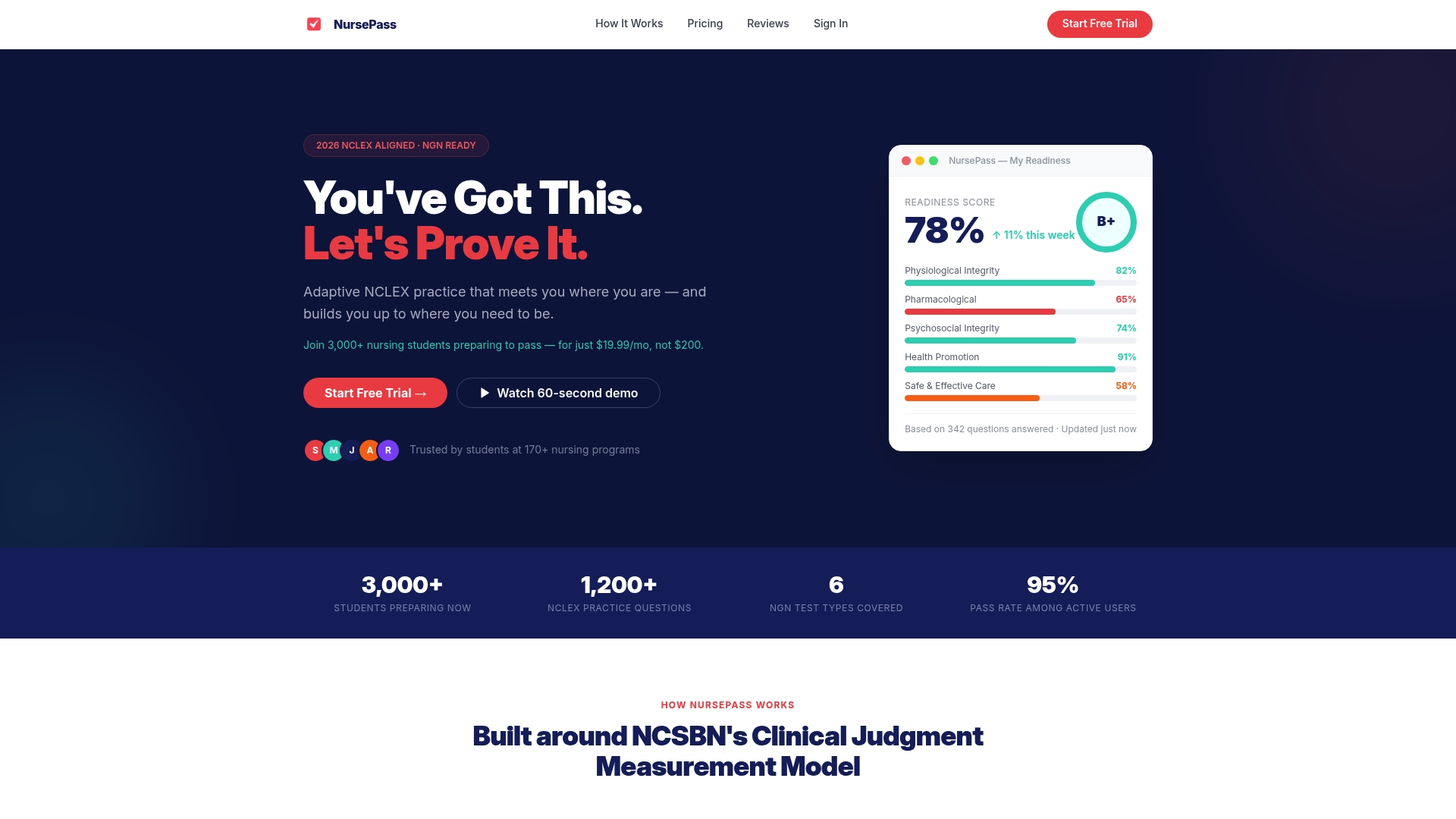
Nursepass offers over 1,200 NCLEX practice questions aligned with the NGN format, including case studies and bowtie items. The live readiness score updates after every session, giving you an objective measure of where you stand. Subcategory heat maps show exactly which CJMM steps and content areas need attention. More than 3,000 nursing students have used the platform, with a 95% pass rate among active users. Start your NCLEX preparation with Nursepass and study with a system that adapts to you.
FAQ
What is the NCLEX exam and who must take it?
The NCLEX is the National Council Licensure Examination, required for nursing licensure in the U.S. and Canada. All nursing graduates seeking RN or PN licensure must pass it before practicing legally.
How many questions are on the NCLEX in 2026?
The exam delivers between 85 and 150 questions using computerized adaptive testing. The exam ends when the algorithm reaches a statistically confident pass or fail decision, not when you hit a fixed number.
What is the NCLEX passing score?
The NCLEX does not use a percentage-based passing score. The NCSBN sets a logit-based threshold that represents the minimum competence level for safe entry-level nursing practice.
How long does it take to prepare for the NCLEX?
Preparation time varies by individual, but most candidates benefit from 4–8 weeks of structured daily study. Scheduling consistent sessions focused on clinical judgment and NGN-style practice questions produces the best results.
Can you retake the NCLEX if you fail?
Yes. Candidates who do not pass can retake the exam. Retake policies, including waiting periods and attempt limits, are set by individual state boards of nursing, so check your specific state's requirements.