
The NCLEX test plan categories are the official content framework that the National Council of State Boards of Nursing (NCSBN) uses to organize every question on the exam. The NCSBN revises this framework every three years, incorporating nurse practice acts and clinical expert input to keep the test plan current. Four major Client Needs categories anchor both the NCLEX-RN and NCLEX-PN exams, and each carries a specific percentage range that tells you exactly how many questions to expect. Knowing those ranges before you build your study plan is the single most direct way to study smarter, not longer.
What are the main NCLEX test plan categories?
The four Client Needs categories are Safe and Effective Care Environment, Health Promotion and Maintenance, Psychosocial Integrity, and Physiological Integrity. Two of those four categories break into subcategories, giving the NCLEX-RN a total of eight distinct content areas. The Client Needs framework also weaves in cross-cutting themes like clinical judgment, communication, culture, and patient teaching throughout every category.

The NCLEX-PN uses the same four parent categories but labels and scopes them differently to reflect practical nursing responsibilities. The most notable difference is that the RN plan calls the top subcategory "Management of Care," while the PN plan uses "Coordinated Care." That label shift signals a real difference in expected scope: RN candidates answer to a broader leadership and delegation standard.
The table below maps every content area for both exams side by side.
| Client Needs Category | NCLEX-RN Subcategory | NCLEX-PN Subcategory |
|---|---|---|
| Safe and Effective Care Environment | Management of Care | Coordinated Care |
| Safe and Effective Care Environment | Safety and Infection Prevention and Control | Safety and Infection Prevention and Control |
| Health Promotion and Maintenance | (single area, no subcategory) | (single area, no subcategory) |
| Psychosocial Integrity | (single area, no subcategory) | (single area, no subcategory) |
| Physiological Integrity | Basic Care and Comfort | Basic Care and Comfort |
| Physiological Integrity | Pharmacological and Parenteral Therapies | Pharmacological Therapies |
| Physiological Integrity | Reduction of Risk Potential | Reduction of Risk Potential |
| Physiological Integrity | Physiological Adaptation | Physiological Adaptation |
The NCLEX-PN drops "Parenteral" from the pharmacology label, reflecting the narrower medication administration scope of practical nurses. Both exams share Safety and Infection Prevention and Control as a parallel content area, which signals that patient safety content carries consistent weight regardless of license level.
How is content weighted across NCLEX test plan categories?
Category weighting is the most practical piece of information you can extract from the NCLEX test blueprint. The NCLEX-RN assigns Management of Care 15–21% of all questions, making it the single heaviest content area on the exam. Pharmacological and Parenteral Therapies follows at 13–19%, which means those two subcategories alone can account for more than a third of your total question count.
Here is the full NCLEX-RN content distribution alongside the NCLEX-PN equivalent.
| Content Area | NCLEX-RN % Range | NCLEX-PN % Range |
|---|---|---|
| Management of Care / Coordinated Care | 15–21% | 18–24% |
| Safety and Infection Prevention and Control | 10–16% | 10–16% |
| Health Promotion and Maintenance | 6–12% | 6–12% |
| Psychosocial Integrity | 6–12% | 9–15% |
| Basic Care and Comfort | 6–12% | 7–13% |
| Pharmacological and Parenteral Therapies / Pharmacological Therapies | 13–19% | 10–16% |
| Reduction of Risk Potential | 9–15% | 9–15% |
| Physiological Adaptation | 11–17% | 7–13% |
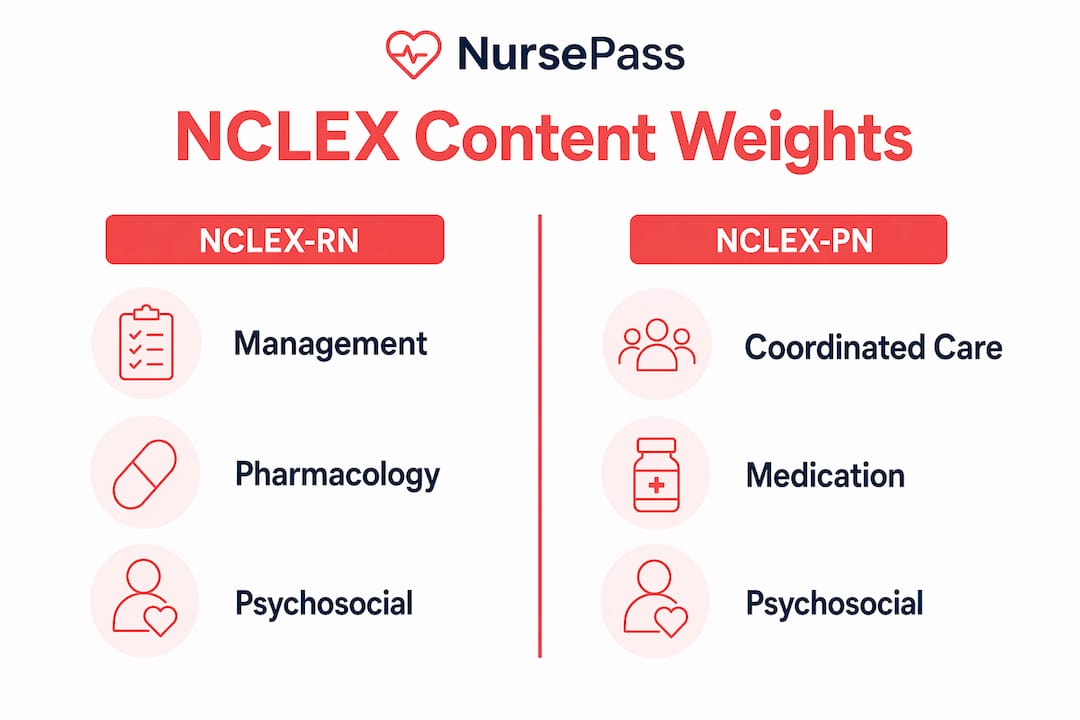
The PN exam weights Coordinated Care at 18–24%, the highest of any single content area on either exam. That reflects the practical nurse's central role in care coordination within a supervised setting.
Use these ranges to allocate your weekly study hours proportionally. If you have 10 hours a week, roughly 2 hours should go to Management of Care or Coordinated Care, and another 1.5 hours to pharmacology. That math keeps your effort aligned with actual exam exposure.
Pro Tip: Do not treat the lower bound of each range as a floor you can ignore. The exam can legally draw questions from anywhere within the range, so a week where Psychosocial Integrity hits 12% instead of 6% is entirely possible.
What are the key strategic nuances of the NCLEX content areas?
The most common mistake nursing students make is treating low-percentage categories as low-priority categories. Computer-adaptive testing means that underperforming in any category triggers harder questions and a longer exam. A weak showing in Psychosocial Integrity, even though it sits at 6–12%, can push your total question count upward and increase overall difficulty across every other category.
Category overlap is the second nuance most students miss. Pharmacological and Parenteral Therapies crosses into Physiological Integrity and Basic Care and Comfort in ways that require integrated thinking, not isolated memorization. A question about insulin administration can simultaneously test pharmacology knowledge, reduction of risk potential, and basic comfort principles. Studying each category in a silo produces gaps that the adaptive engine will find.
Common pitfalls to avoid
- Skipping Psychosocial Integrity review because the percentage range looks small
- Memorizing drug names without connecting them to physiological outcomes
- Ignoring Health Promotion and Maintenance because it feels less clinical
- Treating NCLEX difficulty increases as random rather than as a signal of category weakness
- Studying categories sequentially instead of rotating through all eight regularly
Best practices that actually work
- Review all eight content areas every week, even briefly
- Use sample test items from the official test plan to calibrate your understanding of question format per category
- Connect pharmacology questions back to the physiological system being affected
- Practice clinical judgment scenarios that blend two or more categories in a single question stem
Pro Tip: When you get a practice question wrong, tag it by category immediately. After two weeks, your error log becomes a heat map of your actual weak spots, which is far more reliable than guessing where you need work.
How can you build a study plan around NCLEX exam categories?
A category-based study plan starts with a baseline assessment, not a textbook. Take a timed set of 75 practice questions that covers all eight content areas, then sort your results by category. That sort reveals your starting point with real data rather than assumptions.
Follow these steps to build your plan from that baseline.
- List your eight content areas in order from lowest to highest accuracy. This ranking becomes your priority list for the first study block.
- Allocate weekly hours using the percentage ranges as a guide. Higher-weight categories get more time, but every category gets at least one dedicated session per week.
- Build a rotating weekly schedule. A seven-day cycle works well: two days on your two weakest categories, two days on pharmacology and physiological adaptation, and three days rotating through the remaining four areas.
- Use official resources tied directly to the test blueprint. The NCSBN publishes sample items for each category. Practicing with those items trains you to recognize how the exam frames questions within each content area.
- Reassess every two weeks. Repeat the baseline assessment format, re-sort by category accuracy, and adjust your time allocation. Categories where you have improved can receive slightly less time; new weak spots move up the priority list.
- Add specialty review for Psychosocial Integrity. This category covers therapeutic communication, mental health disorders, and crisis intervention. Many nursing students have less clinical exposure here, so dedicated review materials pay off disproportionately.
A structured NCLEX study schedule built around category weights gives you a clear framework for every study session. The goal is not to memorize facts in each category but to build the clinical judgment to apply them under exam conditions. The NCSBN's Client Needs framework is designed to mirror real nursing decisions, so studying it that way prepares you for both the exam and the job.
Pro Tip: Treat your two-week reassessment as a non-negotiable appointment. Students who skip reassessments tend to keep studying what they already know well, which feels productive but does not move the needle on weak categories.
Key Takeaways
Mastering the NCLEX test plan categories requires proportional study across all eight content areas, not just the highest-weighted ones.
| Point | Details |
|---|---|
| Four parent categories | All NCLEX questions fall under Safe and Effective Care Environment, Health Promotion and Maintenance, Psychosocial Integrity, or Physiological Integrity. |
| Heaviest RN content area | Management of Care carries 15–21% of RN questions, making it the top study priority by volume. |
| PN differs at the top | Coordinated Care leads the PN exam at 18–24%, reflecting the practical nurse's supervised coordination role. |
| Adaptive testing amplifies weak spots | Underperforming in any category, even a low-percentage one, increases exam length and difficulty. |
| Reassess every two weeks | Sorting practice results by category every two weeks keeps your study plan aligned with your actual performance gaps. |
Why I think most students study the NCLEX categories backwards
Most nursing students I have seen approach the NCLEX content areas breakdown by starting with the biggest numbers. They pour hours into Management of Care and pharmacology, feel confident, and then walk into the exam surprised by how hard the Psychosocial Integrity questions feel. The percentage ranges create a false sense of permission to deprioritize the smaller categories. That permission does not exist on a computer-adaptive exam.
The more useful mental model is to think of the eight content areas as eight locks on the same door. The exam does not open until you can turn all eight. A few locks are bigger and heavier, yes, but leaving two or three of the smaller ones untouched means the door stays shut. Students who pass consistently are not the ones who scored highest on pharmacology. They are the ones who had no catastrophic gaps anywhere.
The other thing worth saying plainly: the Client Needs framework is not just an exam structure. It is a model of how nurses actually think about patients. Understanding the client needs categories as a clinical thinking tool, not just a test category list, changes how you approach every practice question. You stop asking "what is the right answer" and start asking "what does this patient need right now." That shift is what the exam is actually testing.
The 2026 test plan has not changed the fundamental category structure, but the emphasis on clinical judgment within each category has grown. Students who treat the categories as a checklist of facts to memorize will find the exam harder than students who treat them as a framework for reasoning.
— Michael
How Nursepass maps directly to NCLEX test plan categories
Nursepass is built around the same eight content areas that appear on the NCLEX exam. Every one of its 1,200-plus practice questions is tagged to a specific category and subcategory, so your results feed directly into a subcategory heat map that shows exactly where your performance stands.
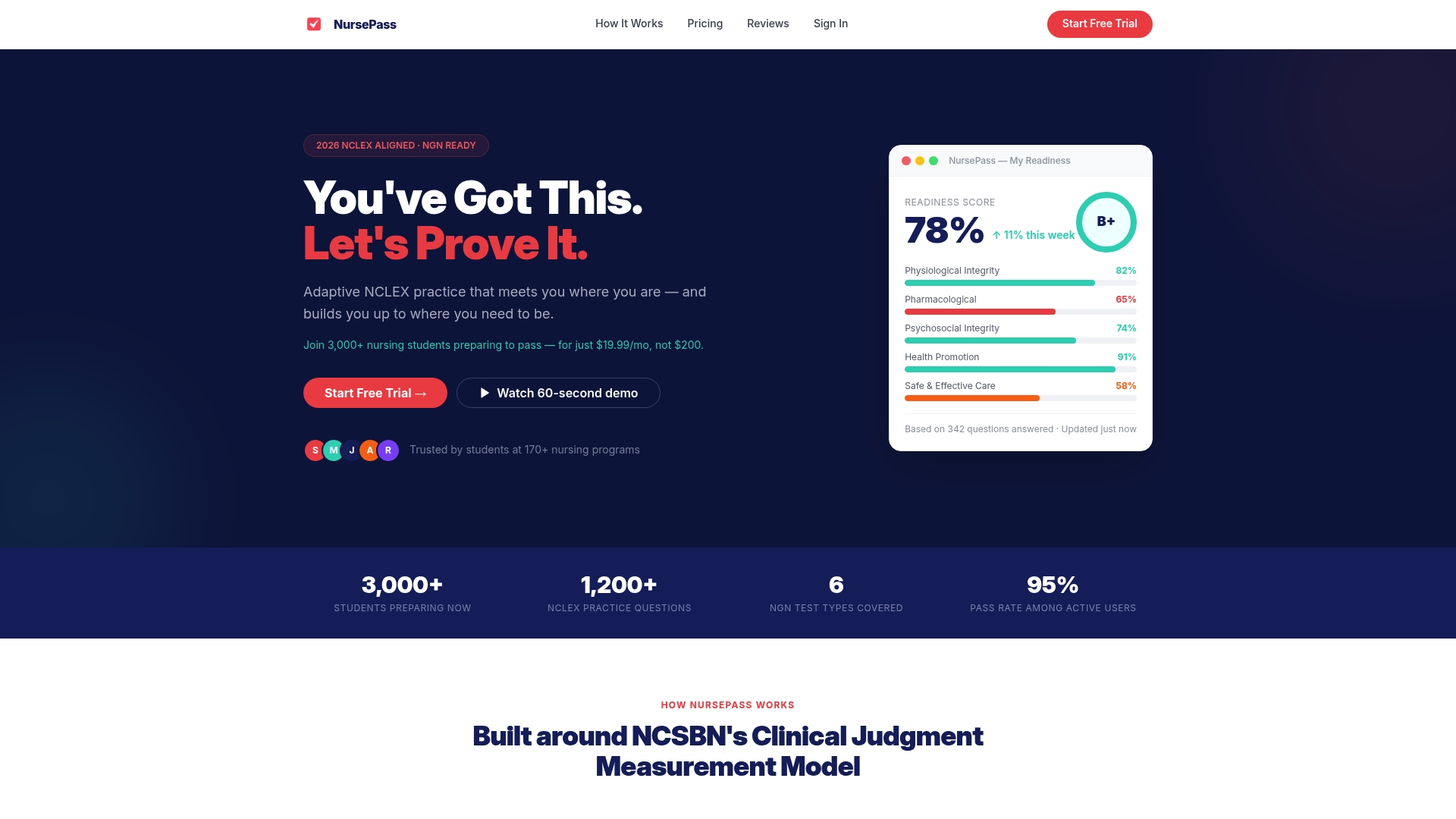
The live readiness score updates after every session, giving you a running picture of your overall exam readiness rather than a single snapshot. More than 3,000 nursing students have used Nursepass, and the platform reports a 95% pass rate among active users. If you want a study tool that organizes your preparation around the actual NCLEX exam structure, Nursepass gives you that alignment out of the box.
FAQ
What are the four main NCLEX test plan categories?
The four Client Needs categories are Safe and Effective Care Environment, Health Promotion and Maintenance, Psychosocial Integrity, and Physiological Integrity. Safe and Effective Care Environment and Physiological Integrity each split into subcategories, giving the full exam eight distinct content areas.
How does the NCLEX-RN category weighting differ from the NCLEX-PN?
The NCLEX-RN weights Management of Care highest at 15–21%, while the NCLEX-PN weights Coordinated Care highest at 18–24%. Pharmacological and Parenteral Therapies carries 13–19% on the RN exam, compared to 10–16% for Pharmacological Therapies on the PN exam.
Does studying only high-percentage categories improve your NCLEX score?
No. Computer-adaptive testing means that weakness in any category increases exam length and difficulty, regardless of that category's percentage weight. Comprehensive preparation across all eight content areas produces better outcomes than focusing only on the heaviest categories.
How often does the NCSBN update the NCLEX test plan?
The NCSBN updates the test plan every three years, incorporating current nurse practice acts and clinical expert input. The 2026 test plan is the current version for both the NCLEX-RN and NCLEX-PN exams.
Where can I find official sample questions for each NCLEX category?
The NCSBN publishes sample test items aligned to each content area within the official test plan documents. Practicing with those items helps you recognize how the exam frames questions within each specific category.