
Nursing board exam eligibility is the set of criteria candidates must fulfill to qualify for the NCLEX, the standardized nurse licensure exam administered throughout the U.S. and Canada. The National Council of State Boards of Nursing (NCSBN) and individual state boards of nursing jointly define these criteria. Meeting them is not automatic after graduation. You must satisfy educational, legal, and procedural requirements before you can sit for the exam. Understanding exactly what those requirements are, and in what order to complete them, is the difference between a smooth application and a costly delay.
What is nursing board exam eligibility, and who sets the rules?
Nursing board exam eligibility is defined as the formal authorization granted by a state board of nursing confirming that a candidate meets all prerequisites to register for and sit the NCLEX. The NCSBN sets the national framework, but each state board applies and enforces the specific criteria within its jurisdiction. That distinction matters because eligibility rules vary by state, and what qualifies you in one state may not automatically qualify you in another.
The NCLEX itself tests nursing knowledge and clinical judgment skills required for safe entry-level practice. It is not an academic grade or a graduation requirement. It is a licensure gatekeeper. The state board and NCSBN use it as the final measure of whether a candidate is ready to practice safely. Passing the exam is what converts your nursing degree into an active license.

Two separate tracks exist: the NCLEX-RN for registered nurse candidates and the NCLEX-PN for practical nurse candidates. Both tracks share the same core eligibility framework, but the specific educational programs and clinical hour requirements differ. Knowing which track applies to you shapes every step of the eligibility process.
What are the educational requirements for board exam eligibility?
Graduation from an approved nursing program is the foundation of nursing exam requirements. The program must hold accreditation from the Accreditation Commission for Education in Nursing (ACEN) or the Commission on Collegiate Nursing Education (CCNE), or carry state board approval. Beyond accreditation, the program must have an NCLEX code issued by NCSBN. Without that code, your graduation does not satisfy the educational eligibility criterion, regardless of your academic record.
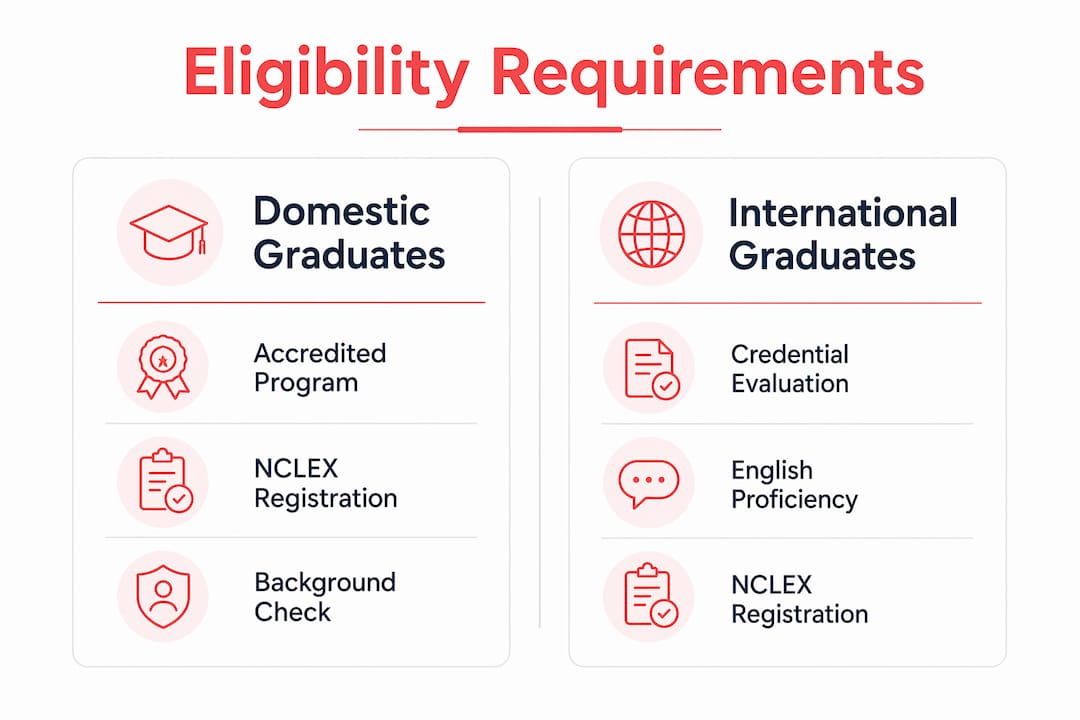
Approved programs include Associate Degree in Nursing (ADN), Bachelor of Science in Nursing (BSN), and other pre-licensure formats. RN candidates must complete an RN-track program, while PN candidates must complete a practical nursing program. The distinction is not interchangeable. Submitting transcripts from the wrong program type will result in an ineligible determination from the state board.
Credential verification is the process by which the state board confirms your program meets all requirements. You submit official transcripts directly from your school to the board. The board then checks accreditation status and NCLEX code validity before approving your application.
- Graduate from an ACEN, CCNE, or state-approved nursing program
- Confirm your program holds a valid NCLEX code through NCSBN
- Submit official transcripts to your state board as part of the licensure application
- Verify whether your program qualifies for RN or PN track eligibility
- Request transcript submission early, since processing times vary by institution
Pro Tip: If you attended nursing school outside the U.S., start the credential evaluation process at least six months before your target exam date. Internationally educated nurses must have their education verified through a credential evaluation service, and that verification process can take several months.
What legal and administrative steps must candidates complete?
Eligibility is not purely academic. Legal and administrative steps form a required layer of the board exam eligibility criteria that many candidates underestimate until they are already behind schedule.
-
Pass a criminal background check. Most states require fingerprint submission and a criminal background check as a condition of licensure eligibility. Some states review results before granting eligibility; others review them concurrently. A prior conviction does not automatically disqualify you, but it requires disclosure and board review.
-
Submit your state board licensure application. The state board application is separate from NCLEX registration. You apply to the board for a nursing license, and the board independently determines your eligibility. This application includes transcripts, background check results, and applicable fees.
-
Register with Pearson VUE for the NCLEX. After submitting your state board application, you register separately with Pearson VUE, the exam administrator. You pay the $200 NCLEX registration fee to NCSBN at this stage. Both applications must be approved before you receive your Authorization to Test.
-
Receive your Authorization to Test (ATT). The ATT arrives by email after both the state board and Pearson VUE approve your applications. Candidates typically receive the ATT 2–8 weeks after state board approval and Pearson VUE registration processing. The ATT has an expiration date, so you must schedule and sit the exam within that window.
-
Schedule your exam through Pearson VUE. Once you hold a valid ATT, you log into the Pearson VUE portal and select a test date and location. You cannot schedule before receiving the ATT.
Pro Tip: Submit your state board application and your Pearson VUE registration within the same week. Coordinating both applications simultaneously reduces the gap between approvals and shortens your wait for the ATT.
How do eligibility criteria differ for international graduates and retakers?
Standard board exam eligibility criteria apply to all candidates, but two groups face additional requirements: internationally educated nurses and candidates retaking the exam.
Internationally educated nurses
Nurses who completed their education outside the U.S. must demonstrate that their credentials are equivalent to American standards. This means submitting to a credential evaluation service that reviews program length, clinical hours, and curriculum content. The evaluation must confirm the program held an NCLEX code or its international equivalent recognized by NCSBN.
English language proficiency is also mandatory in many states when the nursing program was not conducted in English. Accepted exams include the Occupational English Test (OET), the Test of Spoken English (TSE), and the Test of Written English (TWE). Texas, for example, requires a minimum score of 50 on the TSE and 4.0 on the TWE. These scores verify reading, writing, listening, and speaking ability at a level sufficient for safe clinical practice.
| Requirement | Domestic Graduates | International Graduates |
|---|---|---|
| Approved program graduation | Required | Required, plus credential evaluation |
| NCLEX code verification | Via transcript | Via credential evaluation service |
| English proficiency exam | Not required | Required if program not in English |
| Background check | Required | Required |
| ATT process | Standard | Standard, after credential approval |
Retakers
Candidates who did not pass the NCLEX on a previous attempt face time-based eligibility limits. In Texas, retakers must sit the exam within 4 years of graduation or complete a new initial nursing education program. Refresher courses do not satisfy this requirement. That rule catches many candidates off guard, particularly those who delayed retaking the exam due to personal circumstances.
- Confirm your state's retake time limit before assuming you are still eligible
- Contact your state board directly if you are approaching or past the time limit
- Understand that only a new approved nursing program, not a refresher course, restores eligibility after the deadline
What is the step-by-step process for confirming your eligibility?
Confirming nursing license eligibility follows a defined sequence. Skipping or reordering steps creates delays that push back your ATT and exam date.
-
Graduate from an approved nursing program. Your program must hold ACEN, CCNE, or state board approval and carry a valid NCLEX code. Graduation is the trigger for everything that follows.
-
Submit your licensure application to the state board. Include official transcripts, background check results, fingerprints, and all required fees. International applicants also submit credential evaluation reports at this stage.
-
Register for the NCLEX with Pearson VUE. Pay the $200 registration fee. This step runs parallel to, not after, your state board application. Both applications must be complete for the ATT to be issued.
-
Receive your ATT by email. The ATT confirms full eligibility. It includes your candidate ID, eligibility period, and instructions for scheduling. Do not attempt to schedule before this email arrives.
-
Schedule and sit the exam. Log into Pearson VUE, select your test center and date, and confirm your appointment. Arrive with valid government-issued photo ID that matches your ATT exactly.
The Next Generation NCLEX format, introduced in 2023, emphasizes clinical judgment more heavily than previous versions. Eligibility requirements have not changed, but the exam itself demands stronger reasoning skills. Understanding the NCLEX passing standard before you sit helps you calibrate your preparation accurately.
Pro Tip: Allow at least four weeks between submitting both applications and your target exam date. Processing times vary by state, and holiday periods or high-volume seasons can extend ATT delivery beyond the typical 2–8 week window.
Key Takeaways
Nursing board exam eligibility requires completing educational, legal, and procedural steps set by your state board and NCSBN before you can register for or sit the NCLEX.
| Point | Details |
|---|---|
| Educational foundation | Graduate from an ACEN, CCNE, or state-approved program with a valid NCLEX code. |
| Dual application process | Apply to your state board and Pearson VUE separately; both must approve before ATT is issued. |
| ATT timeline | Expect 2–8 weeks after both approvals before receiving your Authorization to Test by email. |
| International applicants | Credential evaluation and English proficiency exams are required and can take several months. |
| Retaker limits | Most states impose time limits; past the deadline, a new nursing program is required, not a refresher course. |
Why eligibility trips up more candidates than the exam itself
Most nursing students treat eligibility as a formality. They assume that graduating from nursing school is enough to get them into the testing room. That assumption causes more delays than any study gap ever will.
The paperwork layer is where things fall apart. A background check submitted to the wrong agency, a transcript sent by the student instead of the school, or a Pearson VUE registration that precedes the state board application by too many weeks. Each of these creates a bottleneck that no amount of studying can fix. I have seen candidates who were fully prepared for the NCLEX sit idle for two months because their ATT was held up by a procedural error they did not know they had made.
International applicants face an even steeper administrative climb. The credential evaluation process is not a rubber stamp. Evaluators look at curriculum content, clinical hours, and program authorization. If your program does not map cleanly to U.S. standards, the evaluation can come back with conditions that require additional documentation. Starting that process six months out is not cautious. It is the minimum.
State-by-state variation is the other factor candidates consistently underestimate. Texas has explicit retake deadlines and English proficiency score minimums. Florida has its own credential evaluation pathway. What is standard in one state may be an exception in another. The only reliable source for your specific requirements is your state board's official website, not a forum post or a classmate's experience from a different state.
Eligibility is a gatekeeper, not a formality. Treat the application process with the same rigor you bring to your NCLEX self-study plan, and you will not lose weeks to preventable delays.
— Michael
How Nursepass helps you prepare once you are eligible
Once your eligibility is confirmed and your ATT is in hand, the real work begins: preparing to pass the NCLEX on your first attempt.
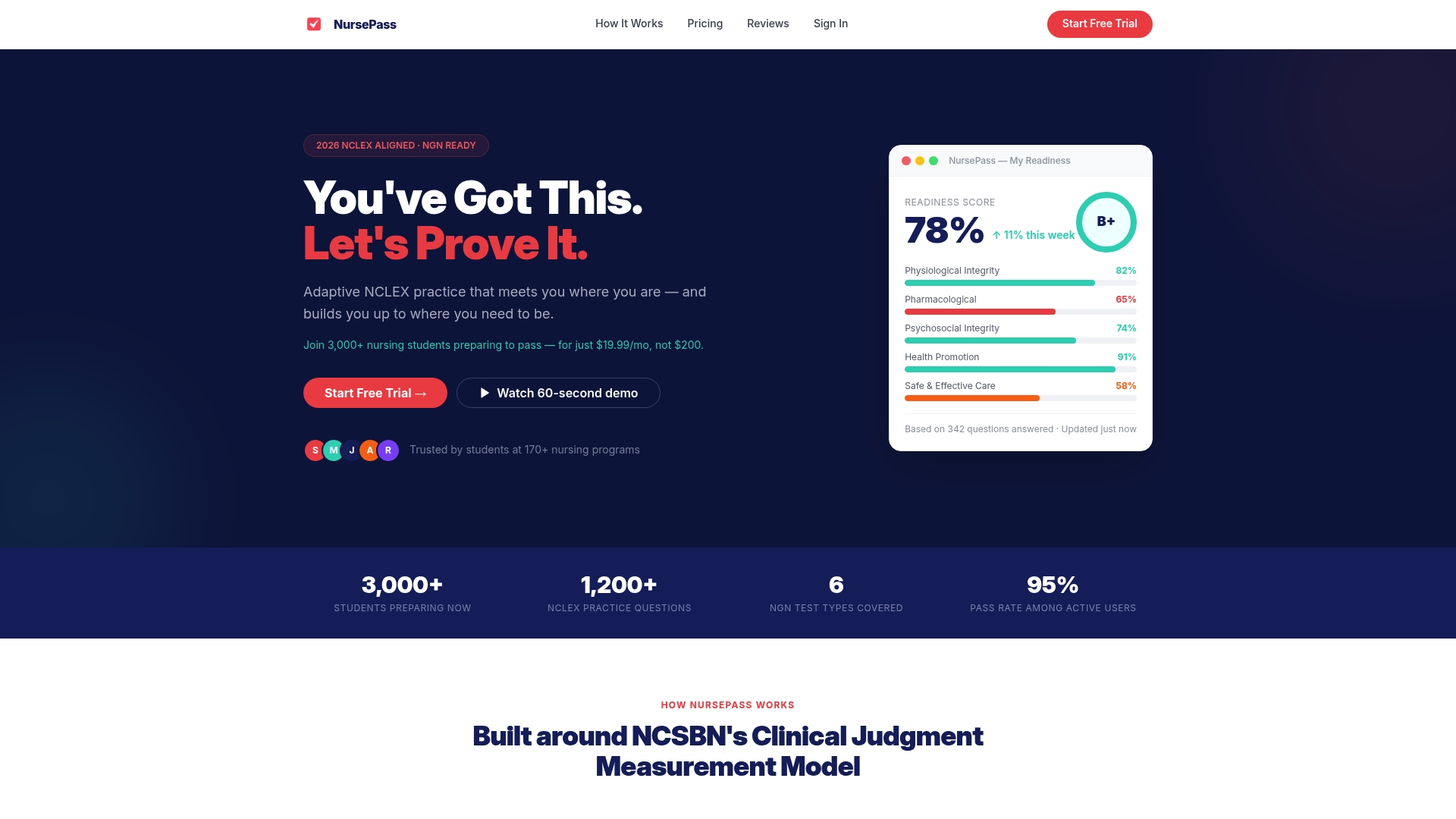
Nursepass is built specifically for nursing students at this stage. The platform offers over 1,200 NCLEX practice questions delivered through an adaptive engine that adjusts to your current competency level. A live readiness score shows you exactly where you stand, and subcategory heat maps identify the clinical areas that need the most attention. More than 3,000 nursing students have used Nursepass, with a 95% pass rate among active users. Visit Nursepass to start building the exam readiness your eligibility has earned you.
FAQ
What is nursing board exam eligibility?
Nursing board exam eligibility is the formal authorization from a state board of nursing confirming a candidate meets all educational, legal, and procedural requirements to sit the NCLEX. Both the state board and NCSBN must approve the candidate before an Authorization to Test is issued.
Who can take the nursing board exam?
Any candidate who has graduated from an ACEN, CCNE, or state-approved nursing program with a valid NCLEX code, passed a criminal background check, and completed both the state board licensure application and Pearson VUE registration can take the NCLEX.
How long does it take to receive the Authorization to Test?
Candidates typically receive their ATT 2–8 weeks after both the state board and Pearson VUE approve their applications. Processing times vary by state and application volume.
Do international nursing graduates have different eligibility requirements?
Yes. Internationally educated nurses must complete a credential evaluation to verify their education meets U.S. standards and may need to pass English proficiency exams such as the OET, TSE, or TWE with required minimum scores set by their state board.
Can I retake the NCLEX if I failed it previously?
Yes, but time limits apply. In Texas, retakers must sit the exam within 4 years of graduation or complete a new nursing education program. Refresher courses do not satisfy the re-education requirement. Check your specific state board for its retake policy.