
The NCLEX difficulty increases because the exam adapts in real time to every answer you give, pushing harder questions the moment you demonstrate competence. This is not a flaw in the test design. It is the entire point. Understanding why nclex difficulty increases, specifically through computerized adaptive testing (CAT) and the Next Generation NCLEX (NGN) clinical judgment model, is the first step toward preparing for it effectively. The National Council of State Boards of Nursing (NCSBN) built this system to measure safe nursing practice, not to trick you. Once you understand the mechanics, the exam becomes far less intimidating.
How computerized adaptive testing shapes NCLEX difficulty
Computerized adaptive testing is the engine behind every NCLEX exam. The algorithm starts each candidate at a medium difficulty level, then adjusts after every single response. Answer correctly, and the next question gets harder. Answer incorrectly, and the difficulty drops slightly before climbing again. The result is an exam that feels relentless because it is always working at the edge of your ability.
The test does not stop at a fixed number of questions. The CAT algorithm ends when it reaches 95% confidence that a candidate is either above or below the passing standard. Question count varies from 75 to 150. That range matters because it means a candidate who finishes at 75 questions is not necessarily doing better or worse than one who answers 150. The number of questions reflects how quickly the algorithm reached a confident decision, nothing more.
Here is how the process unfolds in sequence:
- Starting point. Every candidate begins at medium difficulty, regardless of GPA or school ranking.
- Correct answer. The algorithm serves a harder question to test the upper boundary of your ability.
- Incorrect answer. The algorithm drops difficulty slightly, then works back upward.
- Confidence threshold. Once the system is 95% confident in a pass or fail decision, the exam ends.
- Final determination. The last ability estimate, not the number of questions, decides the outcome.
The practical implication is clear: if your questions feel increasingly hard, you are likely performing well. That sensation of difficulty is the algorithm tracking your competence upward.
Pro Tip: Never try to guess whether you are passing based on question count or perceived difficulty. The exam adapts to performance patterns, not feelings. Guessing your outcome mid-exam creates anxiety that hurts your next answer.
What is the Next Generation NCLEX and why does it feel harder?
The Next Generation NCLEX, launched by NCSBN, restructured the exam around clinical judgment rather than factual recall. Traditional nursing school exams reward memorization. The NGN rewards reasoning. That shift is the single biggest reason candidates who studied hard in school still find the NCLEX unexpectedly difficult.
The NGN uses the NCSBN Clinical Judgment Measurement Model (NCJMM), which breaks clinical reasoning into six steps:
- Recognize cues: Identify relevant patient data from a scenario
- Analyze cues: Determine what the data means for the patient's condition
- Prioritize hypotheses: Rank possible explanations by urgency and likelihood
- Generate solutions: Identify appropriate nursing interventions
- Take action: Select the correct intervention from the options given
- Evaluate outcomes: Assess whether the intervention worked
Each step requires integrated reasoning beyond recall, which is why the cognitive load is higher than anything most nursing programs test directly. A question might present a full patient scenario, lab values, vital signs, and a medication list, then ask you to identify which two findings are most concerning. That is not a memorization task. It is a reasoning task.
The 2026 NCLEX test plan continues integrating clinical judgment case studies and stand-alone items, making questions harder to guess and requiring genuine application. About 10% of exam content consists of clinical judgment items aligned with NGN methodology. That percentage is small but concentrated in difficulty.

| Feature | Traditional NCLEX questions | NGN clinical judgment items |
|---|---|---|
| Cognitive demand | Recall and recognition | Analysis, prioritization, application |
| Format | Single standalone question | Case studies with 6 linked items |
| Skill tested | Knowledge of facts | Clinical reasoning across a patient scenario |
| Preparation method | Memorization and review | Practice with reasoning frameworks |
Pro Tip: Work through NGN case studies in timed conditions. Six-item case study sets can take 10–12 minutes total, roughly double the time of a standard item. Practice pacing now so timing does not become a stressor on exam day.
How does the NCLEX test plan change over time?
NCSBN conducts a practice analysis every three years. Nurses across the country report which tasks they perform, how often, and how critical those tasks are to patient safety. That data directly shapes the NCLEX test plan, shifting content weighting to reflect real nursing duties. Tasks that nearly all new nurses perform gain more emphasis. Tasks that are rare or delegated away lose weight.
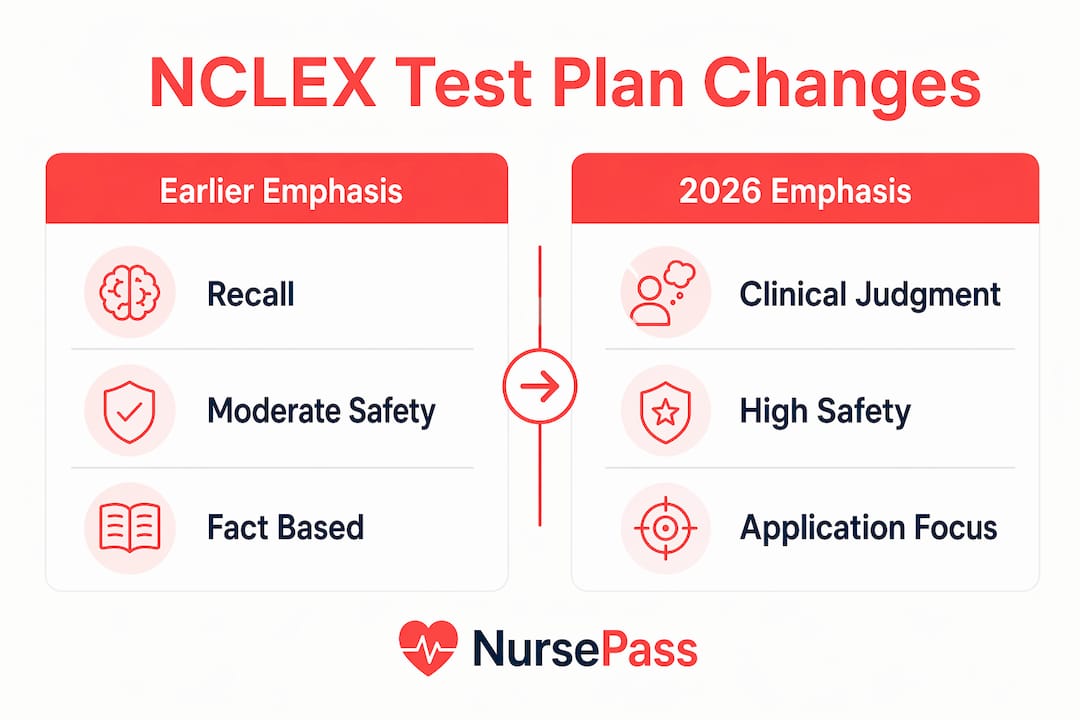
The table below shows how content emphasis has shifted in recent test plans:
| Content area | Earlier emphasis | Current 2026 emphasis |
|---|---|---|
| Infection control and safety | Moderate | Increased |
| Delegation and supervision | Low to moderate | Increased |
| Pharmacological calculations | High | Maintained |
| Clinical judgment integration | Minimal | Significantly increased |
| Health promotion and maintenance | Moderate | Slightly reduced |
These shifts matter because nursing school curricula do not always keep pace. A program that still emphasizes health promotion over delegation and infection control will leave graduates underprepared for the current exam. Practice analysis updates change test plan content weighting to reflect actual nursing duties, and misaligned coursework is a direct cause of candidates finding the test harder than expected.
The 2026 test plan reflects a healthcare environment shaped by post-pandemic nursing realities. Infection control, delegation to unlicensed personnel, and rapid clinical decision-making are now front-line skills for new graduates. The NCLEX tests what nurses actually do, and what nurses actually do has changed.
Common NCLEX exam challenges and how to study smarter
The most common NCLEX exam struggle is not lack of knowledge. It is applying knowledge under pressure to unfamiliar patient scenarios. Candidates who score well on nursing school exams often hit a wall with the NCLEX because the question style is fundamentally different.
The following challenges show up repeatedly among candidates who struggle:
- Test anxiety from adaptive difficulty. Harder questions feel like failure. They are not. They are evidence the algorithm is tracking your ability upward.
- Rote memorization habits. Nursing school rewards recall. The NCLEX rewards reasoning. Candidates who study by reading and re-reading notes are practicing the wrong skill.
- Weak spots in the clinical judgment pipeline. Most candidates do not struggle equally across all six NCJMM steps. Diagnosing exactly which step, whether cue recognition, hypothesis prioritization, or solution generation, causes the most errors allows targeted remediation rather than broad review.
- Poor pacing on case studies. NGN case studies require sustained focus across six linked questions. Candidates who rush or lose context midway through a case set make avoidable errors.
- Overconfidence in familiar content. Effective NCLEX preparation focuses on clinical judgment skills and targeted remediation rather than passive review of content that already feels comfortable.
The shift from memorization to application is the defining study adjustment for the NGN era. Passive reading does not build the reasoning skills the exam tests. Active practice with scenario-based questions, followed by detailed review of why each answer is correct or incorrect, does.
Pro Tip: After each practice session, identify which NCJMM step caused your wrong answers. If you consistently miss "prioritize hypotheses" questions, that step is your remediation target. Broad review wastes time. Targeted remediation builds competence.
Time management is also a real factor. Allocating roughly two minutes per standard item is a common guideline. NGN case studies may take 10–12 minutes for a full six-item set. Practicing under timed conditions before exam day removes the surprise of that pacing shift.
Key Takeaways
The NCLEX difficulty increases by design: the CAT algorithm and NGN clinical judgment model work together to measure your true competence, not just your ability to memorize facts.
| Point | Details |
|---|---|
| CAT drives difficulty upward | Harder questions after correct answers mean the algorithm is tracking your competence, not punishing you. |
| NGN tests reasoning, not recall | Six-step clinical judgment questions require analysis and prioritization, not memorization of isolated facts. |
| Test plan shifts with practice | NCSBN updates content weighting every three years based on real nursing duties, so coursework gaps create exam gaps. |
| Question count is not a verdict | Finishing at 75 or 150 questions reflects algorithm confidence speed, not pass or fail status. |
| Targeted study beats broad review | Identifying your weakest NCJMM step and drilling it directly is more effective than reviewing all content equally. |
The hardest part of the NCLEX is accepting what it actually tests
I have worked with nursing students for years, and the pattern is consistent. The students who struggle most with the NCLEX are not the ones who studied least. They are the ones who studied the wrong way for the longest time.
Nursing school trains you to know things. The NCLEX tests whether you can use what you know when a patient's life depends on it. Those are different skills, and the gap between them is where most candidates get stuck. I have seen students with near-perfect ATI scores walk out of the NCLEX shaken because the questions felt nothing like what they practiced. That is not bad luck. That is a preparation mismatch.
The adaptive format makes this worse psychologically. When questions get harder, the instinct is to panic. The correct response is to recognize that harder questions are a signal, not a threat. The algorithm is doing its job. Your job is to keep reasoning clearly through each scenario without letting the perceived difficulty derail your focus.
The NGN shift toward clinical judgment is actually good news for nursing practice, even if it is uncomfortable for exam preparation. Nurses who can recognize cues, prioritize hypotheses, and evaluate outcomes are safer nurses. The exam is harder because the standard is higher. That is worth understanding before you sit down to test.
My strongest recommendation: stop reviewing content you already know and start practicing the reasoning steps you find hardest. Use performance data to guide that decision. Gut feelings about your weak areas are usually wrong.
— Michael
Nursepass: built for the way the NCLEX actually works
Preparing for an exam that adapts to your performance requires a study tool that does the same thing.
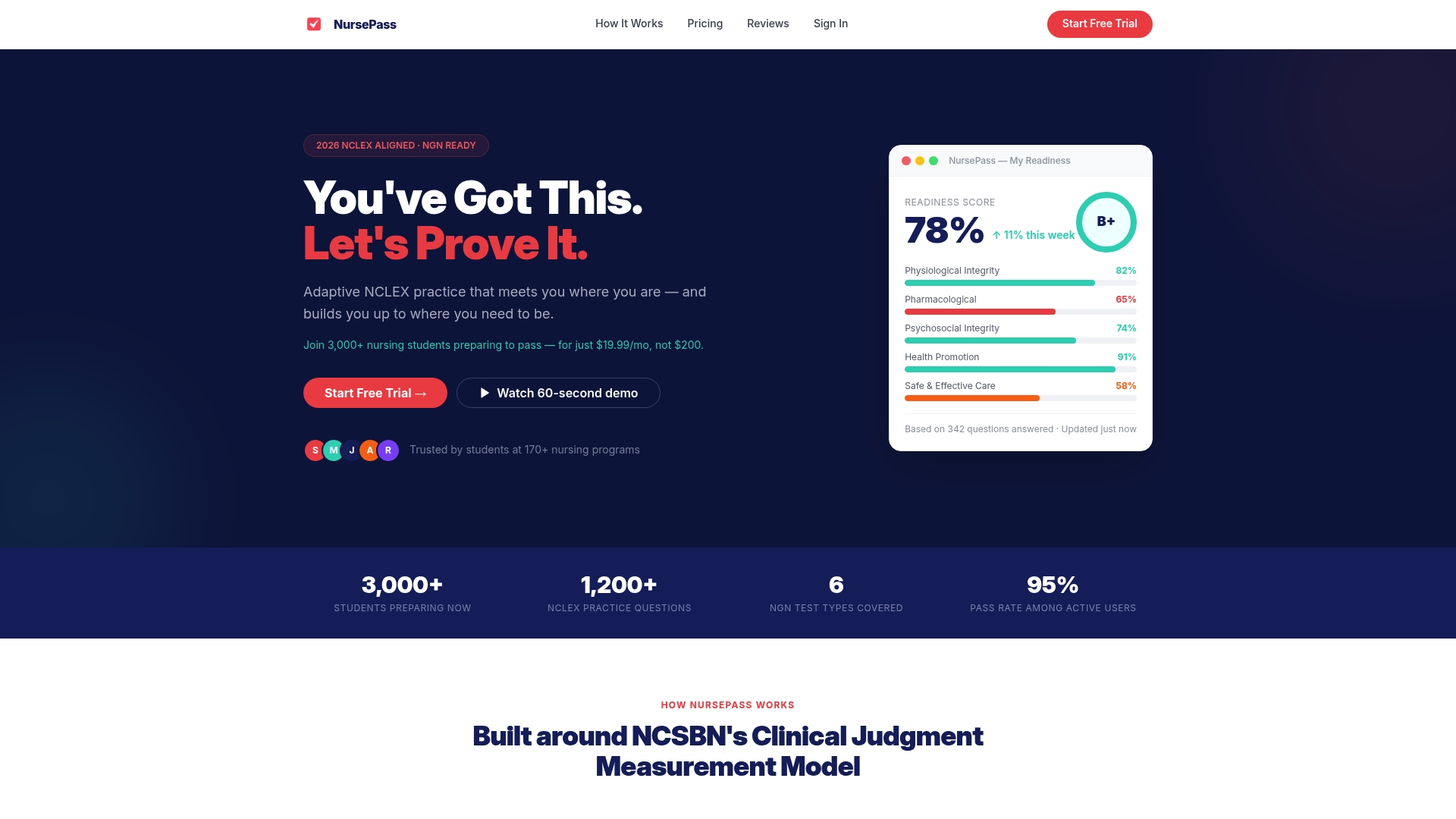
Nursepass offers over 1,200 NCLEX practice questions built around the NGN clinical judgment model and CAT format. Its adaptive engine adjusts question difficulty based on your current competency, so you are always practicing at the right level. The live readiness score and subcategory heat maps show exactly where your reasoning breaks down, by NCJMM step and content area, so you can study with focus rather than guessing what to review next. More than 3,000 nursing students have used Nursepass, with a 95% pass rate among active users. If you are preparing for the 2026 NCLEX, that kind of targeted feedback is not optional. It is the difference between broad review and real preparation.
FAQ
Why does the NCLEX get harder as you answer correctly?
The NCLEX uses computerized adaptive testing, which serves harder questions after correct answers to find the upper boundary of your ability. The algorithm needs 95% confidence in a pass or fail decision before the exam ends.
Does finishing the NCLEX at 75 questions mean you passed?
No. The final question count reflects how quickly the algorithm reached a confident decision, not whether you passed or failed. Candidates can pass or fail at any point in the 75–150 question range.
What makes the Next Generation NCLEX harder than older versions?
The NGN tests clinical judgment through six reasoning steps rather than factual recall. Case study sets require sustained reasoning across linked questions, which demands a higher level of cognitive effort than traditional single-item formats.
How should I change my study habits for the 2026 NCLEX?
Replace passive content review with active practice on scenario-based questions. Identify which clinical judgment step causes the most errors and target that step directly. Timed practice with NGN case studies builds both reasoning skill and pacing.
Why do nursing school grades not always predict NCLEX performance?
Nursing school exams primarily test memorization and recall. The NCLEX tests clinical reasoning and application, which are different cognitive skills. Strong grades reflect content knowledge, not necessarily the reasoning ability the NCLEX measures.