
An effective NCLEX study schedule checklist is a systematic framework that guides nursing students through daily and weekly study tasks to build clinical judgment before exam day. The most successful candidates treat this checklist not as a loose to-do list but as a structured exam study plan with defined milestones, content blocks, and question targets. Research shows that first-time candidates typically complete 2,000 to 3,000 practice questions total. That volume is not accidental. It reflects a deliberate NCLEX preparation checklist built around consistent daily practice, targeted content review, and scheduled self-assessment.
1. what goes on every NCLEX study schedule checklist?
A strong NCLEX preparation checklist starts with four non-negotiable elements: daily study hours, daily question targets, weekly content focus areas, and test-day logistics. Every other item builds on top of these four.
Daily study hours and question targets form the backbone of any study schedule for NCLEX. The optimal prep window is 6 to 12 weeks, with 2 to 4 hours of focused study and 25 to 100 practice questions per day. Skipping days or cramming 200 questions in one sitting both undermine retention.

Weekly content blocks should align with the NCLEX Client Needs categories. Organizing study blocks around Management of Care, Safety and Infection Control, and Physiological Integrity helps scaffold clinical reasoning week by week. Jumping randomly between topics breaks that scaffolding.
Self-assessment checkpoints belong on every checklist. Schedule a full-length practice exam at the midpoint of your prep and again one week before test day. These exams give you objective data, not just a feeling of readiness.
Test-day logistics are a checklist item most students skip until the last minute. Confirming your Pearson VUE test center location, ID requirements, and Authorization to Test (ATT) details belongs in your prep plan from week one.
Performance tracking closes the loop. Tools that show you subcategory-level accuracy let you redirect study time toward real weak spots instead of topics you already know.
Pro Tip: Keep a daily study log. Write down which topics you covered, how many questions you attempted, and your accuracy rate. Reviewing that log weekly reveals patterns you would never notice otherwise.
2. how to customize your checklist for 4, 6, 8, or 12 weeks
The right study schedule for NCLEX depends on how much time you have before your exam date. Each timeline demands a different pacing strategy.
The 4-week sprint
A four-week checklist is an intensive approach suited for students who recently graduated and have strong baseline knowledge. You need 3 to 4 hours of study per day and 75 to 100 questions daily to hit the 2,000-question minimum. Content review is minimal. The focus is almost entirely on question practice and rationale review.
The 6 to 8-week balanced plan
This is the most common NCLEX exam study plan timeline. Weeks one and two focus on content review by category. Weeks three through five shift to mixed question practice with daily rationale review. Weeks six through eight emphasize full-length practice exams and weak-area drilling. Combining prep resources like Saunders, UWorld, and NCLEX Bootcamp works well within this structure.
The 12-week extended checklist
A 12-week plan fits working students, repeat test-takers, or anyone who needs more time to build clinical reasoning from the ground up. Daily commitments drop to 1.5 to 2 hours, but the question volume still needs to reach 2,000 to 3,000 by exam week. Burnout prevention is a real concern at this length. Schedule one full rest day per week from the start.
Timeline comparison
| Timeline | Daily Study Hours | Daily Questions | Full Practice Exams |
|---|---|---|---|
| 4 weeks | 3–4 hours | 75–100 | 2 (midpoint + final week) |
| 6–8 weeks | 2–3 hours | 50–75 | 2–3 |
| 12 weeks | 1.5–2 hours | 25–50 | 3–4 |
Pro Tip: Schedule your full-length practice exams on your calendar before you start studying. Treat them like real exam appointments. Students who skip these milestone exams often misjudge their readiness.
3. why pharmacology and clinical judgment must lead your checklist
Pharmacology is the single highest-yield weak spot for NCLEX test-takers. Candidates should dedicate 20 to 30 percent of total study time to pharmacology. That translates to roughly 30 to 45 minutes of every study session in a standard 6-week plan.
The reason pharmacology demands this weight is straightforward. Drug class knowledge underpins dozens of clinical judgment questions across every NCLEX category. A student who cannot connect a beta-blocker to its cardiac effects will miss questions in Physiological Integrity, Pharmacological Therapies, and Reduction of Risk Potential simultaneously.
Build pharmacology into your checklist systematically. Cover one drug class per day during content review weeks. Use active recall by writing drug names, mechanisms, and nursing considerations from memory before checking your notes. Spaced repetition tools like Anki reinforce this without adding hours to your schedule.
Clinical judgment practice requires a different checklist item: Next Generation NCLEX (NGN) case studies. These multi-part questions test your ability to recognize cues, prioritize hypotheses, and evaluate outcomes. Reading rationales is not enough. You need to work through the reasoning process on each case.
"Building 'reflex' clinical judgment through massive question exposure outperforms content memorization every time. The NCLEX does not test what you know. It tests how you think." — Expert NCLEX Preparation Insights
Add these specific items to your pharmacology and clinical judgment checklist block:
- Review one drug class per study day during content weeks
- Complete at least 10 NGN-style case study questions per week
- Write a one-sentence rationale for every wrong answer before moving on
- Flag drug questions by category in your tracking tool to spot recurring gaps
- Allocate the first 30 minutes of each session to pharmacology before fatigue sets in
High-volume question practice builds the clinical reasoning reflex that pharmacology-heavy questions demand. Re-reading textbook chapters does not replicate that process.
4. what NCLEX exam day preparation belongs on your checklist?
NCLEX exam day preparation is not a last-minute task. It belongs on your checklist from the moment you schedule your test date. Logistical failures on test day disqualify candidates who are academically ready.
Here are the test-day checklist items every nursing student needs:
-
Confirm your test appointment. Log into your Pearson VUE account at least 48 hours before your exam to verify the date, time, and location. Errors happen, and catching them early gives you time to fix them.
-
Verify your ID matches your ATT exactly. Test-day disqualification often comes from a name mismatch between your government-issued ID and your Authorization to Test. Check every character, including middle names and suffixes.
-
Scout your route the day before. Drive or map the route to the test center. Identify parking, the entrance, and any construction delays. Arriving stressed from a navigation problem costs you mental energy you cannot afford to lose.
-
Arrive 30 minutes early. Check-in and verification add 1 to 2 hours beyond your actual exam time. Arriving late can forfeit your appointment entirely.
-
Pack only permitted items. Pearson VUE test centers prohibit phones, notes, and most personal items. Know what you can bring, including approved snacks for breaks, and prepare your bag the night before.
-
Plan your physical and mental state. Sleep at least 7 hours the night before. Eat a real meal before the exam. Avoid cramming the morning of your test. Your brain consolidates information during sleep, not during a last-minute review session.
-
Plan your break strategy. The NCLEX allows optional breaks. Decide in advance whether you will take them and at what point. Having a plan prevents you from losing time to indecision during the exam.
Key takeaways
A structured NCLEX study schedule checklist built around consistent question practice, targeted content blocks, and logistical preparation is the most reliable path to passing on your first attempt.
| Point | Details |
|---|---|
| Question volume is non-negotiable | Complete 2,000 to 3,000 practice questions across your full prep window. |
| Match your timeline to your situation | Choose 4, 6–8, or 12 weeks based on your baseline knowledge and daily availability. |
| Pharmacology demands dedicated time | Allocate 20 to 30 percent of total study time to drug class review and application. |
| Test-day logistics are part of the checklist | Verify your ATT name match and test center details at least 48 hours before exam day. |
| Track performance by subcategory | Use data from practice sessions to redirect study time toward real weak spots. |
What i've learned from watching students build their checklists
Most students build their NCLEX study schedule checklist backward. They start with content review and treat question practice as something they will get to eventually. By week three, they are behind on questions, behind on pharmacology, and starting to panic. The checklist becomes a source of anxiety instead of a tool for confidence.
The students who pass consistently do the opposite. They anchor their checklist to question volume first, then fill in content review around it. They treat rationale review as sacred. Skipping the rationale on a wrong answer is the single most common mistake I see, and it is also the most damaging. You do not learn from getting a question wrong. You learn from understanding exactly why the correct answer is correct.
I also want to push back on the idea that more resources equal better preparation. Saunders, UWorld, and NCLEX Bootcamp are all strong tools. But students who use all three simultaneously without a tracking system end up scattered. Pick two resources, commit to them, and use performance data to guide where you spend your time. Nursepass does this well with its subcategory heat maps and live readiness score, which show you exactly where your time pays off most.
One more thing: do not skip the full-length practice exams. Students who skip them almost always overestimate their readiness. These exams are not just practice. They are the most honest feedback your checklist will ever give you.
— Michael
Build your personalized NCLEX prep plan with Nursepass
Knowing what belongs on your checklist is one thing. Having a platform that builds and tracks it for you is another.
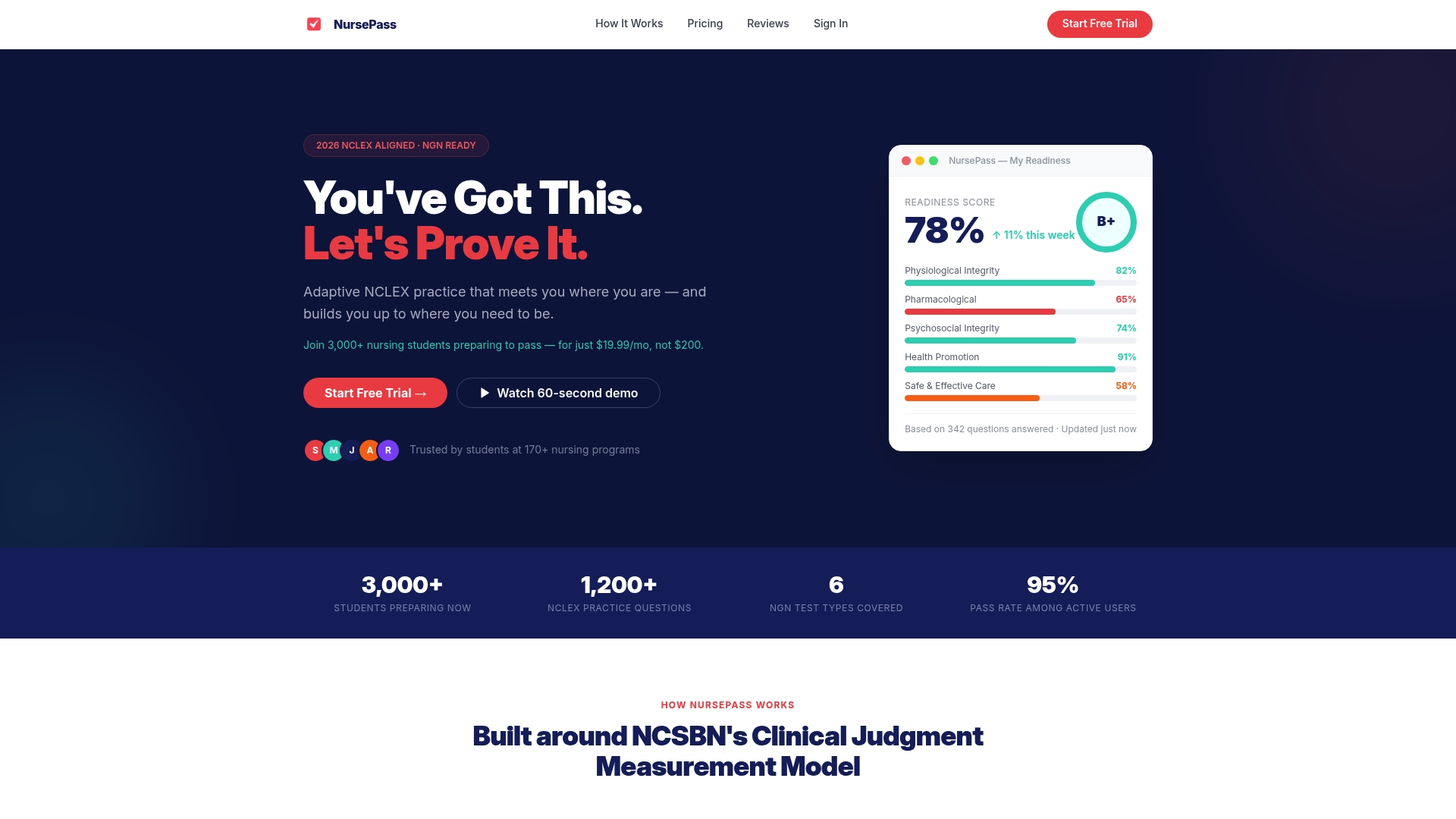
Nursepass gives nursing students access to over 1,200 adaptive NCLEX practice questions, a live readiness score, and subcategory heat maps that show exactly where your preparation stands at any moment. More than 3,000 nursing students have used Nursepass, and the platform reports a 95% pass rate among active users. That is not a coincidence. It reflects what happens when your study schedule checklist is backed by real performance data instead of guesswork. Visit Nursepass to start building your personalized NCLEX exam study plan today.
FAQ
How many weeks should i study for the NCLEX?
The optimal study window is 6 to 12 weeks. Shorter prep risks insufficient question exposure, while longer prep increases burnout and content forgetting.
How many practice questions do i need before the NCLEX?
Most successful first-time candidates complete 2,000 to 3,000 practice questions. Volume builds the clinical reasoning reflex the NCLEX tests more effectively than content review alone.
What should i bring to the NCLEX test center?
Bring a valid government-issued ID that matches your Authorization to Test name exactly. Arrive 30 minutes early for check-in, and leave phones and personal notes in your car or locker.
How much time should i spend on pharmacology?
Dedicate 20 to 30 percent of your total study time to pharmacology. Cover one drug class per day during content review weeks and reinforce with daily practice questions.
What is the best NCLEX study schedule for working students?
A 12-week plan with 1.5 to 2 hours of daily study fits most working students. Prioritize question practice over content re-reading, and schedule one rest day per week to prevent burnout.