
Safe care on the NCLEX is defined as the nurse's ability to protect patients and healthcare workers from harm by applying clinical judgment, safety principles, and ethical practice. The NCLEX tests this competency through the Safe and Effective Care Environment category, which covers two major subcategories: Management of Care and Safety and Infection Control. Together, these subcategories make up a significant portion of the exam, and understanding them is the foundation of passing. This guide breaks down what safe patient care NCLEX questions actually test, how the Clinical Judgment Measurement Model shapes your answers, and which strategies give you the best shot at getting them right.
What is safe care NCLEX and why does it matter?
Safe care NCLEX refers to the set of competencies a nurse must demonstrate to prevent harm, protect patient rights, and deliver ethical, effective care. The NCLEX does not test whether you can recite a policy. It tests whether you can prioritize, delegate, and advocate for patients in real clinical situations. That distinction matters because students who study safe care as a list of facts often miss questions that require applied judgment.
The Safe and Effective Care Environment category sits at the top of the NCLEX blueprint for a reason. Management of Care accounts for 17–23% of the NCLEX-RN exam, and Safety and Infection Control accounts for 9–15%. That means roughly one in three questions you see on exam day will fall under safe care topics. No other single category carries that weight.

What are the Management of Care and Safety/Infection Control subcategories?
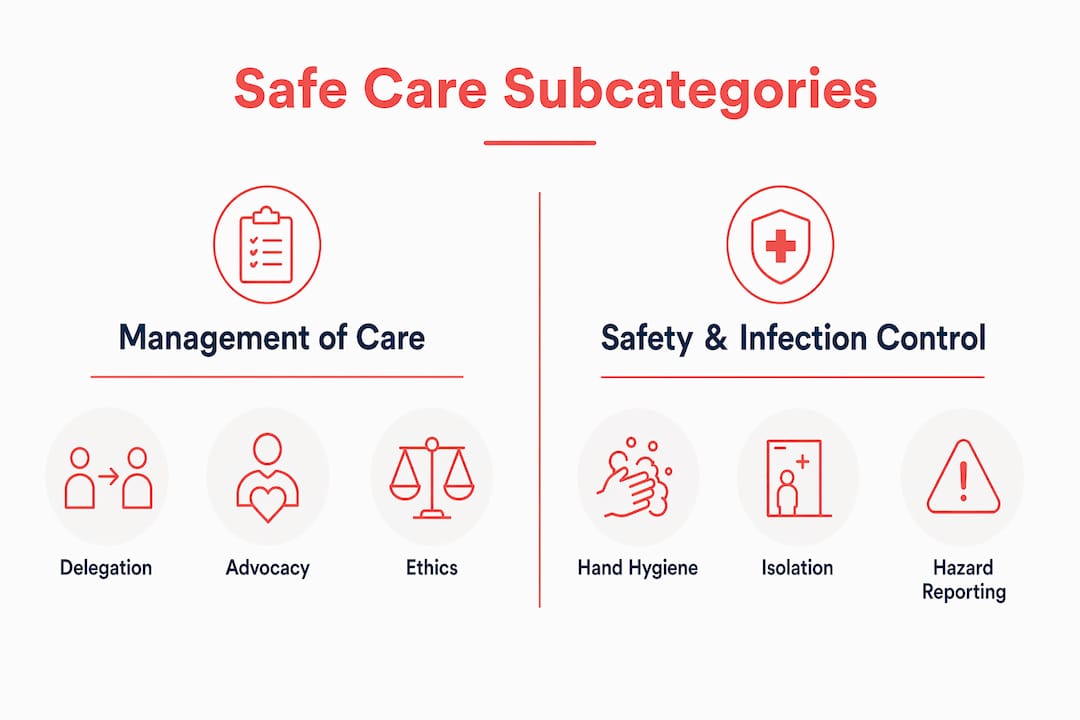
The two subcategories within Safe and Effective Care Environment cover different but overlapping ground. Understanding each one separately helps you study with focus.
Management of Care covers client advocacy, confidentiality, collaboration with the care team, and legal and ethical nursing practice. It also includes delegation, supervision, care coordination, and informed consent. These topics test whether you know the nurse's role within a larger care system, not just at the bedside.
Safety and Infection Control covers hand hygiene, isolation precautions, safe handling of equipment, hazard reporting, and emergency preparedness. These questions test whether you can prevent harm before it happens, not just respond after the fact.
| Subcategory | Core Focus Areas | Exam Weight (RN) |
|---|---|---|
| Management of Care | Delegation, advocacy, client rights, confidentiality, care coordination, legal/ethical practice | 17–23% |
| Safety and Infection Control | Standard precautions, hand hygiene, isolation, hazard handling, incident reporting, emergency response | 9–15% |
The key difference between the two is scope. Management of Care asks you to think about systems and roles. Safety and Infection Control asks you to think about physical risk and prevention. Both require you to apply knowledge, not just recall it.
How does the Clinical Judgment Measurement Model evaluate safe care?
The Clinical Judgment Measurement Model, known as the CJMM, is the foundational 6-step framework used in the Next Generation NCLEX to assess how nurses make safe decisions. The NCLEX no longer rewards memorization alone. It rewards the ability to reason through a clinical situation from start to finish.
The six steps of the CJMM are:
- Recognize Cues: Identify relevant patient data from the scenario
- Analyze Cues: Determine what the data means clinically
- Prioritize Hypotheses: Rank the most likely and most urgent problems
- Generate Solutions: Identify possible nursing actions
- Take Action: Select the safest, most appropriate intervention
- Evaluate Outcomes: Assess whether the action worked
Safe care on NCLEX is less about memorizing steps and more about applying this reasoning chain in context. A question might present a patient with a new fever, a recent surgical wound, and a confused mental status. The CJMM asks you to recognize which cue is most urgent, analyze what it signals, and act on the highest priority first.
This model maps directly onto safe care scenarios. Delegation questions ask you to prioritize hypotheses about which patient is most stable. Infection control questions ask you to generate solutions based on transmission route. Advocacy questions ask you to evaluate whether a patient's rights are being protected.
Pro Tip: Treat every NCLEX safe care item as a mini clinical judgment cycle. Ask yourself: What is the cue? What does it mean? What is the safest action within my scope of practice?
What are effective safe care NCLEX test-taking strategies?
Knowing the content is only half the work. The other half is knowing how to approach the questions themselves. These strategies apply directly to safe care NCLEX tips that improve accuracy under exam conditions.
-
Prioritize using ABCs and Maslow. Airway, breathing, and circulation come first. Physiological needs outrank psychosocial ones. The NCLEX rewards assessment before intervention, so never jump to an action answer when an assessment answer is available and appropriate.
-
Treat the question stem as your only data source. Do not bring in real-world shortcuts or hospital-specific policies. The question stem is the complete dataset. If the scenario does not mention a factor, it does not exist for that question.
-
Eliminate unsafe and unethical options first. Any answer that harms the patient, violates scope of practice, or ignores patient rights is wrong. Removing those options narrows your choice quickly.
-
Read every word in case study sequences. Next Generation NCLEX case studies build on each other. A detail in the first screen may be the key to answering the fifth question correctly.
-
Handle Select All That Apply questions independently. For SATA items, each option must be safe and correct on its own. Do not select an option because it seems partially right. Partial correctness does not earn credit.
-
Avoid real-world shortcuts. What nurses do in a busy unit is not always what the NCLEX expects. The exam tests ideal, evidence-based practice. Choosing the "quick fix" you have seen in clinical rotations often leads to the wrong answer.
Pro Tip: Rely on the scenario data and your knowledge of scope of practice. When two answers both seem safe, choose the one that assesses or prevents harm rather than the one that treats it after the fact.
How do management of care and infection control protect patients in practice?
The exam topics in safe care are not abstract. They map directly onto nursing actions that prevent real harm every day. Understanding the practical side of these topics helps you answer questions with more confidence, because you can picture the clinical situation clearly.
Delegation is one of the most tested management of care skills. A registered nurse can delegate tasks like vital signs or basic hygiene to a nursing assistant, but cannot delegate assessment, teaching, or care planning. Getting delegation wrong in practice means a patient receives care from someone unqualified to provide it. The NCLEX tests this boundary repeatedly because it is a genuine patient safety risk.
Infection control practices are equally concrete. The key actions include:
- Performing hand hygiene before and after every patient contact
- Applying the correct isolation precautions based on transmission route (contact, droplet, or airborne)
- Using personal protective equipment correctly and removing it without self-contamination
- Reporting equipment malfunctions or unsafe conditions before they cause harm
- Following safe injection practices to prevent bloodborne pathogen exposure
Advocacy and patient rights protection also fall under safe care in nursing. A nurse who fails to report a colleague's unsafe practice, or who allows a procedure to proceed without informed consent, has failed a safe care standard. The NCLEX tests these scenarios because they reflect real legal and ethical obligations nurses carry every day.
Fall prevention and emergency preparedness round out the practical picture. Keeping bed rails up, placing call lights within reach, and knowing the facility's emergency codes are all safe care actions that appear in exam questions and in daily nursing work.
Key Takeaways
Safe care NCLEX competency requires applying clinical judgment across Management of Care and Safety and Infection Control topics, not just recalling facts.
| Point | Details |
|---|---|
| Safe care exam weight | Management of Care (17–23%) and Safety and Infection Control (9–15%) together make up roughly one in three NCLEX-RN questions. |
| CJMM is the reasoning framework | The 6-step Clinical Judgment Measurement Model guides how you recognize, prioritize, and act on safe care scenarios. |
| Assessment before intervention | Always choose an assessment answer over an action answer unless the patient is in immediate danger. |
| SATA requires independent judgment | Each option in a Select All That Apply question must be safe and correct on its own. Partial correctness does not count. |
| Delegation boundaries matter | RNs delegate tasks, not nursing judgment. Assessment, teaching, and care planning stay with the RN. |
Why safe care is the hardest category to fake your way through
I have reviewed hundreds of NCLEX prep approaches over the years, and safe care is the category where surface-level studying falls apart fastest. Students who memorize infection control steps can still miss questions because they apply the right action to the wrong situation. The NCLEX is not checking your memory. It is checking your judgment.
The biggest mistake I see is treating Management of Care questions like a policy quiz. Students look for the answer that sounds most official or most thorough. But the NCLEX is asking something simpler and harder at the same time: what does this specific patient need right now, and who is the right person to provide it? That requires you to think, not just recall.
Clinical judgment cannot be crammed. It builds through repeated exposure to NCLEX-style scenarios where you practice the full reasoning cycle, not just the answer. Students who work through a high volume of practice questions with detailed rationales develop a mental pattern for safe care decisions. That pattern is what carries you through the exam when a question feels unfamiliar.
My honest advice is to stop studying safe care as a category and start studying it as a skill. Read the rationale for every question you get wrong. Ask why the correct answer is safer, not just what it is. That shift in approach is what separates students who pass from those who retake.
— Michael
Nursepass: built for NCLEX safe care preparation
Nursing students who want focused practice on Safe and Effective Care Environment topics will find Nursepass worth their time. The platform offers over 1,200 NCLEX practice questions built around the same clinical judgment framework the exam uses, including questions targeting delegation, infection control, and patient advocacy.
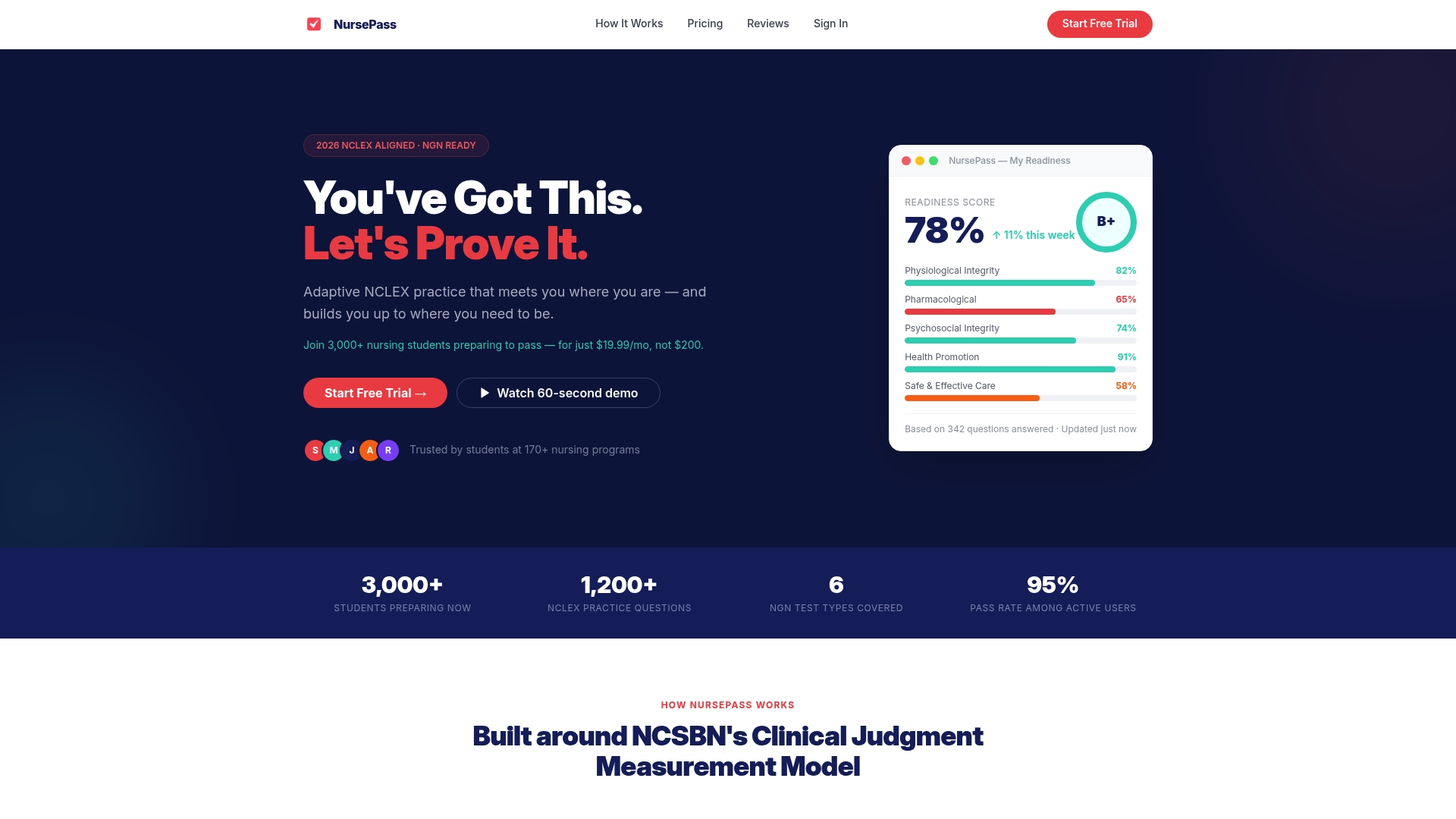
Nursepass uses an adaptive engine that adjusts question difficulty based on your current performance. Its subcategory heat maps show exactly where your safe care knowledge is strong and where it needs work, so you study the right material instead of reviewing what you already know. More than 3,000 nursing students have used the platform, and Nursepass reports a 95% pass rate among active users. If safe care questions are costing you points, targeted practice with real rationales is the fastest way to close that gap.
FAQ
What is the safe care category on the NCLEX?
Safe care on the NCLEX falls under the Safe and Effective Care Environment category, which includes Management of Care and Safety and Infection Control. These subcategories test delegation, infection prevention, patient advocacy, and clinical judgment in safety-focused scenarios.
How much of the NCLEX covers safe care topics?
Management of Care makes up 17–23% of the NCLEX-RN exam, and Safety and Infection Control makes up 9–15%. Combined, safe care topics account for roughly one in three questions on the exam.
What is the CJMM and how does it relate to safe care?
The Clinical Judgment Measurement Model is the 6-step framework the Next Generation NCLEX uses to evaluate clinical reasoning. It applies directly to safe care questions by requiring students to recognize cues, prioritize problems, and select the safest intervention within nursing scope of practice.
How should I approach Select All That Apply safe care questions?
Evaluate each option independently. Every choice you select must be both safe and correct on its own. Do not select an option because it seems partially right or because it fits a general rule you remember from class.
What is the most common mistake on safe care NCLEX questions?
The most common mistake is choosing an intervention before completing an assessment. The NCLEX consistently rewards assessment-first thinking, and students who rush to action answers miss questions they would otherwise get right.