
Mock exam accuracy is defined as how precisely a practice test replicates the real NCLEX in format, question type, difficulty distribution, and scoring behavior. The role of mock exams accuracy goes far beyond generating a score. It gives you a diagnostic snapshot of where your knowledge holds and where it breaks under pressure. When mock exams are built with genuine fidelity to the NCLEX blueprint, they predict readiness with real reliability. Techniques like retrieval practice, performance calibration, and error analysis all depend on that fidelity to work. Nursepass applies these principles directly, with over 1,200 adaptive NCLEX questions and a live readiness score that reflects your actual competency level.
How do mock exams improve exam accuracy for nursing students?
Mock exams improve accuracy through a mechanism called the testing effect. Retrieving information from memory during a test strengthens that memory far more than rereading notes. The result is better recall under the timed, high-stakes conditions of the actual NCLEX.
The performance gains are measurable. Students who use practice tests improve their scores by 10–25 percentage points compared to students who only restudy. Nearly 90% of students perform better on the real exam than on their initial mock. That gap exists because mocks force active recall, not passive recognition.
Time management is a second major benefit. The NCLEX does not reward students who know the material but cannot pace themselves. Repeated mock testing trains you to allocate time per question, recognize when to move on, and maintain focus through fatigue. These are skills that only develop through practice under real conditions.
- Retrieval practice: Answering questions from memory encodes information more deeply than reviewing notes.
- Pacing calibration: Timed mocks reveal whether you spend too long on hard questions and rush easy ones.
- Confidence building: Repeated exposure to exam pressure reduces anxiety on test day.
- Gap identification: Mock testing improves self-assessment accuracy, helping you distinguish what you know from what you only think you know.
Pro Tip: After each mock, spend at least as much time reviewing your answers as you spent taking the test. That review session is where the real learning happens.
What factors determine the accuracy and predictive validity of mock exams?
Predictive validity is the technical term for how well a mock exam forecasts your actual NCLEX result. Not all practice tests have it. A mock earns predictive validity only when it mirrors the real exam across four specific dimensions.

Blueprint fidelity is the first dimension. The NCLEX follows a defined content outline that weights clinical judgment, safety, and health promotion at specific percentages. A mock that overloads pharmacology questions and underweights psychosocial integrity will mis-train you. True blueprint fidelity means the topic distribution in your practice test matches the actual exam's structure.
Difficulty-shape fidelity is the second dimension. The NCLEX uses computerized adaptive testing, which means question difficulty adjusts based on your performance. A mock that presents only medium-difficulty questions gives you a false sense of readiness. Realistic difficulty distribution includes easy, medium, and hard questions in proportions that reflect what you will actually face.
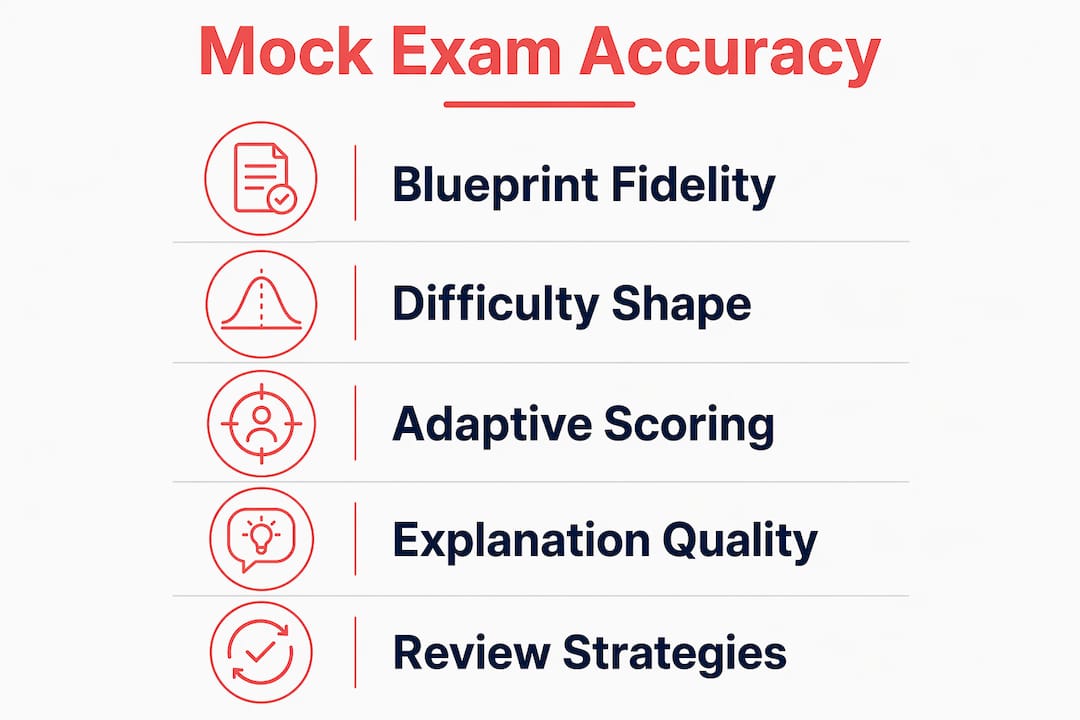
Adaptive and scoring fidelity form the third dimension. Accuracy claims from mock platforms often confuse marketing language with genuine exam fidelity. True scoring fidelity means the mock's pass or fail threshold reflects the NCLEX standard, not an arbitrary cutoff. If the navigation, question format, or scoring logic differs from the real test, the mock can actively mis-train your decision-making.
Explanation fidelity is the fourth dimension. A mock that tells you only whether you got a question right or wrong teaches you nothing. Detailed rationales that explain why each answer is correct or incorrect are what convert a score into a learning tool. Predictive exams require rotating equivalent questions and analyzing performance trends, not just reporting a single number.
Pro Tip: Before committing to any mock exam platform, check whether its question bank aligns with the current NCLEX-RN test plan published by the National Council of State Boards of Nursing (NCSBN). If the platform cannot confirm that alignment, its accuracy claims are unverified.
How to effectively use mock exams to improve nursing exam accuracy?
A single mock exam score tells you almost nothing. A series of scores analyzed over time tells you everything. The most effective approach treats mock exams as an iterative loop: attempt, review, identify patterns, and retest.
-
Take the mock under real conditions. Sit in a quiet space, set a timer, and avoid interruptions. Simulating the actual test environment trains your brain to perform under the same constraints it will face on exam day.
-
Categorize every error after the exam. Errors fall into three types: silly mistakes from rushing, conceptual gaps where you misunderstood a principle, and content gaps where you simply lacked the knowledge. Each type requires a different response. Rushing errors call for pacing work. Conceptual errors call for deeper review. Content gaps call for targeted study.
-
Track trends across at least five mock exams. Performance trends over multiple mocks reveal readiness far more reliably than any single score. A plateau in your scores often signals a pacing problem or a recurring conceptual error, not a lack of effort.
-
Use productive failure as a learning tool. Failing a mock question enhances long-term memory more than getting it right on the first try. The act of making an error and then correcting it activates deeper encoding of the correct information. Do not skip questions you got wrong. Study them first.
-
Track both speed and accuracy together. Monitoring speed and accuracy together gives a more reliable picture of NCLEX readiness than accuracy alone. A student who answers 80% of questions correctly but runs out of time has a pacing problem, not a knowledge problem.
Pro Tip: Build an error log in a simple spreadsheet. Record the question topic, the error type, and the correct rationale. Review the log weekly. Patterns will emerge within two to three mocks.
Nursepass supports this process directly. Its subcategory heat maps show exactly which NCLEX content areas need attention, and its adaptive engine adjusts question difficulty based on your current performance. You can review your NCLEX readiness over time rather than relying on a single session's result.
What are common misconceptions about mock exam accuracy?
The biggest misconception nursing students carry into mock testing is that a low score means failure. A low score is a diagnostic result. It tells you where to study next. Treating it as a verdict causes students to panic and abandon their preparation plan, which is the worst possible response.
- Memorizing repeated questions is not mastery. Repeated exposure to the same questions builds recognition memory, not clinical reasoning. Recognition memory creates false mastery because you remember the answer, not the concept. The NCLEX tests application, not recall of specific questions.
- One score does not predict your NCLEX result. A single mock score reflects one session on one day. Readiness is a trend, not a number. Students who score low early and improve consistently are often better prepared than students who score high once and plateau.
- Difficulty level is not the same as exam fidelity. A very hard mock exam is not automatically a more accurate one. Fidelity comes from matching the NCLEX blueprint, not from making questions harder than the real test.
- Mock exams are not a final verdict. Mock exams act as a vaccine against exam stress by building resistance through repeated exposure to pressure and pacing conditions. Their purpose is to build endurance and psychological resilience, not to predict a pass or fail with certainty.
Students who understand these distinctions use mock exams as tools. Students who misunderstand them use mock exams as sources of anxiety. The difference in outcomes is significant. Reviewing your exam readiness indicators across multiple sessions gives you a far clearer picture than any single score.
Key Takeaways
Mock exams improve NCLEX accuracy only when they replicate the real exam's blueprint, difficulty distribution, and scoring logic, and when students analyze errors systematically across multiple sessions.
| Point | Details |
|---|---|
| Accuracy requires fidelity | A mock exam must match the NCLEX blueprint, difficulty shape, and scoring logic to be predictive. |
| Trends beat single scores | Track performance across at least five mocks to identify readiness patterns and strategy problems. |
| Error analysis drives improvement | Categorize mistakes as rushing, conceptual, or content gaps and study each type differently. |
| Productive failure accelerates learning | Getting a question wrong and correcting it encodes the right answer more deeply than instant success. |
| Misconceptions cost preparation time | Treating a low mock score as failure, or memorized answers as mastery, undermines real readiness. |
Why mock exam strategy matters more than mock exam scores
Most nursing students I have worked with share the same blind spot. They treat their mock exam score as the product. The score is not the product. The error analysis is.
I have seen students score in the 60th percentile on every mock and pass the NCLEX on their first attempt. I have also seen students score in the 80th percentile on a single mock, stop studying, and fail. The difference was not intelligence or knowledge. It was how they used the data their mocks generated.
The 2026 NCLEX format places even greater weight on clinical judgment and next-generation question types. That shift makes blueprint fidelity more critical than ever. A mock exam built on the old question format does not prepare you for what you will actually face. Before you trust any platform's accuracy claims, verify that its question bank reflects the current NCLEX-RN test plan.
My honest advice is this: use mock exams early, use them often, and spend more time on your error log than on your score. The accuracy improvement techniques that actually move the needle are all rooted in what happens after the test, not during it.
— Michael
Nursepass: built for NCLEX mock exam accuracy
Nursing students who want mock exams that reflect the real NCLEX need more than a question bank. They need a platform that adapts to their current level, tracks their progress over time, and shows them exactly where to focus next.
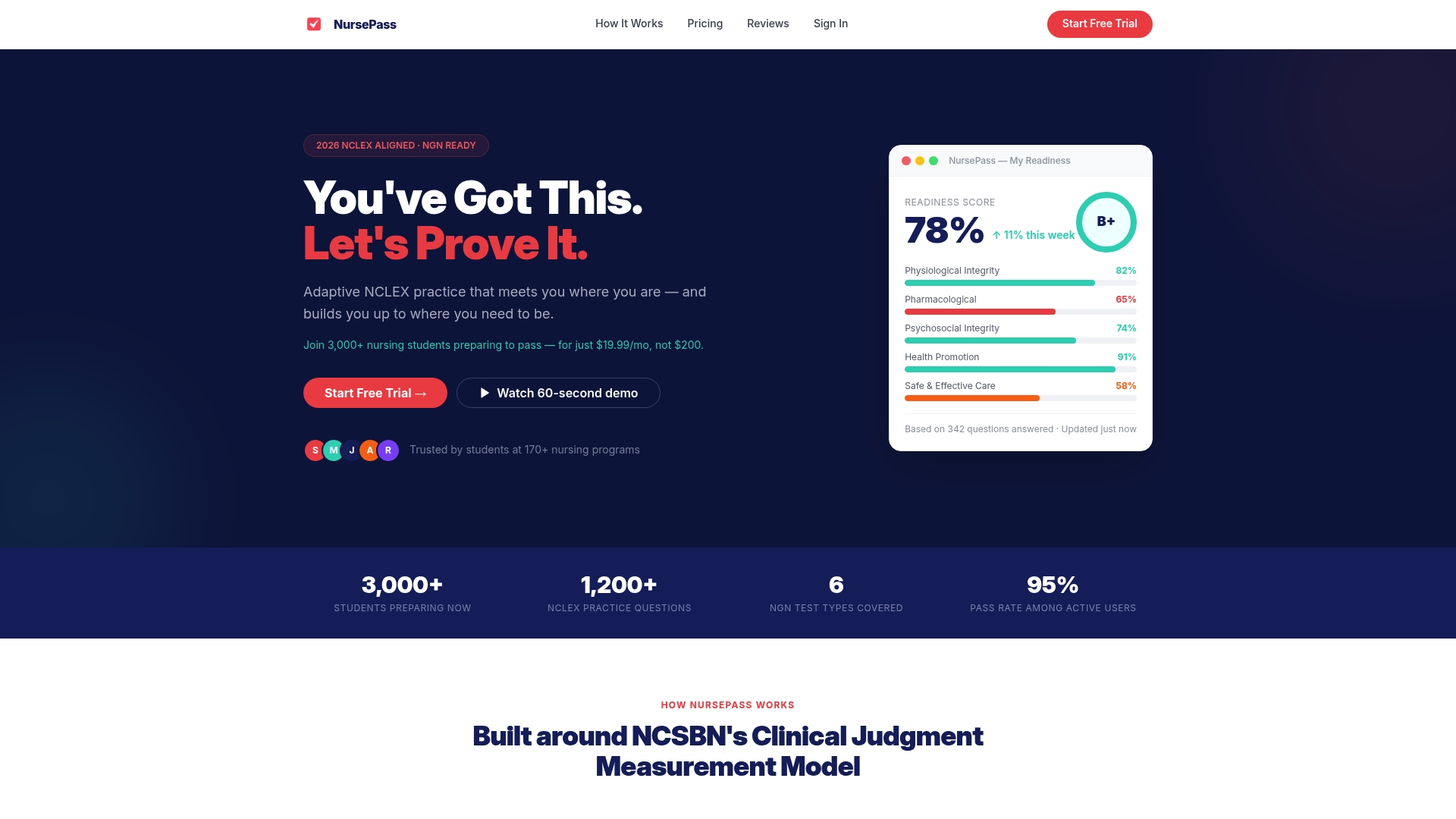
Nursepass offers over 1,200 NCLEX practice questions built to match the current test blueprint. Its adaptive engine adjusts question difficulty based on your performance in real time. The live readiness score and subcategory heat maps show you which content areas need work before test day. More than 3,000 nursing students have used Nursepass, and the platform reports a 95% pass rate among active users. Start your preparation with high-fidelity NCLEX practice and build the kind of accuracy that holds up on the real exam.
FAQ
What is the role of mock exams in NCLEX accuracy?
Mock exams build NCLEX accuracy by replicating real exam conditions, strengthening retrieval memory, and exposing knowledge gaps through diagnostic feedback. Their accuracy depends on how closely they match the NCLEX blueprint and scoring logic.
Do mock exams predict NCLEX performance?
Mock exams predict performance most reliably when you track trends across multiple sessions rather than relying on a single score. Performance trends over five or more mocks reveal readiness patterns that a single result cannot show.
How many mock exams should I take before the NCLEX?
There is no fixed number, but analyzing trends across at least five mock exams gives a reliable picture of readiness. Consistency and error analysis matter more than the total count.
Why do I score lower on mocks than on the real NCLEX?
Students often score lower on initial mocks because retrieval practice is harder than recognition. Students improve by up to 25 percentage points from their first mock to the actual exam as their recall and pacing improve.
How should I respond to a low mock exam score?
Treat a low score as a diagnostic result, not a verdict. Categorize your errors by type, update your study plan to address the specific gaps, and retest within one to two weeks to measure whether the targeted review worked.