
Cost-effective study habits for nursing students are defined as high-impact learning techniques that maximize retention and NCLEX readiness without requiring expensive materials or unlimited time. The most proven methods include active recall, spaced repetition, focused time blocks, and strategic note-taking. These approaches are grounded in nursing education research, not marketing. Nursing students who build their routines around these techniques spend less money, study fewer hours, and retain more. The key insight: quality of study method matters far more than quantity of hours or dollars spent.
1. Why active recall is the best affordable study technique
Active recall is the highest-evidence study technique for nursing students, significantly outperforming passive reading. That finding matters because most nursing students default to re-reading notes or highlighting textbooks, which creates the illusion of learning without building real memory.
Active recall works by forcing your brain to retrieve information rather than recognize it. Retrieval is harder than recognition, and that difficulty is exactly what builds durable memory. The NCLEX tests retrieval under pressure, so practicing retrieval during study directly mirrors exam conditions.
Practical low-cost ways to use active recall:
- Write a question on one side of an index card and the answer on the other. Paper flashcards cost almost nothing.
- After reading a section, close the book and write down everything you remember. Then check for gaps.
- Teach a concept aloud to yourself or a study partner. If you cannot explain it simply, you have not learned it yet.
- Use free digital flashcard tools to create and review sets on your phone during commute time.
Pro Tip: When you get a flashcard wrong, do not just flip it and move on. Write the correct answer in your own words before continuing. That extra step triples the retention benefit.
The re-reading questions technique is a common trap. Students feel productive while re-reading, but their test scores do not reflect the time invested. Active recall feels harder because it is harder. That difficulty is the signal that learning is happening.
2. How spaced repetition builds durable memory on a budget
Spaced repetition improves long-term retention when content is reviewed today, again in 2–3 days, then in one week. That schedule prevents the forgetting curve from erasing what you worked to learn.

The forgetting curve, identified by Hermann Ebbinghaus, shows that memory drops sharply within 24 hours of learning something new. Spaced repetition interrupts that drop by scheduling reviews at the exact moment your brain is about to forget. The result is long-term memory built at a fraction of the study time cramming requires.
Here is a simple spaced repetition schedule you can follow without any paid software:
- Day 1: Study new material and create flashcards or notes.
- Day 3: Review all day-1 material. Mark what you still struggle with.
- Day 7: Review everything again, focusing extra time on weak spots.
- Day 14: Final review before moving the material to your "mastered" pile.
Free tools like Anki automate this schedule for you. Anki tracks which cards you get right and wrong, then spaces reviews accordingly. The software is free on desktop and costs a one-time fee on iOS, but the desktop version works on any laptop.
Pro Tip: Do not create more than 20–30 new flashcards per day. Flooding your review queue makes the system collapse. Slow, steady card creation keeps spaced repetition manageable.
Nursing students who prioritize consistent weekly review perform better on the NCLEX than those who cram. Consistent review is also cheaper. Last-minute cramming often drives students to buy expensive prep courses in a panic. Spaced repetition removes that panic entirely.
3. Using focused, time-boxed sessions to reduce fatigue
Effective study sessions for nursing students last 25–30 minutes with 5-minute breaks, repeated 3–4 times rather than extended marathon sessions. Cognitive overload sets in after 90 minutes of continuous study, and anything learned after that point is retained poorly.
The Pomodoro Technique formalizes this structure. You set a timer for 25 minutes, study with full focus, then take a 5-minute break. After four cycles, you take a longer 15–20 minute break. Any free phone timer works. You do not need a paid app.
Key rules for time-boxed sessions that actually work:
- Phone goes face-down or in another room during the 25-minute block.
- No multitasking. One topic per block.
- Breaks mean actual rest: walk, stretch, or get water. Not social media.
- Track your completed blocks. Seeing four completed Pomodoros in a row builds momentum.
Scheduling non-study time and breaks reduces cortisol spikes, enhancing memory and cognitive performance. That is not a suggestion to study less. It is evidence that rest is part of the study plan, not a reward for finishing it.
4. Strategic note-taking methods tailored for nursing concepts
The right note-taking method depends on the type of content you are studying. Using one format for everything wastes time and reduces recall. Cornell notes, concept maps, and drug cards offer efficient, scalable note-taking for nursing content.
Here is how to match the method to the material:
| Content Type | Best Method | Why It Works |
|---|---|---|
| Lecture content | Cornell notes | Separates cues, notes, and summary for easy review |
| Body systems | Concept maps | Shows relationships between structures and functions |
| Pharmacology | Drug cards | Isolates drug class, action, side effects, and nursing implications |
| Pathophysiology | Flowcharts | Traces cause and effect through disease progression |
Cornell notes divide your page into three sections: a narrow left column for cue questions, a wide right column for notes, and a summary box at the bottom. After class, you cover the right column and use the cue questions to test yourself. That built-in active recall makes Cornell notes more effective than standard linear notes.
Drug cards work especially well for pharmacology because they force you to condense information. One card per drug. Front: drug name and class. Back: mechanism, side effects, contraindications, and one key nursing implication. Paper index cards cost under $2 for a pack of 100.
Pro Tip: Review your notes within 24 hours of writing them. That single habit, applied consistently, reduces the total time you need to spend reviewing before an exam.
5. Leveraging free and low-cost digital resources
Free digital resources cover most of what nursing students need for NCLEX prep. The instinct to buy expensive prep courses before exhausting free options is a costly mistake.
Start with what your school already provides. Many nursing programs include access to ATI or HESI as part of tuition. Those platforms contain thousands of practice questions and detailed rationales. Use them fully before spending a dollar on outside resources.
Budget-friendly digital tools worth using:
- YouTube: Channels focused on nursing education cover pharmacology, pathophysiology, and NCLEX strategy in depth. Free and available on any device.
- Anki: Free desktop flashcard software with pre-built nursing decks shared by other students.
- Khan Academy: Free anatomy, physiology, and biology content that reinforces nursing science foundations.
- Scholarly: Free AI tools like Scholarly can bridge lecture materials and flashcard creation, saving significant preparation time.
Paid question banks make sense close to your NCLEX date, when targeted practice on your weak areas delivers the highest return. Buying them in your first semester is premature. Build your foundation with free tools first, then invest selectively.
The adaptive study plan approach works well here. Identify which content areas need the most work, then direct your free resources toward those gaps before spending money on anything else.
6. Applying the 80/20 rule to nursing content
The Pareto Principle applies directly to nursing study. 20% of material accounts for 80% of exam performance, which means focusing on must-know safety protocols and core pathologies delivers the greatest return on your study time.
That 80/20 split is not an excuse to skip content. It is a prioritization framework. High-yield NCLEX topics include cardiac and respiratory disorders, fluid and electrolyte imbalances, pharmacology safety, infection control, and maternal-newborn nursing. These areas appear repeatedly across NCLEX question sets.
Students who spend equal time on every topic waste hours on low-yield content. A student who masters cardiac medications and their nursing implications will outperform a student who read every chapter but mastered none of them. Depth on high-yield content beats breadth across all content.
Consistent exposure to NCLEX-style questions and rationales throughout nursing school outperforms last-minute cramming. Reading the rationale for every question you answer, right or wrong, is the fastest way to close knowledge gaps on high-yield topics.
7. Building a repeatable weekly study system
Students succeed by building repeatable systems tailored to learning goals instead of rote memorization or peer comparison. A system removes the daily decision of what to study, which reduces procrastination and decision fatigue.
A simple weekly structure for nursing students:
- Monday, Wednesday, Friday: New content using active recall and Cornell notes.
- Tuesday, Thursday: Spaced repetition review of previous material using Anki or paper flashcards.
- Saturday: NCLEX-style practice questions on the week's topics, with full rationale review.
- Sunday: Rest, or light review of one weak area. No new material.
This structure costs nothing to implement. It requires a calendar, a timer, and the study materials you already have. The low-cost exam prep checklist approach confirms that structure, not spending, predicts NCLEX outcomes.
Adjust the schedule to your clinical rotation days and personal energy patterns. Some students retain more in the morning. Others focus better at night. The method matters more than the time of day. Pick a consistent schedule and protect it.
Key takeaways
Cost-effective nursing study works because method and consistency outperform time spent and money invested, every time.
| Point | Details |
|---|---|
| Active recall beats passive review | Self-testing with flashcards or cue questions builds the retrieval skills NCLEX demands. |
| Spaced repetition prevents cramming | Reviewing material on days 1, 3, and 7 moves knowledge into long-term memory affordably. |
| Time-boxed sessions reduce burnout | 25–30 minute focused blocks with breaks outperform marathon study sessions. |
| Match notes to content type | Cornell notes, concept maps, and drug cards each serve a different nursing content category. |
| Prioritize high-yield content | Mastering the top 20% of tested material drives 80% of NCLEX exam performance. |
What I have learned about studying smarter in nursing school
Nursing school has a way of making students feel that more hours and more money equal better results. That belief is wrong, and I have seen it burn out capable students who had everything it took to pass.
The students who struggle most are often the ones studying six hours a day with no system. They re-read chapters, highlight everything, and feel exhausted without retaining much. The students who pass consistently are the ones who study two focused hours with active recall and spaced repetition, then stop.
Perfectionism is expensive in nursing school. Trying to master every detail in every chapter costs time, money on extra resources, and mental energy you need for clinical rotations. The 80/20 rule is not a shortcut. It is the most honest description of how NCLEX is actually built.
My strongest advice: build your system in week one of nursing school, not the week before your NCLEX. A repeatable routine using free tools and proven techniques will carry you further than any expensive prep course you buy in a panic. Confidence on exam day comes from months of consistent, focused practice. Not from a last-minute spending spree.
— Michael
Nursepass supports your study plan without the high cost
Nursing school demands a lot. Your study tools should not add financial stress on top of academic pressure.
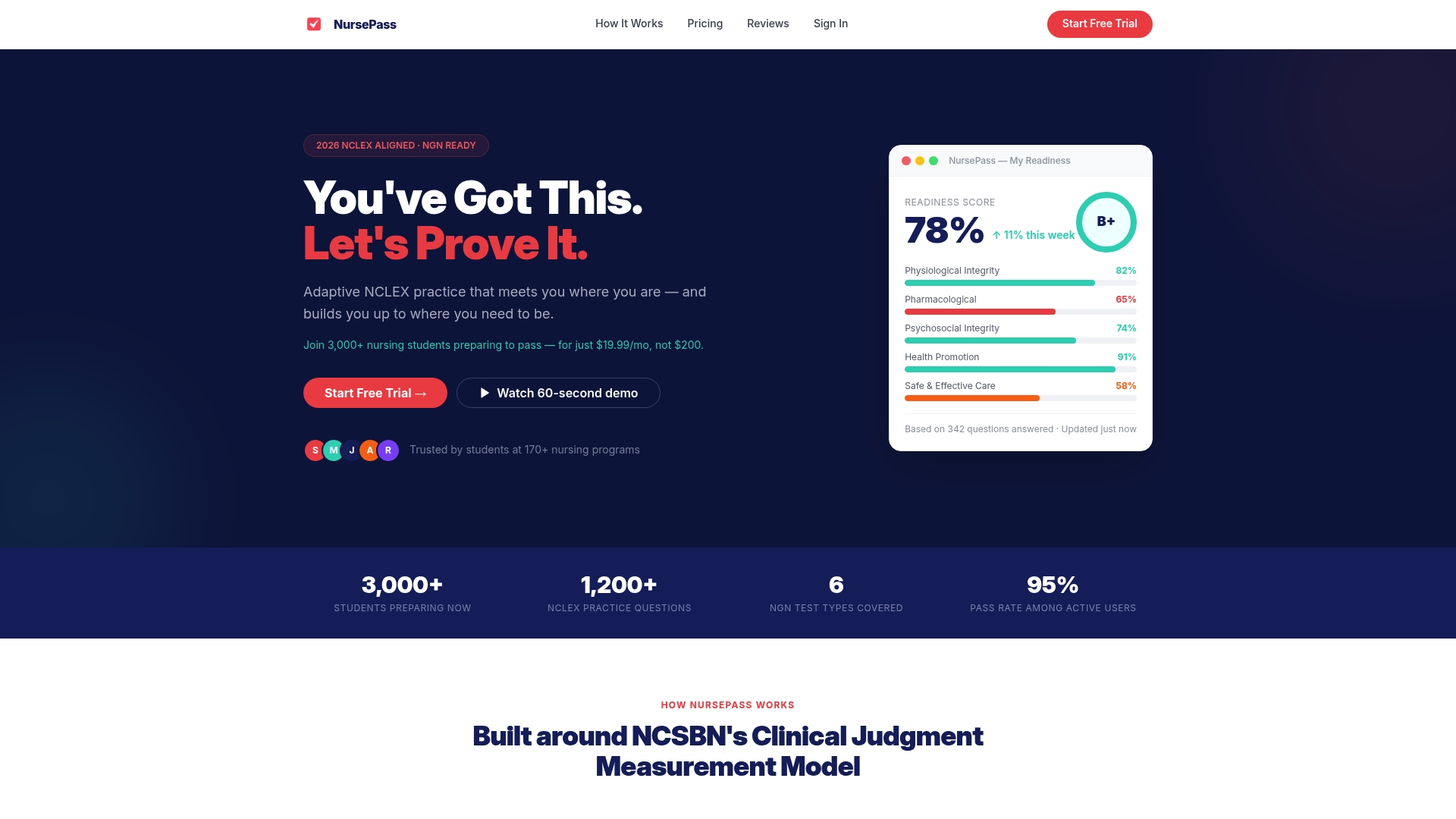
Nursepass is built specifically for nursing students preparing for the NCLEX. The platform uses an adaptive learning engine that adjusts question difficulty to your current competency level, so every practice session targets your real gaps. With over 1,200 NCLEX practice questions, a live readiness score, and subcategory heat maps, you can see exactly where to focus next. More than 3,000 nursing students have used Nursepass, and active users report a 95% pass rate. Visit Nursepass to see how adaptive practice fits into the budget-friendly study system you are building.
FAQ
What is the most cost-effective study method for nursing students?
Active recall is the most cost-effective method. It requires only flashcards or a blank sheet of paper and produces stronger retention than any passive review technique.
How long should a nursing student study each day?
Two to three hours of focused, structured study outperforms five or six hours of unfocused review. Sessions of 25–30 minutes with short breaks prevent cognitive overload and improve retention.
Is spaced repetition free to use?
Yes. Anki, the most widely used spaced repetition tool, is free on desktop and works on any laptop or computer without a subscription.
How do I prioritize what to study for the NCLEX?
Focus on high-yield topics first: cardiac and respiratory disorders, pharmacology safety, fluid and electrolyte balance, and infection control. These areas account for the largest share of NCLEX questions.
When should nursing students start using NCLEX practice questions?
Start using NCLEX-style questions from the first semester of nursing school. Consistent exposure to question rationales throughout the program outperforms any amount of last-minute cramming.