
A low-cost exam prep checklist for nursing students is a curated study plan that combines affordable resources, structured scheduling, and targeted NCLEX skill-building to minimize expenses while maximizing exam readiness. Most students underestimate total prep costs, focusing only on the registration fee while ignoring hidden expenses that can double or triple the bill. The Next Generation NCLEX (NGN) now emphasizes clinical judgment over memorization, which means your prep strategy matters as much as your budget. This checklist gives you both.
1. What does a low-cost exam prep checklist nursing students actually need?
A practical nursing exam prep checklist covers six areas: budgeting, resource selection, scheduling, NGN practice, exam day logistics, and retake planning. Most students skip the budgeting step entirely. That single omission causes financial stress mid-prep and forces last-minute cuts to study materials. Start with a full cost picture before you spend a dollar on resources.
The checklist works as a decision filter. Every purchase, every study hour, and every resource choice runs through it. Students who follow a structured checklist spend less and retain more because they eliminate guesswork from the process.

2. Understanding the hidden costs of nursing exam preparation
Hidden costs in exam prep are the expenses beyond the base NCLEX registration fee that most candidates fail to budget for in advance. True prep costs often exceed the exam registration fee by three to four times when you add study materials, retake fees, travel, and scheduling changes. That gap catches students off guard.
Here is a breakdown of the most common hidden costs:
- Registration fee: The base NCLEX fee, paid to Pearson VUE
- Study materials: Question banks, review books, and video courses
- Retake fees: Typically $225–$400 per additional attempt
- Travel and lodging: Testing centers are not always local
- Rescheduling fees: Charged when you change your exam date after booking
- ATT reapplication: If your Authorization to Test expires before you test, you pay to reapply
| Cost Category | Estimated Range | Notes |
|---|---|---|
| Base registration | Fixed per state board | Check your state's nursing board |
| Study materials | $0–$300 | Free options exist through libraries |
| Retake fee | $225–$400 | Avoid by scheduling promptly |
| Travel and lodging | $0–$200 | Varies by testing center distance |
| Rescheduling | $0–$50+ | Avoid by booking a firm date early |
Pro Tip: Schedule your exam immediately after receiving your ATT. The ATT is valid for only 90 days, and missing that window forces a full reapplication with additional fees.
3. Choosing one primary prep resource and supplementing for free
The single most damaging mistake in nursing exam prep is resource stacking. Students who complete one prep course thoroughly outperform those who use multiple courses partially. Buying three question banks and finishing none of them wastes both money and time.
Choose your primary resource based on three criteria: NGN question coverage, adaptive feedback, and price. Once you select it, commit fully before adding anything else.
Free supplements to stack on top of your primary resource:
- University library databases: Many universities provide free access to premium NCLEX prep tools, e-books, and video courses through institutional licenses that students routinely overlook.
- NCSBN Learning Extension: The official body behind the NCLEX offers free and low-cost NGN practice items.
- YouTube nursing educators: Channels covering pharmacology, med-surg, and clinical reasoning are free and high quality.
- Your nursing school's simulation lab: Many programs offer open lab hours for case study practice.
Nursepass offers over 1,200 NCLEX practice questions with an adaptive engine that adjusts to your current competency level. Its live readiness score and subcategory heat maps show you exactly where to focus, which eliminates the need to buy additional diagnostic tools.
Pro Tip: Balance NGN-style questions with traditional NCLEX questions in a 40/60 ratio during the first four weeks. Shift to 60/40 NGN-heavy practice in the final two weeks before your exam.
4. Building a realistic study schedule on a tight budget
An effective NCLEX prep period runs 8–12 weeks with four to six hours of daily study. That structure is not arbitrary. It reflects how long clinical reasoning skills take to consolidate through repeated practice. Shorter timelines increase anxiety and reduce retention.
A sustainable daily routine looks like this:
- 60–90 minutes of content review: Focus on one body system or pharmacology category per session.
- 75–100 practice questions: Mix traditional and NGN formats daily.
- Rationale review: Read rationales for both correct and incorrect answers to build clinical reasoning, not just answer recognition.
- Weekly timed full exam: Simulating exam conditions weekly builds endurance and surfaces weak content areas early.
- One full rest day per week: Rest is not optional. Burnout is the leading reason students abandon prep before their exam date.
Track your progress with a simple spreadsheet or the built-in analytics in your primary prep tool. Nursepass's subcategory heat maps do this automatically, showing performance by topic so you spend time where it counts most.
Pro Tip: Avoid cramming in the 48 hours before your exam. Use that time for light review and logistics prep only. Last-minute cramming raises cortisol and impairs recall on test day.
5. Mastering NGN question types without spending extra
The Next Generation NCLEX tests clinical judgment through question formats that did not exist in previous versions. Practicing NGN-specific item types like unfolding case studies and drag-and-drop questions directly improves clinical judgment skills and NCLEX pass rates. Familiarity with the format removes cognitive load on exam day.
The six NGN item types you need to practice:
- Unfolding case studies: Multi-part scenarios where patient conditions evolve across six questions
- Bow-tie items: Require you to identify a condition, select interventions, and predict outcomes simultaneously
- Matrix/grid questions: Assess multiple variables in a table format
- Drag-and-drop cloze: Fill-in-the-blank with clinical terms
- Highlighting: Identify relevant clinical data within a passage
- Extended multiple response: Select all correct options from a longer list
| NGN Item Type | Clinical Skill Tested | Free Practice Source |
|---|---|---|
| Unfolding case studies | Clinical reasoning across time | NCSBN Learning Extension |
| Bow-tie items | Cause-effect clinical judgment | Nursepass adaptive questions |
| Matrix/grid | Multi-variable assessment | University library resources |
| Highlighting | Data recognition in context | NCSBN sample items |
Successful NCLEX candidates complete 2,000–3,000 practice questions including NGN formats before their exam. That volume builds pattern recognition that no amount of passive reading can replicate. Budget your time accordingly.
6. Exam day readiness and managing retakes affordably
Exam day logistics are a separate checklist from your study plan. Failing to prepare for check-in requirements causes unnecessary stress and, in rare cases, disqualification from testing that day.
Exam day checklist:
- Valid government-issued photo ID: Name must match your ATT exactly
- ATT confirmation: Printed or accessible on your phone
- Testing center address and parking: Confirm the day before
- Arrival time: Arrive 30 minutes early to complete check-in
- Prohibited items list: No phones, notes, or personal items in the testing room
If a retake becomes necessary, use your Candidate Performance Report (CPR). The CPR identifies which NCLEX content areas fell below the passing standard. Build your retake prep plan around those specific categories rather than repeating a full general review. That targeted approach is faster and cheaper.
Pro Tip: Budget for one potential retake when you first plan your prep. Setting aside $300 in advance removes the financial panic that derails focused study after a first attempt.
Reviewing your NCLEX readiness score before booking your exam date gives you an objective measure of whether you are ready. Nursepass's live readiness score updates after every practice session, so you always know where you stand.
Key Takeaways
A structured, budget-conscious nursing exam study plan built around one primary resource, free institutional supplements, and consistent NGN practice is the most cost-effective path to passing the NCLEX on the first attempt.
| Point | Details |
|---|---|
| Budget all costs upfront | Hidden fees can triple your total prep cost; plan for retakes, travel, and materials from day one. |
| Commit to one primary resource | Students who finish one prep course thoroughly outperform those who use several partially. |
| Use free institutional resources | University library licenses often include premium NCLEX prep tools at no extra cost to you. |
| Schedule your exam immediately | Your ATT expires in 90 days; delays force reapplication fees and lost prep momentum. |
| Practice NGN formats daily | Completing 2,000–3,000 questions including NGN types builds the clinical judgment the exam requires. |
What I've learned about affordable NCLEX prep after years of watching students succeed and fail
Most students who struggle financially with NCLEX prep share one pattern: they bought too much, too early, and used too little of it. I have seen students spend $800 on overlapping courses and still fail because they never finished any single resource deeply enough to build real clinical reasoning.
The students who pass on a tight budget do the opposite. They pick one tool, work it completely, and fill gaps with free resources from their university library or the NCSBN directly. That discipline is harder than it sounds when you are anxious and every ad promises the perfect shortcut.
The NGN shift matters more than most students realize. Memorizing drug names and normal lab values is not enough anymore. The exam now asks you to think like a nurse in a deteriorating patient scenario. That skill comes from practicing case studies and reading rationales, not from passive review. Free resources can absolutely build that skill if you use them with intention.
My honest advice: check your university library before you spend a single dollar on prep materials. You may already have access to everything you need. Then build your 8-week study schedule and protect it like a clinical rotation. Consistency beats intensity every time.
— Michael
How Nursepass supports affordable NCLEX preparation
Nursepass is built specifically for nursing students who need focused, efficient prep without paying for features they will never use.
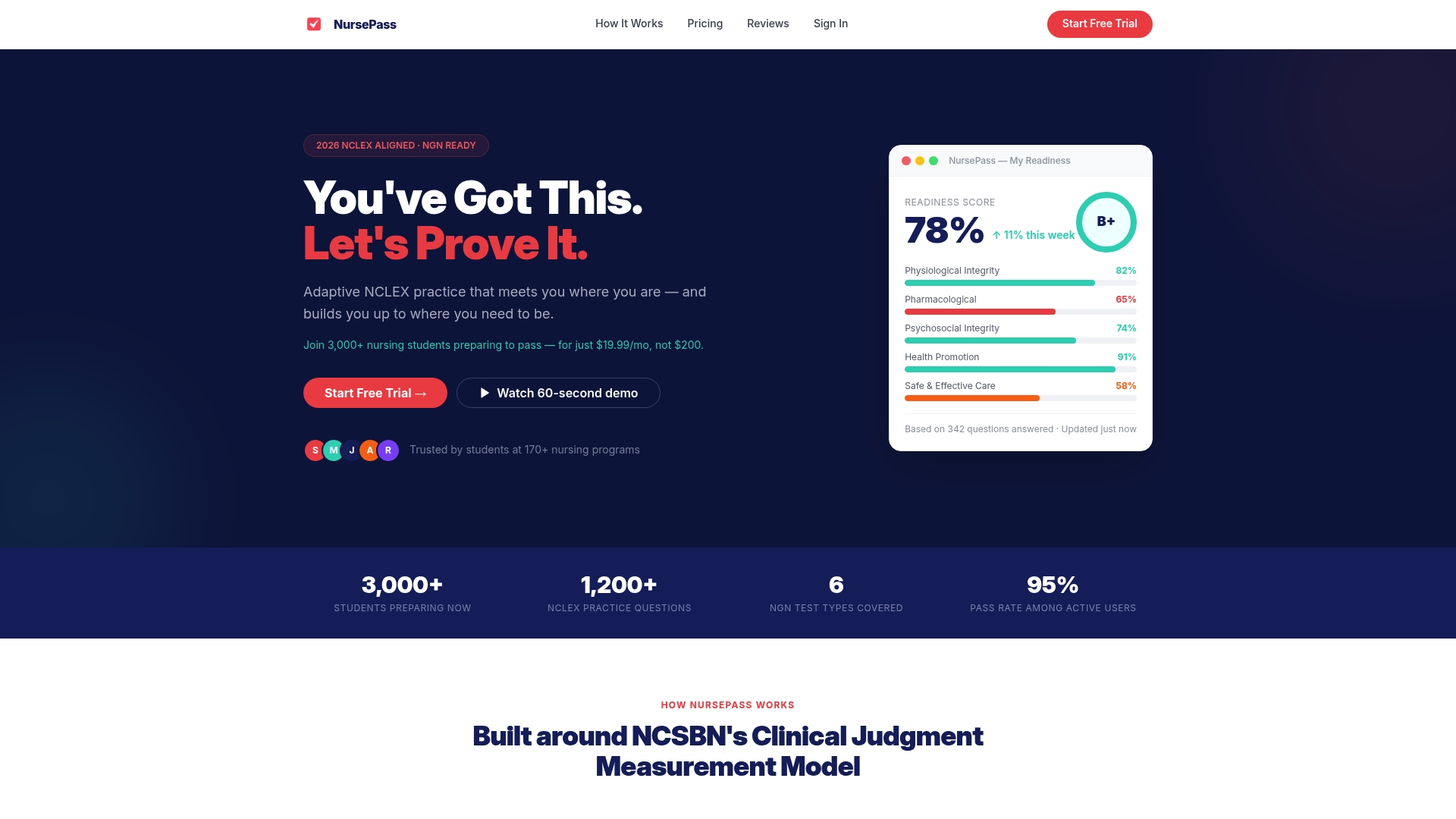
The platform includes over 1,200 NCLEX practice questions, a live readiness score that updates after every session, and subcategory heat maps that show your exact weak spots. More than 3,000 nursing students have used Nursepass, with 95% of active users passing the NCLEX. The adaptive engine adjusts question difficulty to your current level, so every session targets the skills you actually need to build. Visit Nursepass to see how a focused, affordable prep tool fits into your study checklist.
FAQ
What is the biggest hidden cost in nursing exam prep?
Retake fees are the most significant hidden cost, typically running $225–$400 per attempt. Budgeting for one potential retake from the start prevents financial stress if a second attempt becomes necessary.
How long should I study for the NCLEX on a budget?
An 8–12 week prep period with four to six hours of daily study is the standard recommendation for effective NCLEX preparation. Shorter timelines increase the risk of a retake, which costs more in the long run.
Can I prepare for the NCLEX using only free resources?
Free resources alone can be sufficient if your university library provides access to premium prep tools through institutional licenses. Supplement with NCSBN's official NGN practice items and structured case study review.
What happens if my ATT expires before I take the NCLEX?
An expired ATT requires you to reapply through your state board and pay additional fees. Schedule your exam immediately after receiving your ATT to avoid this cost entirely.
How many practice questions do I need before the NCLEX?
Successful candidates typically complete 2,000–3,000 practice questions before their exam, including NGN-specific formats like unfolding case studies and bow-tie items. Volume builds the pattern recognition that clinical judgment questions require.