
Nursing exam pacing under pressure is the skill of managing time per question while maintaining clinical judgment quality throughout the NCLEX. Most students focus on speed, but the real challenge is decision quality within a strict time ceiling. The NCLEX uses computer-adaptive testing (CAT), which means the exam adjusts to your performance in real time. That format rewards consistent, confident reasoning far more than rushing. This guide covers the exact techniques, mental frameworks, and preparation habits that keep your pacing steady when the pressure peaks.
What are the key time management techniques for pacing the NCLEX?
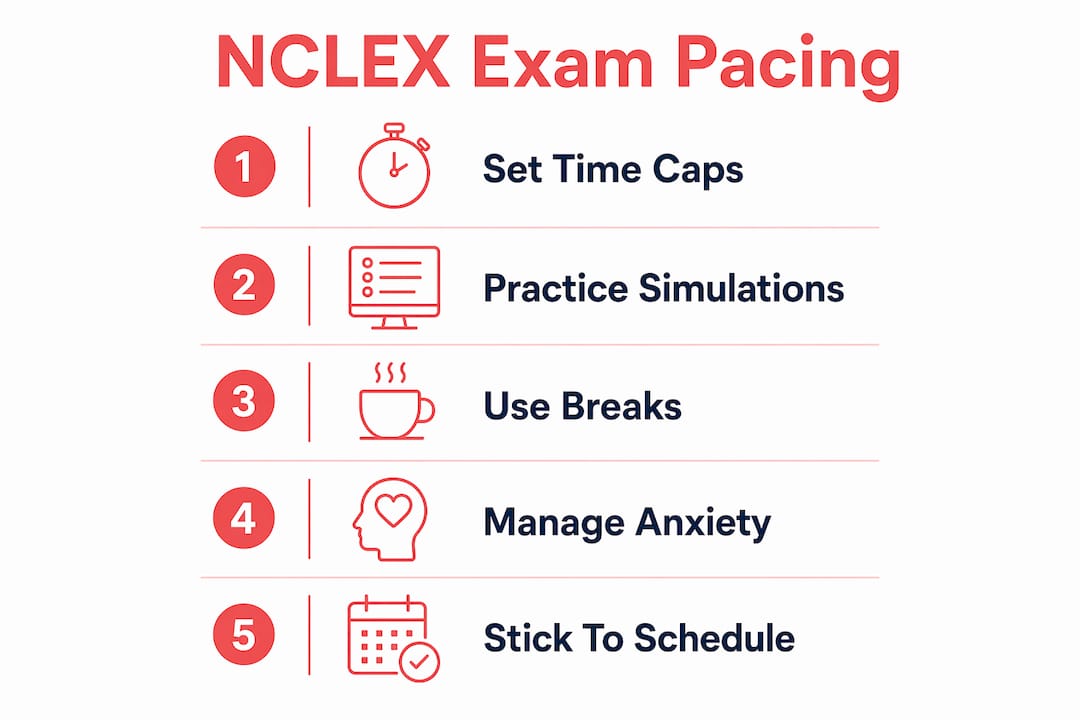
Effective nursing exam time management starts with understanding how the NCLEX actually works. The CAT format ends when the system reaches 95% confidence that you are above or below the passing standard. You cannot finish early by choice. That means obsessing over your question count creates unnecessary anxiety and disrupts your rhythm.
The most widely recommended guardrail is the 90-second rule. Most exam prep guides advise a 90-second time cap per question on the first pass to prevent losing time on difficult items. Spending four minutes on one question does not improve your odds. It just steals time from questions you could answer correctly.

The flag-and-move strategy is the practical application of that rule. When you hit the 90-second mark and still feel stuck, flag the question and move forward. Your subconscious continues processing flagged items while you work through easier questions. Returning with fresh eyes often produces a faster, cleaner answer.
NCLEX breaks are another underused pacing tool. The exam offers optional breaks around question 75–100, roughly two hours in, lasting about 10–15 minutes. Those breaks count against your total five-hour exam window, so use them deliberately.
- Flag and move: Set a firm 90-second cap, flag anything that stalls you, and return only after completing the current block.
- Break timing: Take your optional break when you feel cognitive fatigue building, not as a reward or an escape.
- Pacing checkpoints: Every 25 questions, do a quick mental check. Are you rushing? Are you overthinking? Recalibrate.
- Question type awareness: Next Gen NCLEX items like bow-tie and extended drag-and-drop questions take longer by design. Budget extra time for those formats.
Pro Tip: Treat your NCLEX break like a pit stop, not a vacation. Stand up, stretch, drink water, close your eyes for 60 seconds, and re-enter focused. Students who skip breaks show higher error rates on their final questions.
How can nursing students manage exam anxiety to improve pacing?
Stress and pacing are directly connected. Moderate, short-lived stress can sharpen focus and boost motivation. Overwhelming stress does the opposite. It disrupts concentration, slows processing, and causes the kind of mental freeze that destroys your pacing.
The goal is not to eliminate stress. The goal is to keep it at a productive level throughout the exam. That requires a defined anxiety-control protocol you have practiced before test day.
A practical reset sequence works like this:
- Stop: Recognize the moment panic starts. Your signal might be rereading the same sentence three times or feeling your heart rate spike.
- Exhale slowly: A long, controlled exhale activates the parasympathetic nervous system and lowers cortisol within seconds.
- Ground yourself: Name three things you can physically feel. This interrupts the anxiety spiral and pulls your attention back to the present.
- Re-enter the question: Read only the last sentence of the question stem first. That is usually where the actual clinical ask lives.
This anxiety-control protocol takes under 20 seconds. The clock keeps running, so brevity matters. Practice the sequence during timed study sessions so it becomes automatic.
Pre-exam preparation also reduces baseline anxiety on test day. A structured self-study plan built weeks in advance prevents the last-minute cramming that spikes cortisol the night before the exam. Sleep, hydration, and a consistent morning routine on exam day are not soft suggestions. They are performance variables.
Pro Tip: Build a "panic threshold" during practice. Decide in advance: if I reread a question more than twice without progress, I flag it and move on. Having a pre-committed rule removes the in-the-moment decision and protects your pacing.
What tools and study habits support effective pacing before exam day?
Pacing is a skill. Like any skill, it requires deliberate practice under realistic conditions. Studying under pressure in a controlled environment before test day is the single most effective way to reduce pacing panic when it counts.
Simulate the real exam environment
Full-length timed practice sets are non-negotiable. Sitting through 75 to 145 questions in one session, with a timer running, trains your brain to sustain focus and make decisions under fatigue. One or two sessions per week in the final month before your exam builds the mental endurance the NCLEX demands.
CAT simulators replicate the adaptive difficulty curve of the real exam. Using a platform that adjusts question difficulty based on your performance gives you accurate pacing data. You learn which question types slow you down and which ones you can move through confidently.
Build a study schedule that mirrors exam pacing
A structured NCLEX study schedule does more than organize your content review. It trains your daily rhythm to match exam conditions. Study in blocks that match the exam's time structure. Take timed breaks at the same intervals the NCLEX allows.
Avoid cramming. Effective exam pacing begins well before test day through workload management, sleep hygiene, and reducing last-minute cramming. Cramming raises baseline stress and degrades the clinical reasoning you need on exam day.
| Study Habit | Pacing Benefit |
|---|---|
| Full-length timed practice sets | Builds mental endurance for long exam sessions |
| CAT simulator use | Reveals which question types disrupt your pacing |
| Structured weekly schedule | Prevents cramming and reduces baseline anxiety |
| Timed break practice | Trains you to use breaks as cognitive resets |
| Clinical judgment drills | Speeds up decision-making on complex questions |
Nursepass offers over 1,200 adaptive NCLEX practice questions and a live readiness score that shows your performance in real time. More than 3,000 nursing students use the platform, and active users report a 95% pass rate. The subcategory heat maps show exactly where your pacing slows down by content area, which makes targeted practice far more efficient than generic question banks.
What are common pacing mistakes under pressure and how to avoid them?
Most pacing failures on the NCLEX follow predictable patterns. Recognizing them in advance gives you a recovery plan before they derail your exam.
| Pacing Mistake | Why It Happens | How to Fix It |
|---|---|---|
| Overthinking early questions | CAT anxiety about adaptive difficulty | Apply the 90-second rule from question one |
| Excessive rereading | Uncertainty and stress response | Flag after two reads and move on |
| Skipping breaks | Fear of wasting time | Use breaks as scheduled cognitive maintenance |
| Second-guessing answers | Low confidence in clinical judgment | Commit to your first well-reasoned answer |
| Rushing near the end | Fatigue and time anxiety | Maintain consistent per-question pacing throughout |
Overthinking early questions is the most common trap. Because the NCLEX is adaptive, students assume early questions carry extra weight. They do not. Consistent clinical reasoning across all questions matters far more than perfecting any single answer.
Excessive rereading is a close second. Reading a question three or four times without progress is a sign your brain has stalled, not that the answer is about to appear. The rereading trap wastes minutes and raises anxiety. Flag it and move.
Pro Tip: If you notice your pacing slipping, do a single-breath reset and recommit to your per-question cap. Recovering from a pacing slump takes one decision, not a strategy overhaul.
Skipping breaks is a mistake that compounds over time. Students who skip their optional break often hit a cognitive wall in the final third of the exam. That wall shows up as slower processing, more second-guessing, and lower accuracy on questions they would normally answer correctly.
Key Takeaways
Consistent clinical reasoning within a firm per-question time cap is the foundation of effective nursing exam pacing under pressure.
| Point | Details |
|---|---|
| Apply the 90-second rule | Cap each question at 90 seconds on the first pass, then flag and move on. |
| Use breaks as cognitive resets | Take optional NCLEX breaks to restore focus, not to escape the exam. |
| Practice anxiety reset routines | Build a stop-exhale-ground sequence and rehearse it during timed study sessions. |
| Simulate exam conditions | Use full-length timed practice sets and CAT simulators to build pacing endurance. |
| Recognize common pacing traps | Overthinking, excessive rereading, and skipping breaks are the top pacing killers. |
What I have learned about pacing that most guides get wrong
Most pacing advice focuses on the clock. Watch the time, cap your minutes, move faster. That framing misses the real problem. The students I have seen struggle most on the NCLEX are not slow. They are uncertain. And uncertainty makes you reread, second-guess, and freeze.
The mindset shift that actually works is this: your job on every question is to make the best clinical decision you can with the information in front of you, then commit and move. Not the perfect decision. The best available one. That is exactly what nurses do in clinical practice, and the NCLEX is testing whether you can do it under pressure.
Simulation is where that mindset gets built. Practicing pacing under timed, CAT-mimicking conditions before exam day builds the confidence that replaces hesitation with action. Students who run full-length practice blocks with real time pressure report far less pacing panic on test day. The exam feels familiar because they have already been there.
The emotional pitfall I see most often is treating a hard question as a personal failure. The NCLEX is designed to push you to your competency edge. A difficult question means the system is calibrating, not that you are failing. Accepting that reality mid-exam is a pacing skill in itself.
Integrate pacing practice into your clinical judgment development from the start of your prep, not as a last-minute add-on. The two skills reinforce each other. Better clinical reasoning means faster, more confident decisions. Faster decisions mean better pacing. Better pacing means less anxiety. That cycle runs in your favor when you build it deliberately.
— Michael
Nursepass: built for NCLEX pacing and performance
Preparing for the NCLEX without tracking your pacing performance is like training for a race without a stopwatch. You need data to improve.
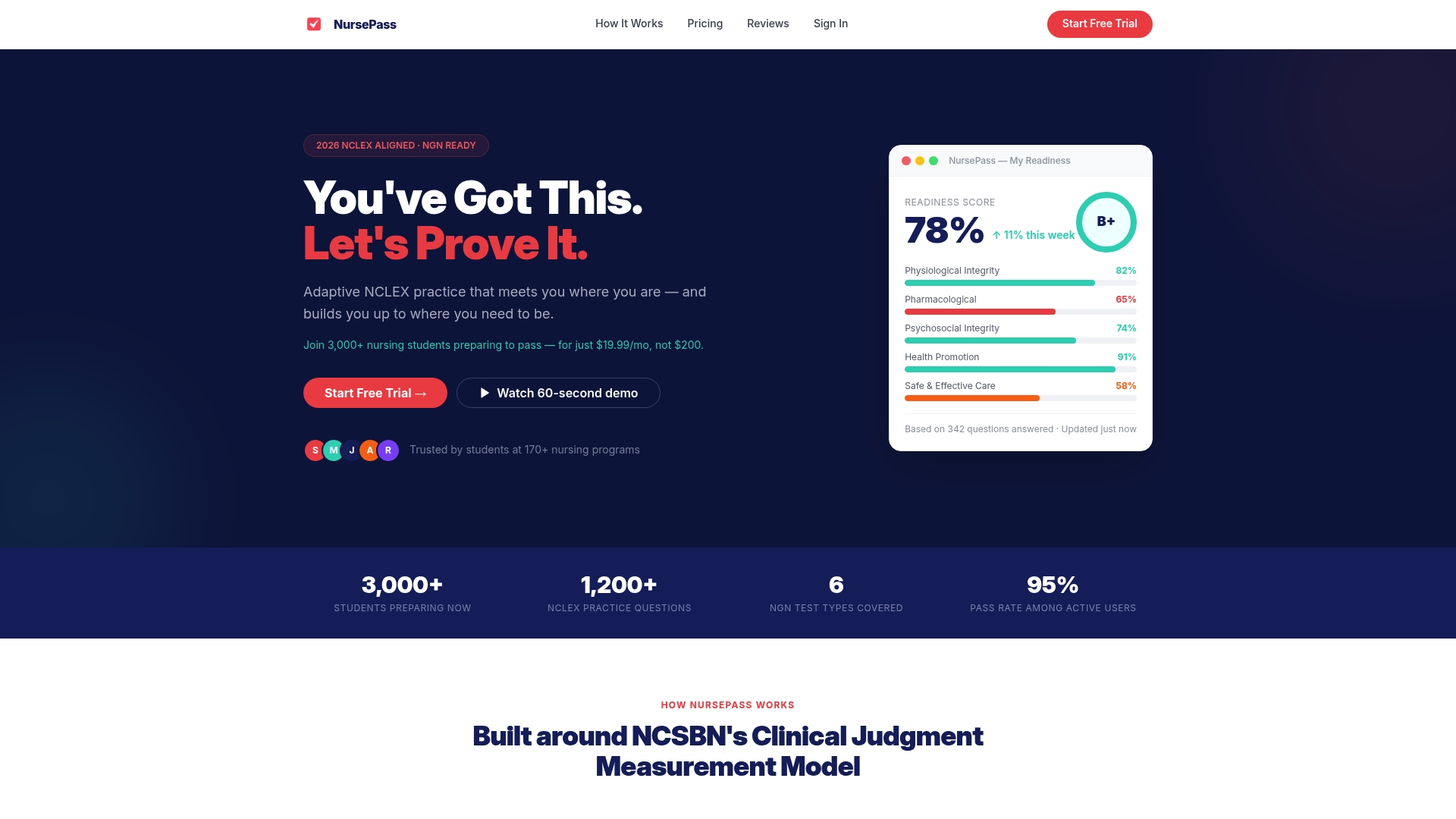
Nursepass gives you over 1,200 adaptive NCLEX practice questions that adjust to your current competency level, so every session builds the decision-making speed the real exam demands. The live readiness score updates as you practice, and the subcategory heat maps show exactly which content areas slow your pacing down. More than 3,000 nursing students use Nursepass, with active users reporting a 95% pass rate. If you are serious about walking into the NCLEX with your pacing dialed in, Nursepass is where that work gets done.
FAQ
What is the 90-second rule for NCLEX pacing?
The 90-second rule is a per-question time cap that prevents you from losing exam time on difficult items. If you cannot answer within 90 seconds, flag the question and move forward.
How does CAT affect pacing on the NCLEX?
The NCLEX CAT format ends when the system reaches 95% confidence in your performance level, not when you hit a fixed question count. Focusing on question count causes anxiety that disrupts your pacing.
Should I take the optional NCLEX break?
Yes. Students who skip breaks show higher error rates on their final questions. Use the 10–15 minute break for stretching, hydration, and a brief mental reset.
How do I stop second-guessing my answers during the exam?
Commit to your first well-reasoned answer and move on. Second-guessing without new information does not improve accuracy. It only wastes time and raises anxiety.
How early should I start practicing exam pacing?
Start timed, full-length practice sets at least four to six weeks before your exam date. Building pacing endurance takes repeated exposure to realistic exam conditions, not last-minute drills.