
The nursing school to NCLEX checklist is a step-by-step framework that takes you from graduation to passing the National Council Licensure Examination, covering eligibility verification, study strategy, and test-day preparation. The National Council of State Boards of Nursing (NCSBN) governs the exam, and its 2026 Next Generation NCLEX (NGN) format places clinical judgment at the center of every question. Approximately 13% of U.S.-educated first-time candidates fail the NCLEX. That number drops sharply for students who follow a structured, data-backed preparation plan from day one of their nursing school to NCLEX transition.
1. Confirm your nursing school to NCLEX checklist eligibility
Eligibility comes before everything else. Completing an accredited nursing program is the first hard requirement before you can register for the NCLEX. Accreditation bodies like the Accreditation Commission for Education in Nursing (ACEN) and the Commission on Collegiate Nursing Education (CCNE) validate your program's standing.
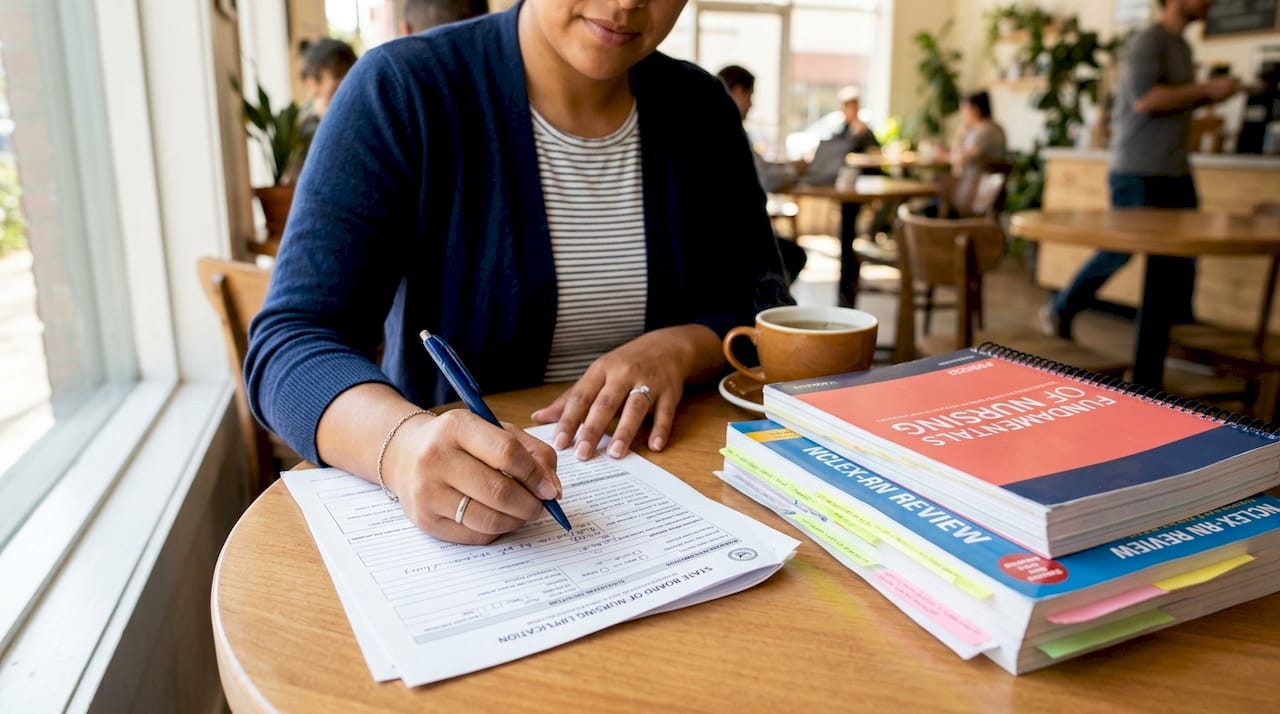
After graduation, apply for licensure through your state board of nursing. Each state has its own application portal, fees, and processing timelines, so check your specific board's requirements early. Do not assume the process is the same across states.
Once your state board approves your application, Pearson VUE sends your Authorization to Test (ATT) by email. The ATT is time-limited, typically valid for 90 days, so schedule your exam promptly after receiving it.
Pro Tip: Schedule your exam within the first two weeks of receiving your ATT. Waiting too long compresses your final study window and adds unnecessary pressure.
2. Apply for state licensure and register with Pearson VUE
The licensure application and NCLEX registration are two separate processes that run in parallel. Submit your state board application first, then register with Pearson VUE to pay the exam fee. Both steps must be complete before your ATT is issued.
Gather your documents before starting either application. You will need official transcripts, proof of graduation, and any state-specific background check materials. Some states also require a Social Security number and fingerprinting.
Pearson VUE manages all NCLEX scheduling. Once your ATT arrives, log into the Pearson VUE portal to select your test center and date. Urban test centers often book out two to three weeks in advance, so check availability early.
3. Build a study plan aligned with the NGN format
The 2026 NGN format tests clinical judgment through six new item types, including unfolding case studies, matrix questions, and extended drag-and-drop items. Memorizing facts is not enough. You need to practice making decisions the way a safe, entry-level nurse would.
Structure your study plan around the four major client needs categories: Safe and Effective Care Environment, Health Promotion and Maintenance, Psychosocial Integrity, and Physiological Integrity. These categories anchor every NCLEX question, so your review must cover all four without skipping the ones that feel less familiar.
A daily target of 75–100 practice questions, including NGN-style case studies, builds both speed and clinical reasoning. Spread your sessions across morning and evening blocks to avoid mental fatigue. Use a self-study plan to map out your weeks from the start.
Pro Tip: Treat every study session like a clinical shift. Ask yourself "What would a safe nurse do?" before selecting any answer. That mindset shift is what the NGN format rewards.
4. Review rationales for every practice question
Reviewing rationales for every question, including the ones you answered correctly, is the single most underused study habit among nursing students. Correct answers reached by guessing do not build clinical judgment. They create a false sense of readiness.
When you review a rationale, identify the clinical principle behind the correct answer. Ask why the other options were wrong. This process trains you to recognize patterns across question types, which is exactly what the NGN format demands.
Rationale review also exposes your knowledge gaps faster than any other method. A wrong answer with a well-understood rationale is more valuable than a correct answer you cannot explain.
5. Use readiness assessments as your progress benchmark
Four consecutive readiness assessment scores rated "High" or "Very High" correlate with a 99% chance of passing the NCLEX. That is not a motivational claim. It is a data point that tells you exactly when you are ready to sit for the exam.
Readiness assessments work because they simulate exam conditions and measure your performance across all content categories. A single high score is encouraging. Four consecutive high scores are predictive. Use the NCLEX readiness assessment guide to understand how to interpret your scores and act on the results.
Schedule your exam only after your scores consistently land in the high range. Booking the exam before reaching that threshold adds risk without adding benefit.
6. Build exam endurance for a five-hour test
The NCLEX runs up to five hours and delivers between 85 and 150 questions depending on the computer adaptive testing (CAT) algorithm. The exam algorithm stops when 95% statistical confidence is reached, not at a fixed question count. A longer exam does not mean you are failing.
Mental endurance is a trainable skill. Practice sitting for 90-minute uninterrupted question blocks at least twice a week in the final month before your exam. This trains your brain to sustain focus under timed pressure.
Avoid cramming the night before. Sleep, hydration, and a normal routine do more for your performance on exam day than one more practice set at midnight.
7. Prepare your exam day checklist
Every item on your exam day checklist matters. Missing one can prevent you from sitting for the exam.
- Valid, government-issued photo ID (driver's license, passport, or state ID)
- Your ATT email or letter printed or accessible on your phone
- A small water bottle and snacks for the break period
- Cash for incidental expenses like parking or vending machines
- Comfortable, layered clothing since test center temperatures vary
Do not bring electronic devices, smartwatches, study materials, or personal items beyond what the test center allows. Pearson VUE test centers provide lockers for prohibited items, but leaving them at home is simpler.
Arrive at least 30 minutes early. Late arrivals may forfeit their exam appointment without a refund.
8. Avoid the most common transition mistakes
Most NCLEX failures trace back to a small set of avoidable errors. Recognizing them before exam day is the advantage most students skip.
- Relying on memorization instead of clinical application. The NGN format rewards decision-making, not recall. Shift your study focus to "why" and "what next" rather than "what is."
- Skipping rationale reviews. Students who skip rationales after practice questions repeat the same errors. Rationale review is not optional.
- Panicking over exam length. A longer exam is not a signal of failure. The CAT algorithm adjusts to your performance, and more questions simply mean the system needs more data.
- Ignoring delegation and safe care topics. NCLEX testing prioritizes clinical safety judgment over content recall, with delegation, prioritization, and infection control carrying significant weight.
- Scheduling the exam before readiness scores are consistent. Booking early feels productive but costs you if your scores are not yet in the high range.
"The NCLEX is not a test of what you know. It is a test of how safely you think. Students who shift from memorization to clinical decision-making pass at a significantly higher rate."
Pro Tip: Use an adaptive study plan that adjusts question difficulty based on your current performance. Static question banks do not replicate the CAT experience.
Key Takeaways
The most reliable path from nursing school to passing the NCLEX combines confirmed eligibility, consistent NGN-style practice, and data-backed readiness assessments before scheduling your exam date.
| Point | Details |
|---|---|
| Confirm eligibility first | Graduate from an accredited program and apply for state licensure before registering with Pearson VUE. |
| Practice NGN-style questions daily | Complete 75–100 questions per day, including unfolding case studies, to build clinical judgment. |
| Review every rationale | Read rationales for correct and incorrect answers to close knowledge gaps and avoid repeated errors. |
| Use readiness scores to time your exam | Four consecutive "High" or "Very High" readiness scores predict a 99% pass rate. |
| Prepare your exam day items in advance | Bring valid photo ID, your ATT, snacks, water, and cash. Leave all electronic devices at home. |
What I have learned about the nursing school to NCLEX transition
Most students treat the NCLEX like a final exam. It is not. It is a licensure decision, and the exam is designed to determine whether you are safe to practice, not whether you can recall the most facts under pressure.
The students I have seen struggle most are the ones who studied hard in nursing school but never shifted their mindset from "memorize and repeat" to "assess and decide." The NGN format makes that shift non-negotiable. Clinical judgment questions do not reward the student who knows the most. They reward the student who thinks most like a safe nurse.
Readiness assessments changed how I think about exam timing. Booking the exam based on a calendar date feels like control. Booking it based on four consecutive high readiness scores is actual control. The data tells you when you are ready. Trust it over your gut.
Mental stamina is the most underestimated factor in NCLEX preparation. Sitting for five hours under pressure is a physical and cognitive challenge. Students who practice long question sessions in the weeks before their exam perform noticeably better than those who only do short daily sets. Build that endurance deliberately.
— Michael
Nursepass supports your path from nursing school to NCLEX
Preparing for the NCLEX requires more than a stack of textbooks. It requires a system that tells you where you stand, what to work on next, and when you are ready to sit for the exam.
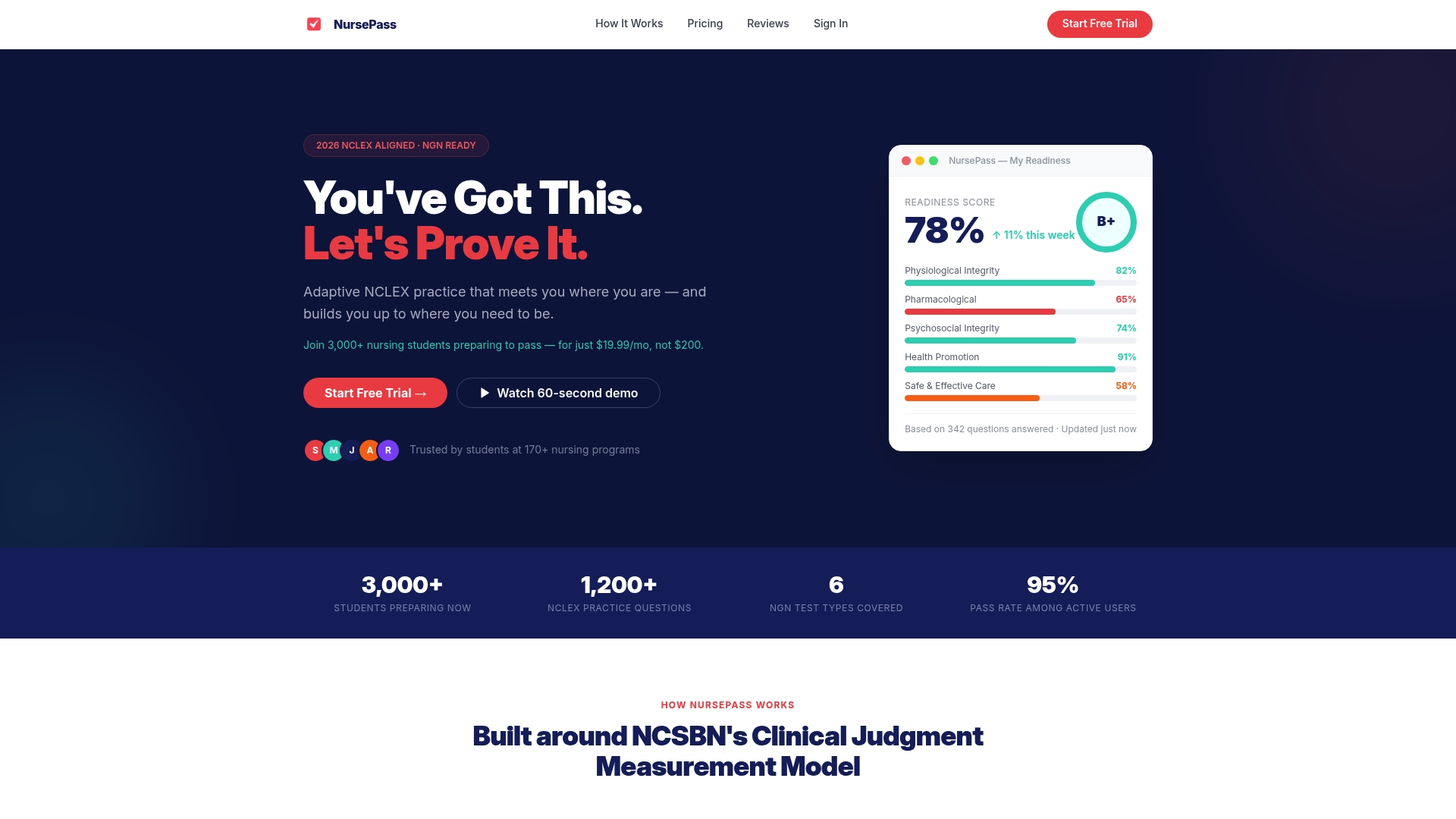
Nursepass is built specifically for nursing students in this transition. The platform offers over 1,200 NCLEX practice questions calibrated to the 2026 NGN format, a live readiness score that updates as you practice, and subcategory heat maps that show exactly where your knowledge gaps are. More than 3,000 nursing students have used Nursepass, with a 95% pass rate among active users. If you want a structured, data-driven path from graduation to passing, Nursepass gives you the tools to get there.
FAQ
What is the nursing school to NCLEX checklist?
The nursing school to NCLEX checklist is a structured framework covering graduation from an accredited program, state licensure application, NCLEX registration, study planning, and exam day preparation. It ensures no critical step is missed before sitting for the exam.
How many questions are on the NCLEX in 2026?
The NCLEX delivers between 85 and 150 questions depending on the computer adaptive testing algorithm, which stops once 95% statistical confidence in your performance level is reached. Exam length varies by candidate and does not indicate pass or fail status.
When should I schedule my NCLEX after nursing school?
Schedule your exam after receiving your ATT and after achieving four consecutive "High" or "Very High" readiness assessment scores, which research links to a 99% pass rate. Do not book based on a calendar date alone.
What does the 2026 NGN format test?
The Next Generation NCLEX tests clinical judgment and safe decision-making through six new item types, including unfolding case studies, matrix questions, and extended multiple-response items. Delegation, prioritization, and infection control carry significant weight.
What should I bring to the NCLEX test center?
Bring a valid government-issued photo ID, your Authorization to Test letter or email, a small water bottle, snacks, and cash for incidentals. Electronic devices, smartwatches, and study materials are not permitted inside the testing room.