
Clinical judgment is the core cognitive skill the NCLEX measures, defined by the NCSBN as the process of observing cues, analyzing data, and deciding on safe nursing actions. The 2026 NCLEX test plan continues to build the entire exam around this skill, testing it through case-study item sets and stand-alone questions. Nursing students who master clinical judgment NCLEX strategies do not just pass the exam. They build the decision-making foundation that defines safe, effective nursing practice from day one on the floor.
What are the six clinical judgment steps tested on the NCLEX?
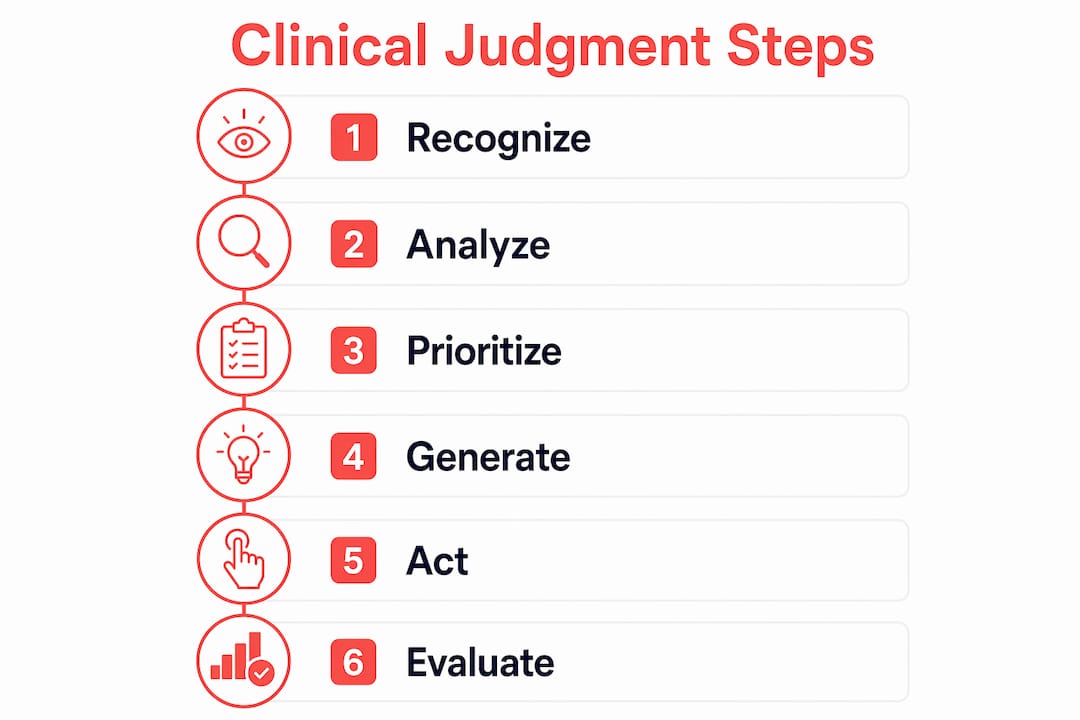
The six measurable clinical judgment functions tested by the NCLEX are: recognize cues, analyze cues, prioritize hypotheses, generate solutions, take action, and evaluate outcomes. These steps form the NCSBN Clinical Judgment Measurement Model (NCJMM), which is the official framework behind every clinical judgment question on the exam. Understanding each step is not optional. It is the foundation of your entire test strategy.
Here is what each step means in practice:
- Recognize cues: Identify relevant patient data from the scenario. This means spotting abnormal vital signs, lab values, or symptoms that matter, while ignoring irrelevant details.
- Analyze cues: Determine what the cues mean together. A patient with low oxygen saturation, increased respiratory rate, and confusion points toward respiratory failure, not anxiety.
- Prioritize hypotheses: Rank possible explanations by urgency. The most life-threatening condition gets your attention first.
- Generate solutions: Identify nursing interventions that address the prioritized hypothesis. Think about what actions are within your scope and what the patient needs most.
- Take action: Select and carry out the most appropriate intervention. The NCLEX tests whether you choose the right action at the right time.
- Evaluate outcomes: Reassess the patient after your action. Did the intervention work? What changed? What comes next?
NCLEX questions may target one step or ask you to move through several steps within a single case study. Recognizing which step a question is testing helps you focus your reasoning and avoid overthinking.
Pro Tip: When you read a question stem, ask yourself: "Is this asking me to notice something, decide something, act on something, or check the result?" That single question tells you which NCJMM step is in play.

How to apply the 7-step method to NCLEX case-study questions
Experts recommend a structured 7-step method for navigating complex NCLEX clinical judgment case studies. This method works because it forces you to slow down, read the full picture, and reason like a nurse rather than guess from habit. Students who apply it consistently report stronger accuracy on high-difficulty NCLEX questions.
- Read the scenario headline carefully. The opening line tells you the patient's age, setting, and chief complaint. That context shapes every answer that follows.
- Scan all information tabs before answering. Case studies include multiple tabs: history, vitals, labs, medications, and provider orders. Read all of them before selecting any answer.
- Isolate relevant cues from extraneous data. Not every detail matters. Identify the two or three findings that are abnormal, trending, or unexpected.
- Identify which clinical judgment step the question assesses. Is it asking you to recognize a problem, prioritize it, act on it, or evaluate it? Match your reasoning to the step.
- Apply priority frameworks in context. Use ABCs (airway, breathing, circulation), safety, and acute before chronic. Apply them critically, not automatically. A patient with a blocked airway beats every other concern.
- Choose actions within the nurse's scope. The NCLEX will offer tempting answer choices that belong to the provider, not the nurse. Eliminate those first.
- Reassess the patient after every intervention. Careful reassessment after every nursing action is critical for evaluating outcomes and choosing the next best step.
Pro Tip: Never answer a case-study question from the first tab alone. Students who skip to the question without reading all tabs miss the cues that change the correct answer entirely.
What are common clinical judgment mistakes on the NCLEX?
Common NGN mistakes include treating all abnormal findings as equally urgent, missing trends, choosing provider actions instead of nursing actions, and selecting too many answer options. These errors reduce exam accuracy and require active correction through practice and self-awareness. Knowing the pattern of your mistakes is more valuable than reviewing content you already know.
The most frequent errors nursing students make on clinical judgment questions include:
- Treating all abnormal findings as equally urgent. A mildly elevated blood pressure in a chronic hypertension patient is not the same emergency as a sudden drop in oxygen saturation. Context determines urgency.
- Missing trends over time. A single abnormal value is less alarming than a value that has been worsening across three assessments. Always look for direction and change, not just a snapshot.
- Selecting provider-only actions. Ordering a CT scan, prescribing medication, or inserting a central line are not nursing actions. If an answer requires a provider order you do not have, eliminate it.
- Choosing too many options in multiple-response questions. More is not better. Select only the options that are clearly supported by the clinical data in the scenario.
- Skipping outcome evaluation. After a nursing action, the next logical step is to check whether it worked. Students who ignore the evaluate outcomes step miss a predictable category of questions.
Pro Tip: After every practice session, sort your wrong answers by NCJMM step. If most errors cluster in "prioritize hypotheses," that is your study target, not a random weakness.
How to prioritize NCLEX clinical judgment questions based on nursing scope and safety
Priority frameworks such as ABCs, safety, acute before chronic, and Maslow's hierarchy guide answer selection on clinical judgment items. Applying them in context, rather than mechanically, is what separates high scorers from students who second-guess every answer. The goal is to match the urgency of the situation to the scope of the nurse.
Applying priority frameworks correctly
ABCs remain the most reliable starting point. Airway problems take priority over breathing problems, which take priority over circulation problems. A patient who cannot breathe beats every other concern on the list. Safety comes next. A patient at immediate risk of falling, self-harm, or medication error requires action before a patient with chronic pain.
Acute before chronic is a rule that trips up many students. A patient with newly onset chest pain and diaphoresis takes priority over a patient with a known history of angina who is stable. The word "new" or "sudden" in a scenario is a cue that urgency has shifted.
Matching actions to nursing scope
The NCLEX tests whether you know what a nurse can do independently versus what requires a provider order. Use this framework when evaluating answer choices:
| Situation | Nursing action | Provider-only action |
|---|---|---|
| Low oxygen saturation | Apply supplemental oxygen | Order a chest X-ray |
| Elevated blood glucose | Notify provider, check orders | Prescribe insulin dose |
| Patient fall risk | Implement fall precautions | Order physical therapy consult |
| Acute pain | Administer ordered analgesic | Prescribe new pain medication |
Nursing students who understand NCLEX test plan categories recognize that scope-of-practice questions appear across every content area. Practicing this distinction daily builds the reflex you need under exam pressure.
What practice routines boost clinical judgment skills for NCLEX success?
Practicing NGN-style case studies weekly using NCLEX-aligned resources with strong rationales is the most effective way to build clinical judgment skills. Rote memorization of facts does not prepare you for questions that require reasoning through a patient scenario. Consistent, reflective practice does.
Build your study routine around these habits:
- Read full case studies, not isolated questions. Practicing with complete scenarios trains your brain to process multiple data points at once, which is exactly what the exam demands.
- Remediate by reasoning pattern, not by topic. When you miss a question, identify whether the error was in recognizing cues, prioritizing, or evaluating outcomes. Fix the reasoning flaw, not just the content gap.
- Study pharmacology in clinical context. Knowing a drug's mechanism is less useful than knowing when a nurse should hold it, report a side effect, or reassess after administration.
- Avoid rapid guessing. Students who rush through clinical judgment practice questions without reading the full scenario reinforce bad habits. Slow, deliberate practice builds the right instincts.
- Track your performance by subcategory. Knowing that you score well on "recognize cues" but struggle with "evaluate outcomes" tells you exactly where to spend your next study hour.
- Review the 2026 NCLEX test plan updates. The 2026 NCLEX test plan continues to emphasize clinical judgment with revised Client Needs categories. Aligning your study to the current plan prevents wasted effort on outdated content.
Nursepass supports this kind of targeted preparation with over 1,200 NCLEX practice questions, a live readiness score, and subcategory heat maps that show exactly where your clinical reasoning gaps are. More than 3,000 nursing students have used Nursepass, and the platform reports a 95% pass rate among active users. That kind of feedback loop, seeing your weak spots in real time, is what makes practice sessions productive rather than repetitive.
Pro Tip: After completing a full case study, write one sentence explaining why the correct answer was right and why your wrong choice was wrong. That single habit accelerates reasoning improvement faster than re-reading content.
Key takeaways
Mastering clinical judgment NCLEX strategies requires understanding the NCJMM framework, applying a structured approach to case-study questions, and practicing prioritization within nursing scope consistently.
| Point | Details |
|---|---|
| Know the six NCJMM steps | Recognize, analyze, prioritize, generate, act, and evaluate are the six steps every NCLEX clinical judgment question tests. |
| Use the 7-step case-study method | Read all tabs, isolate cues, identify the judgment step, and reassess after every action before selecting your answer. |
| Avoid the most common errors | Do not treat all abnormals as equally urgent, and never select provider-only actions as nursing interventions. |
| Apply priority frameworks in context | Use ABCs, safety, and acute-before-chronic critically, not automatically, to match urgency to the clinical situation. |
| Practice with purpose and reflection | Remediate by reasoning pattern, track subcategory performance, and study full case studies rather than isolated questions. |
Why clinical judgment is the skill that defines your nursing career
Most students treat the NCLEX as a content exam. They memorize lab values, drug names, and disease processes, then wonder why they still struggle with case-study questions. The exam is not testing what you know. It is testing how you think when a patient's condition is changing and you have to act.
I have seen nursing students with strong content knowledge freeze on clinical judgment questions because they never practiced reasoning under pressure. The NCJMM framework is not bureaucratic structure. It is a map of how experienced nurses actually think at the bedside. When you internalize those six steps, you stop guessing and start reasoning.
The students who improve fastest are not the ones who study the most hours. They are the ones who reflect on why they got a question wrong, identify the reasoning flaw, and correct it before the next session. That kind of deliberate practice is uncomfortable. It requires you to sit with a wrong answer and understand it rather than move on. But it is the only thing that actually changes how you think.
Clinical judgment matters beyond the exam. The nurse who can recognize a deteriorating patient, prioritize the right intervention, and evaluate whether it worked is the nurse who prevents codes, catches medication errors, and earns the trust of the team. The NCLEX is measuring whether you are ready to be that nurse. These strategies prove that you are.
— Michael
How Nursepass prepares you for clinical judgment questions
Nursing students who want structured, adaptive preparation for the 2026 NCLEX will find that Nursepass is built specifically for this challenge.
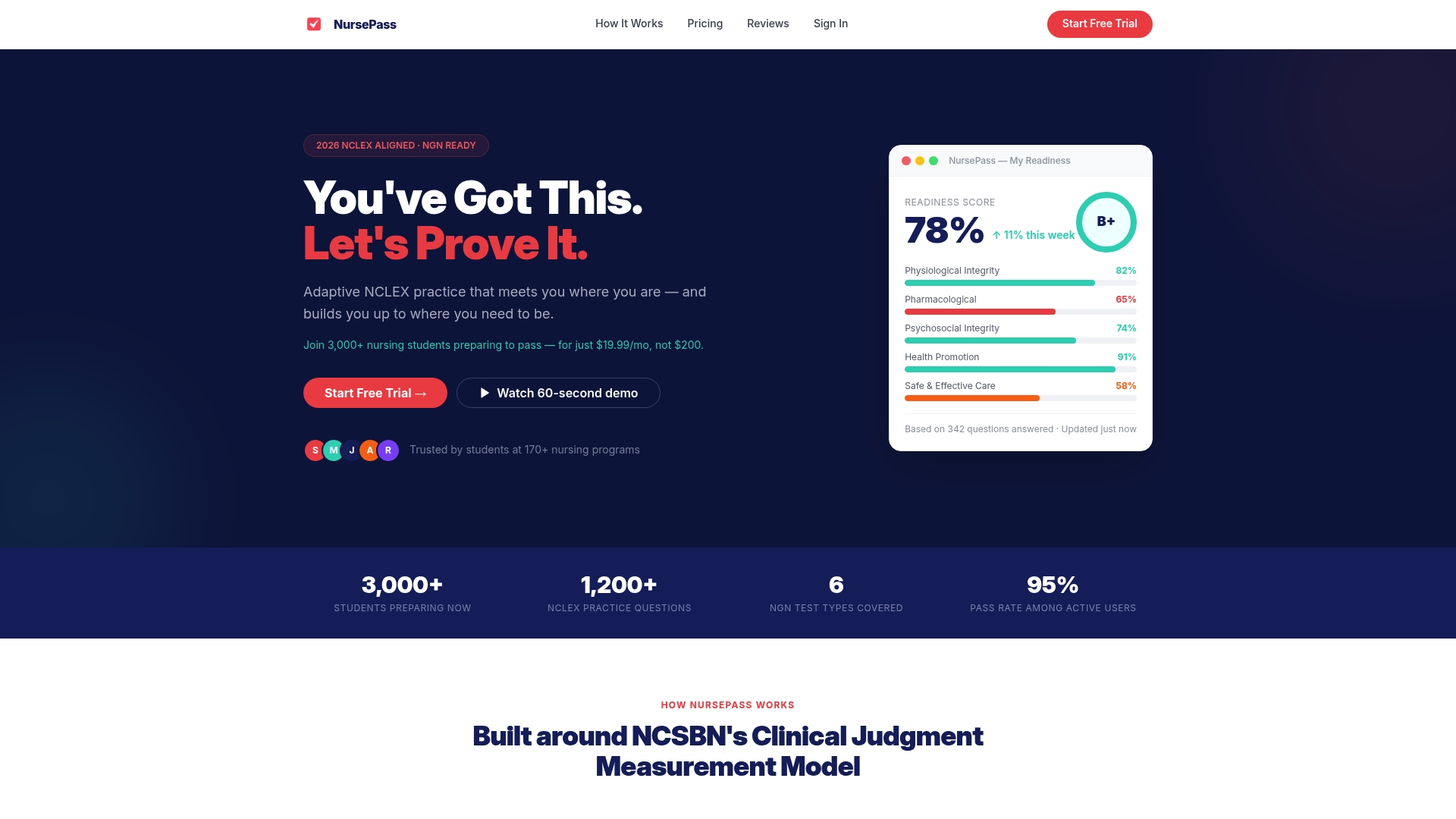
Nursepass offers over 1,200 NCLEX practice questions aligned with the 2026 test plan, including clinical judgment case studies with detailed rationales. The platform's adaptive engine adjusts question difficulty to your current performance level, so every session targets your actual weak spots rather than content you have already mastered. The live readiness score and subcategory heat maps give you a clear picture of where your clinical reasoning stands right now. With a 95% pass rate among active users, Nursepass gives nursing students the focused, data-driven preparation that turns clinical judgment strategies into real exam confidence.
FAQ
What is clinical judgment on the NCLEX?
Clinical judgment on the NCLEX is the process of recognizing patient cues, analyzing their meaning, prioritizing hypotheses, generating solutions, taking action, and evaluating outcomes. The NCSBN Clinical Judgment Measurement Model (NCJMM) defines these six steps as the official framework for all clinical judgment questions.
How many clinical judgment questions appear on the NCLEX?
The NCLEX includes 18 case-study item sets and approximately 10% stand-alone clinical judgment items. These items test one or more of the six NCJMM steps within realistic patient scenarios.
What priority framework works best for NCLEX clinical judgment questions?
ABCs (airway, breathing, circulation), safety, and acute before chronic are the most reliable priority frameworks for NCLEX clinical judgment questions. Apply them in context rather than automatically, since the clinical scenario always determines which framework applies first.
How do I avoid choosing provider actions on NCLEX questions?
Before selecting any answer, ask whether the action requires a provider order. Nursing actions include administering ordered medications, applying oxygen, implementing fall precautions, and notifying the provider. Ordering tests, prescribing medications, and performing procedures outside nursing scope are provider-only tasks.
How often should I practice clinical judgment case studies before the NCLEX?
Practice at least several NGN-style case studies each week using NCLEX-aligned resources with strong rationales. Remediate missed questions by reasoning pattern and retest weak areas rather than moving on without reflection.