
Types of NCLEX practice questions now include innovative formats designed to assess clinical judgment far beyond traditional multiple-choice recall. The National Council of State Boards of Nursing (NCSBN) introduced the Next Generation NCLEX (NGN) to measure clinical reasoning through the Clinical Judgment Measurement Model (CJMM). Mastering the full NCLEX question breakdown, from standard multiple-choice to unfolding case studies, is the most direct path to exam confidence. Nursing students who practice across all NGN formats build the layered thinking skills the exam actually tests.
1. Types of NCLEX practice questions: the full NGN breakdown
The NGN includes six primary innovative item types: Bow-Tie, Matrix/Grid, Cloze (drop-down), Trend, Extended Multiple Response, and Highlight/Hot Spot. Each format uses a distinct scoring model, including 0/1 all-or-nothing, plus/minus scoring, and Rationale Scoring. That variety means a single study method built around traditional multiple-choice questions will leave critical gaps. Knowing each format before exam day removes the cognitive shock of encountering an unfamiliar question structure under timed conditions.

2. Extended multiple response and traditional multiple-choice questions
Extended Multiple Response (EMR) is the NGN's updated version of the classic "select all that apply" format. The key difference is scoring: EMR uses partial credit scoring, so selecting some correct options still earns points even if you miss others. Traditional multiple-choice questions use 0/1 scoring, meaning one correct answer earns full credit and any wrong answer earns nothing. Understanding which scoring model applies changes how you approach each question.
When practicing EMR items, apply these strategies:
- Read every option independently before selecting any.
- Ask yourself, "Would a safe nurse do this?" for each choice.
- Avoid selecting options just because they sound clinically reasonable in isolation.
- Do not leave EMR items blank. Partial credit rewards thoughtful selection.
Pro Tip: On EMR items, commit to each option as a true-or-false decision rather than ranking options against each other. That mental shift reduces second-guessing and improves accuracy.
Traditional multiple-choice questions remain part of the NCLEX and still require strong content knowledge. They test recall and application but do not reflect the full clinical reasoning the NGN demands. Treat them as a foundation, not a ceiling.
3. Matrix/Grid and Bow-Tie questions for parallel clinical reasoning
Matrix/Grid and Bow-Tie items are the most cognitively demanding NCLEX question formats. Both require you to evaluate multiple clinical cues simultaneously rather than selecting a single best answer.
Matrix/Grid items present a table where each row represents a clinical option and each column represents a category, such as "Indicated" or "Contraindicated." You select a response for every row. Multiple-choice matrix items use 0/1 scoring per row, while multiple-response matrix items use plus/minus scoring. Missing one row costs you, so careful reading of every cell matters.
Bow-Tie items place a central clinical condition in the middle of a diagram. You then select nursing actions on one side and monitoring parameters on the other. Bow-Tie items use Rationale Scoring, which rewards interconnected correctness rather than isolated responses. Getting the center right but the actions wrong earns less than a fully aligned answer.
Nursing students struggle most with Bow-Tie and Matrix questions because these formats require parallel decision-making aligned with all six steps of the CJMM. Practicing within that framework is the most efficient preparation approach.
Common challenges with these formats include:
- Selecting actions that are clinically correct in general but wrong for the specific condition presented.
- Ignoring the monitoring parameters column and focusing only on interventions.
- Rushing through the matrix rows without reading each category header carefully.
Pro Tip: Use the "center-out" approach on Bow-Tie items. Identify the core condition first, then logically deduce which actions and parameters connect to it. This method simplifies analysis of complex interconnected elements and raises accuracy.
Mastery of the Bow-Tie format builds exam confidence because a single item tests multiple judgment tasks at once. Students who practice Bow-Tie questions regularly report stronger performance across all NGN formats, not just this one.
4. Drag-and-Drop (Cloze), Drop-Down, and Highlight/Hot Spot formats
These three interactive formats test cause-and-effect reasoning, data interpretation, and the ability to identify clinically significant findings within a body of text or data.
Cloze (drag-and-drop) items present a nursing note or clinical scenario with blank spaces. You drag the correct terms or phrases into each blank. Some versions ask you to prioritize a sequence of nursing actions. Scoring is typically per blank, so one wrong placement does not erase all your points.
Drop-down items embed a menu of choices within a sentence or table. The linked rationale format connects two drop-down choices, meaning your selection in one field must logically support your selection in another. This format tests cause-and-effect logic directly.
Highlight/Hot Spot items present a block of clinical text, such as a nurse's note or lab results, and ask you to click on findings that are concerning or improving. Over-selecting in Highlight items leads to zero points because plus/minus scoring penalizes incorrect selections. Strategic selection is not optional here. It is the entire skill being tested.
Effective strategies for these formats include:
- Read the full scenario before selecting anything.
- For Highlight items, identify only findings that are clinically abnormal or clearly significant.
- For drop-down linked rationale items, read both blanks together before committing to either answer.
- Practice reading nursing notes quickly, since time pressure is real on these items.
Pro Tip: Treat Highlight items like a triage decision. Ask yourself, "Would I call the physician about this finding right now?" If the answer is no, do not highlight it.
5. Trend items and unfolding case studies
Trend items and case studies represent the highest-order NCLEX question formats because they require you to analyze patient data across time and apply clinical judgment to a realistic, evolving scenario.
Trend items present vital signs, lab values, or assessment findings at multiple time points. Your task is to identify whether the patient is improving, deteriorating, or stable. Trend items test early CJMM steps like Recognize Cues and Analyze Cues. A patient whose blood pressure drops from 118/76 to 88/52 over three readings is telling a clear story. Your job is to read it accurately and quickly.
Unfolding case studies present a patient scenario that evolves across six linked questions. Each question tests a different step of the CJMM, from recognizing cues to evaluating outcomes. Case studies simulate real-world nursing judgment through multiple linked questions, making them the closest thing to actual clinical decision-making on the exam.
| Question in case study | CJMM step tested | Example task |
|---|---|---|
| Question 1 | Recognize Cues | Identify abnormal assessment findings |
| Question 2 | Analyze Cues | Determine what the findings suggest |
| Question 3 | Prioritize Hypotheses | Select the most likely clinical condition |
| Question 4 | Generate Solutions | Choose appropriate nursing interventions |
| Question 5 | Take Action | Implement the correct priority action |
| Question 6 | Evaluate Outcomes | Assess whether interventions worked |
Strategies for trend and case study items:
- Practice reading NCLEX case study format scenarios under timed conditions to build reading speed.
- After each case study, map your wrong answers to the specific CJMM step you missed.
- Do not treat each question in a case study as independent. The scenario builds, and earlier answers inform later ones.
- Review lab reference ranges regularly so trend data reads as meaningful, not just numbers.
6. How to choose the right question types for your study plan
Not all NCLEX question formats deserve equal practice time at every stage of preparation. The right mix depends on where you are in your study plan and which CJMM steps feel weakest.
| Question format | Scoring model | Judgment skill focus | Best used for |
|---|---|---|---|
| Traditional multiple-choice | 0/1 | Knowledge recall | Building content foundation |
| Extended Multiple Response | Plus/minus partial credit | Analysis and selection | Mid-prep skill building |
| Matrix/Grid | 0/1 or plus/minus per row | Parallel evaluation | Strengthening systematic thinking |
| Bow-Tie | Rationale scoring | Linked clinical reasoning | Advanced prep and confidence |
| Cloze/Drag-and-Drop | Per blank | Sequencing and prioritization | Procedural and care-planning practice |
| Drop-Down | 0/1 or linked rationale | Cause-and-effect logic | Pharmacology and pathophysiology |
| Highlight/Hot Spot | Plus/minus | Data identification | Assessment and monitoring practice |
| Trend | Plus/minus | Recognize and Analyze Cues | Data interpretation drills |
| Unfolding Case Study | Mixed per question | Full CJMM sequence | Comprehensive readiness checks |
Start your preparation with traditional multiple-choice and Extended Multiple Response to build content knowledge and basic reasoning. Move into Matrix, Bow-Tie, and case studies as your NCLEX readiness grows. Trying to master Bow-Tie items before you understand the underlying content is a common mistake that wastes study time.
Pro Tip: Track which question formats you consistently miss. If Highlight items are your weak spot, that signals a gap in clinical assessment skills, not just test-taking strategy. Address the underlying skill, not just the format.
Key takeaways
The most effective NCLEX preparation covers all nine NGN question formats because each one tests a different step of the Clinical Judgment Measurement Model.
| Point | Details |
|---|---|
| NGN has nine distinct formats | Each format uses a different scoring model and tests a specific clinical judgment skill. |
| Scoring model shapes strategy | Plus/minus scoring penalizes over-selection; rationale scoring rewards linked reasoning across all choices. |
| Bow-Tie and Matrix are hardest | These formats require parallel decision-making aligned with the CJMM and need dedicated practice. |
| Case studies test the full CJMM | Each of the six linked questions maps to one step of clinical judgment from recognition to evaluation. |
| Match format to study stage | Build content knowledge with multiple-choice first, then progress to Bow-Tie and case studies. |
The format is the message
I have reviewed a lot of NCLEX prep approaches over the years, and the most common mistake I see is treating all practice questions as interchangeable. A student who drills 500 traditional multiple-choice questions and then walks into the NGN is not prepared. They are just fast at a skill the exam no longer rewards on its own.
The NGN formats are not harder versions of the old exam. They are a different cognitive task. Bow-Tie items ask you to hold a clinical condition in your mind while simultaneously evaluating actions and parameters. That is not recall. That is clinical reasoning, and it requires deliberate practice with the right format.
My strongest recommendation is to learn the six steps of the CJMM before you practice a single NGN question. Mapping errors to CJMM steps after each practice session is the fastest way to identify exactly where your reasoning breaks down. A wrong answer on a Trend item usually means a gap in Recognize Cues. A wrong answer on a Bow-Tie usually means a gap in Generate Solutions or Take Action. Once you know which step fails you, your study becomes targeted instead of scattered.
The students I have seen pass with confidence are not the ones who practiced the most questions. They are the ones who understood why each format exists and what clinical skill it demands.
— Michael
Nursepass: practice every NGN format in one place
Preparing for the NGN means you need access to every question format, not just traditional multiple-choice. Nursepass covers all NGN item types across its bank of over 1,200 NCLEX practice questions, including Bow-Tie, Matrix/Grid, Highlight, Trend, and unfolding case studies.
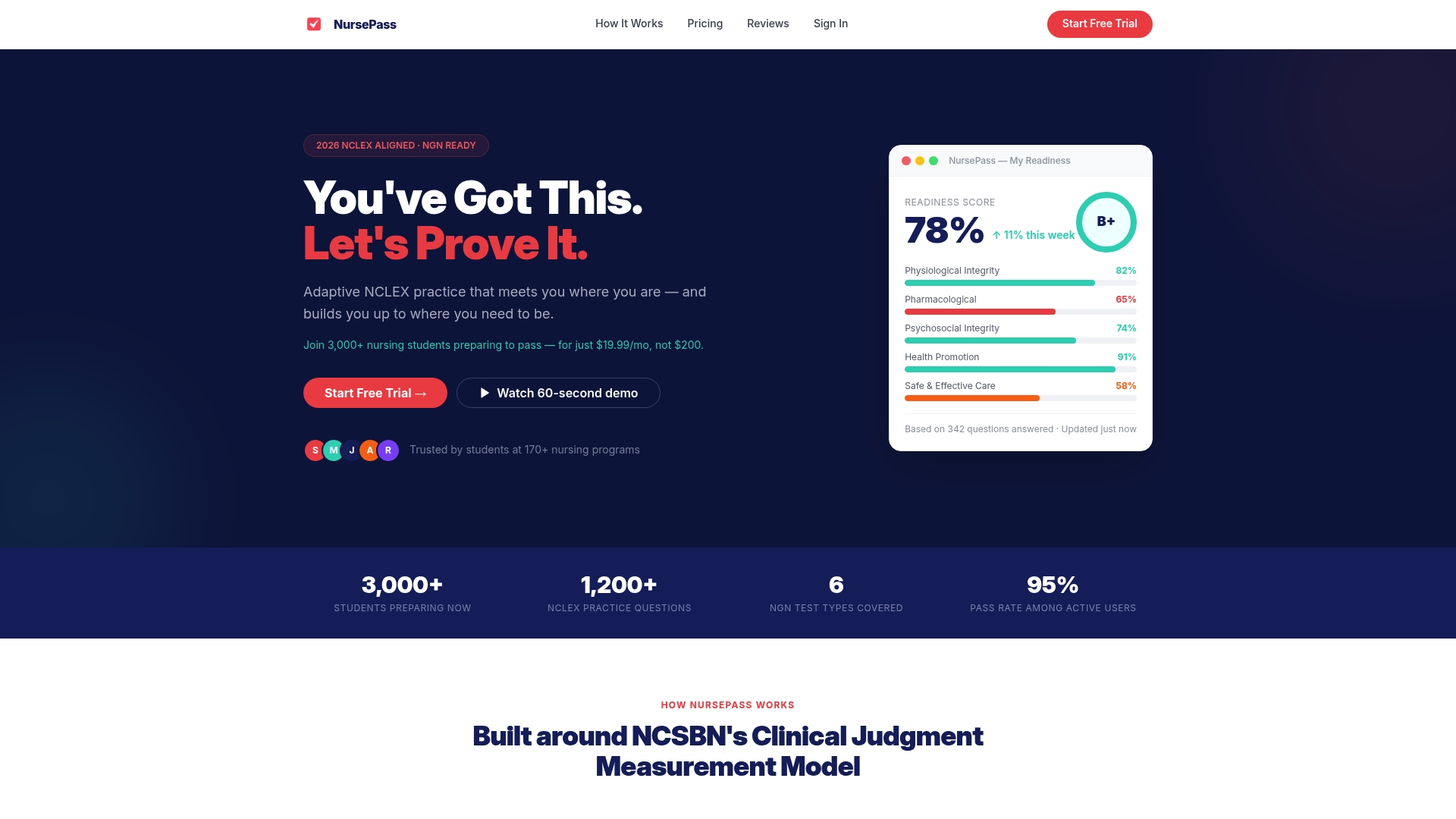
The platform's adaptive engine adjusts question difficulty to your current competency level, so you spend time on the formats and content areas where you actually need work. A live readiness score and subcategory heat maps show you exactly where your clinical judgment is strong and where it needs attention. More than 3,000 nursing students have used Nursepass, and active users report a 95% pass rate. Every question includes detailed rationales so you can map wrong answers directly to the CJMM step you missed.
FAQ
What are the main types of NCLEX practice questions in 2026?
The NGN includes nine question formats: traditional multiple-choice, Extended Multiple Response, Matrix/Grid (multiple-choice and multiple-response), Bow-Tie, Cloze drag-and-drop, drop-down, Highlight/Hot Spot, Trend, and unfolding case studies. Each format tests a different step of the NCSBN Clinical Judgment Measurement Model.
How does scoring differ across NCLEX question formats?
Scoring models vary by format: traditional multiple-choice uses 0/1 scoring, Extended Multiple Response and Highlight items use plus/minus partial credit, and Bow-Tie items use Rationale Scoring that rewards interconnected correct reasoning across all selections.
Why are Bow-Tie questions considered the hardest NCLEX format?
Bow-Tie items require you to link a central clinical condition with correct nursing actions and monitoring parameters simultaneously. They use Rationale Scoring, which means partially correct answers earn less credit than fully aligned responses across all three components.
What is the best way to practice NCLEX alternate format questions?
The most efficient approach is to practice each NGN format within the CJMM framework and then map wrong answers to the specific clinical judgment step you missed. This targeted review improves both content knowledge and exam performance faster than volume-based drilling.
How many questions should I practice before the NCLEX?
No single number guarantees readiness. The quality and variety of practice matters more than volume. Practicing across all different NCLEX question formats with detailed rationale review builds the clinical reasoning skills the exam actually measures.