
The NCLEX case study format is defined as a set of unfolding clinical scenarios presented through electronic health record style tabs, requiring candidates to apply the NCSBN Clinical Judgment Measurement Model (CJMM) across six cognitive steps. The Next Generation NCLEX (NGN) update made this format central to the exam, shifting the focus from isolated recall to active clinical reasoning. The NCLEX exam includes 18 case-study items divided into three sets of 6 linked questions each, plus roughly 10% stand-alone clinical judgment items. That structure means case studies account for a significant share of your score, making fluency with the format non-negotiable.
What is the NCLEX case study format and how is it structured?
The NCLEX case study format presents a single patient scenario across multiple linked questions, all anchored to the same clinical situation. Unlike traditional standalone multiple-choice questions, every question in a set builds on the same patient data. You cannot answer question 5 well without absorbing what questions 1 through 4 already revealed.

The interface uses a split-screen with EHR-style tabs on one side and the question on the other. You navigate between tabs to gather the clinical picture before selecting your answer. This mirrors the way nurses actually work, pulling information from multiple sources before making a decision.
Common tabs you will encounter include:
- Nurses' notes: Narrative observations and assessments from the care team
- Vital signs: Trending data across time points, not just a single reading
- Lab results: Values that may shift between questions as the patient's condition evolves
- Medication administration records: Current orders and what has already been given
- History and physical (H&P): Background diagnoses, allergies, and admission reason
- Intake and output: Fluid balance data critical for renal or cardiac scenarios
- Diagnostic results: Imaging, ECG findings, or culture reports
- Progress notes: Physician or provider updates on the clinical plan
The unfolding nature of case studies means later questions often rely on the clinical picture built by earlier exhibits. A lab result introduced in question 2 may become the deciding factor in question 6. This demands synthesis of evolving data, not a fresh start with each new question.
Pro Tip: Before answering question 1 in a case set, spend 60 seconds scanning all available tabs. A medication allergy buried in the H&P tab can change every answer that follows.
The cognitive load of navigating multiple EHR tabs under time pressure is real. Students who practice tab navigation before exam day perform more efficiently than those who encounter the interface for the first time during the test.
How does the CJMM integrate with NCLEX case study questions?
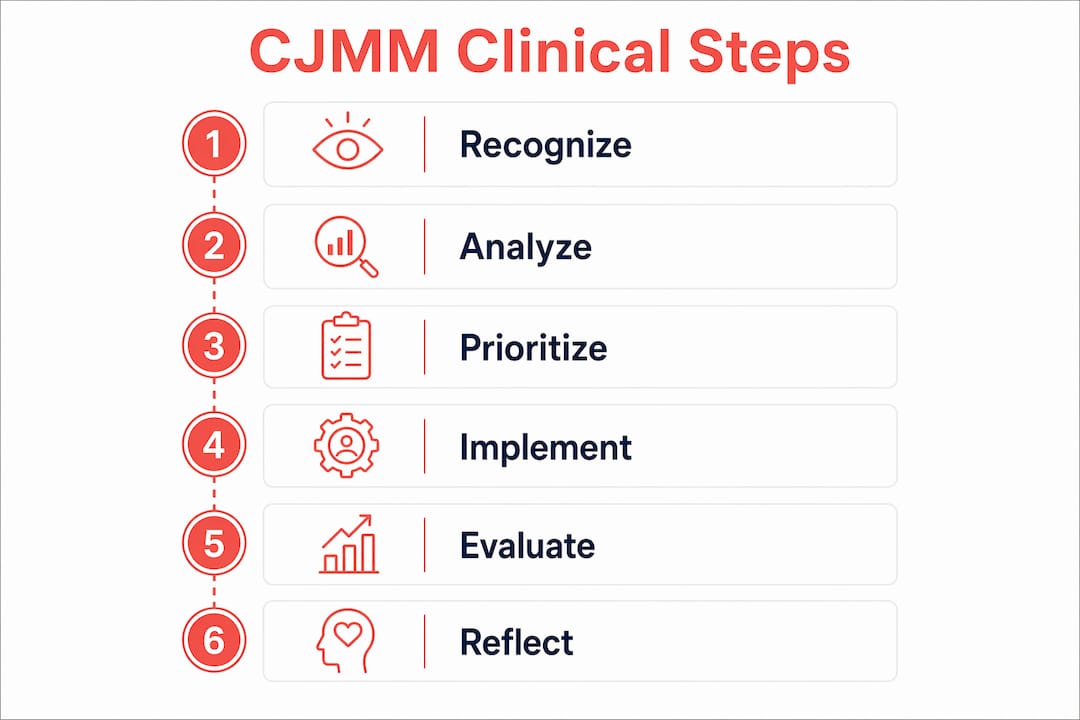
The NCSBN Clinical Judgment Measurement Model (CJMM) is the framework that defines what every NGN case study question is actually testing. Each of the six measurable clinical judgment steps maps directly to specific question types within a case set. Understanding this mapping tells you exactly what cognitive skill each question demands.
The six steps are:
- Recognize cues: Identify relevant data from the patient scenario. A question might ask which findings from the nurses' notes require immediate attention.
- Analyze cues: Determine what the recognized cues mean clinically. This step asks you to connect a rising creatinine with decreased urine output and draw a conclusion.
- Prioritize hypotheses: Rank possible explanations by likelihood and urgency. A matrix question might ask you to rate three potential diagnoses from most to least probable.
- Generate solutions: Identify appropriate nursing interventions for the prioritized hypothesis. Drag-and-drop formats often test this step.
- Take action: Select the specific action to implement. Bow-tie questions frequently test this step alongside its rationale.
- Evaluate outcomes: Assess whether the intervention worked. A final question in a set might show updated labs and ask which findings indicate improvement.
Mapping study materials to the six CJMM functions directly improves a student's ability to answer NGN case scenarios correctly. The reason is simple: when you know which cognitive step a question targets, you stop second-guessing and start reasoning systematically.
The CJMM framework also explains why memorizing isolated facts is insufficient for the NGN exam. A question testing "analyze cues" requires you to synthesize two or three data points into a clinical conclusion. No amount of flashcard review prepares you for that unless you practice the reasoning process itself.
Pro Tip: Label each practice question with its CJMM step after you answer it. Over time, you will see which steps you consistently miss, and you can target those gaps directly.
Applying CJMM steps mimics real nurse decision-making and builds clinical reasoning capacity beyond the exam. Students who internalize the six steps report that patient care decisions in clinical rotations feel more structured and confident.
What question types and formats appear in NCLEX case studies?
The NGN case study format uses several question types that go well beyond traditional four-option multiple choice. Each format tests a different layer of clinical reasoning, and recognizing the format quickly saves valuable time during the exam.
The NGN formats include extended multiple response, drag-and-drop, matrix/grid, highlight in text, and bow-tie visual questions. Each one demands a different approach.
| Format | What it tests | Key strategy |
|---|---|---|
| Extended select-all-that-apply (SATA) | Recognizing multiple correct cues or actions | Evaluate each option independently; avoid pattern matching |
| Drag-and-drop | Sequencing actions or matching interventions to outcomes | Use CJMM "generate solutions" and "take action" steps |
| Matrix/grid | Comparing multiple patients or ranking hypotheses | Read every row before selecting; avoid anchoring on the first option |
| Highlight in text | Identifying relevant clinical cues within a passage | Focus on abnormal values, time changes, and patient-reported symptoms |
| Bow-tie | Connecting condition, action, and expected outcome | Work from the center outward; confirm the condition before selecting actions |
Scoring on NGN case studies also differs from traditional items. The NGN format adds partial credit scoring methods such as plus/minus and rationale scoring for multi-response items. That means a partially correct answer on a SATA question earns more credit than a completely wrong one. Leaving multi-response items blank is always the wrong move.
Time management across these formats is a real skill. Budgeting 3–4 minutes per unfolding case and practicing CJMM-based reasoning improves both efficiency and accuracy. Students who practice timed case sets consistently outperform those who only review content.
What strategies work best for NCLEX case study preparation?
The single biggest mistake students make is treating NGN case study questions as isolated multiple-choice items instead of synthesizing the combined patient data. Each question in a set is a chapter in the same story. Reading only one chapter and ignoring the rest produces wrong answers.
Effective preparation follows a clear pattern:
- Practice with full case sets, not individual questions. Pulling a single question out of a case set removes the context that makes it meaningful. Always work through all 6 linked questions together.
- Use the CJMM as a checklist. Before submitting each answer, ask yourself which of the six steps the question is testing. This prevents the common error of answering a "prioritize hypotheses" question with a "take action" response.
- Review wrong answers by step, not by topic. If you miss a question, identify whether you failed to recognize the cue, misanalyzed it, or chose the wrong action. Topic-based review misses the reasoning error.
- Build a self-study plan aligned with NGN case practice that dedicates specific sessions to each CJMM step.
- Assess your readiness regularly. A structured NCLEX readiness assessment identifies which CJMM steps need more practice before exam day.
Pro Tip: After completing a full case set, write a two-sentence summary of the patient's clinical story. If you cannot summarize it clearly, you did not synthesize the data well enough, and that gap will cost you points.
Understanding why NCLEX difficulty increases as you answer correctly also helps you interpret your practice performance. The computerized adaptive testing (CAT) engine raises the bar when you succeed, so a harder case set mid-exam is a sign of strong performance, not failure.
Key Takeaways
The NCLEX case study format tests clinical judgment across six CJMM steps through unfolding EHR-based scenarios, and mastering this structure is the most direct path to NGN exam success.
| Point | Details |
|---|---|
| Exam structure | The NCLEX includes 18 case-study questions in three sets of 6 linked items each. |
| EHR tab navigation | Students must synthesize data across nurses' notes, labs, vitals, and medication records within each case. |
| CJMM framework | Each question maps to one of six clinical judgment steps: recognize, analyze, prioritize, generate, act, evaluate. |
| Question formats | Extended SATA, drag-and-drop, matrix, highlight, and bow-tie formats each test a different reasoning layer. |
| Preparation strategy | Practice full case sets timed, label each question by CJMM step, and review errors by reasoning gap, not topic. |
Why the case study format is harder than it looks
I have worked with nursing students preparing for the NGN exam long enough to say this plainly: the case study format does not reward the hardest workers. It rewards the most adaptive thinkers.
Students who grind through thousands of traditional multiple-choice questions often hit a wall with case studies. They know the content cold, but they freeze when the question asks them to synthesize a trending lab value, a new nurse's note, and a medication change into a single clinical decision. That is not a content gap. That is a reasoning gap.
The shift I recommend is simple but uncomfortable. Stop asking "what is the right answer?" and start asking "what would a nurse actually do right now, with this specific patient, given everything I just read?" That reframe changes how you read every tab and every question stem.
The bow-tie format trips up more students than any other. They see the visual and assume it is harder than it is. It is actually the most transparent format on the exam because it forces you to name the condition, the action, and the expected outcome explicitly. If you cannot complete a bow-tie, you have a CJMM gap, not a format problem. Fix the gap.
One more thing: do not skip the evaluate outcomes questions at the end of a case set. Students run low on time and rush those final items. Those questions are often worth partial credit and test a skill, evaluating whether an intervention worked, that shows up constantly in real clinical practice. Treat them as the most important question in the set, not the last one.
— Michael
How Nursepass prepares you for NGN case studies
Nursing students who want structured, CJMM-aligned case study practice have a clear option in Nursepass. The platform offers over 1,200 NCLEX practice questions built around NGN formats, including full unfolding case sets that mirror the actual exam interface.
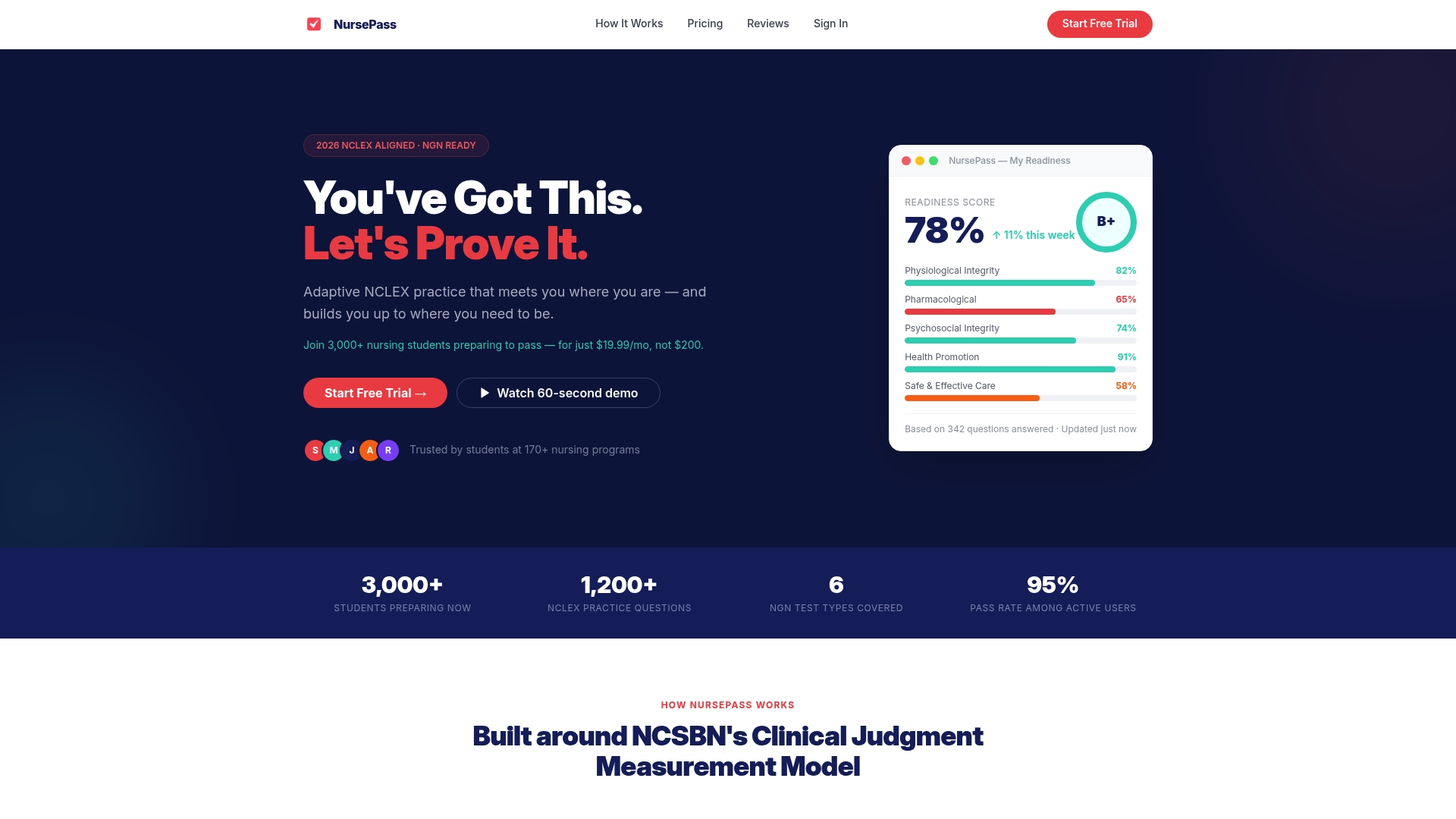
Nursepass uses an adaptive engine that adjusts question difficulty to your current competency level. Its live readiness score and subcategory heat maps show exactly which CJMM steps need more work, so you study what matters instead of reviewing what you already know. More than 3,000 nursing students have used Nursepass, with active users reporting a 95% pass rate. If you want case study practice that builds real clinical judgment, Nursepass is where to start.
FAQ
What is the NCLEX case study format?
The NCLEX case study format is a set of 6 linked questions built around a single unfolding patient scenario, presented through EHR-style tabs. Students must synthesize evolving clinical data across all questions rather than answering each one in isolation.
How many case study questions are on the NCLEX?
The NCLEX includes 18 case-study questions organized into three sets of 6 linked items each. These sets make up a significant portion of the exam score alongside stand-alone clinical judgment items.
What is the CJMM and why does it matter for case studies?
The NCSBN Clinical Judgment Measurement Model (CJMM) defines six cognitive steps that every NGN case study question tests. Knowing which step a question targets helps students apply the right reasoning process instead of guessing.
How is scoring different for NGN case study questions?
Some NGN item types use partial credit scoring methods, including plus/minus and rationale scoring, for multi-response questions. A partially correct answer earns more credit than a blank or fully incorrect response.
How should I practice for NCLEX case studies?
Practice full 6-question case sets under timed conditions, label each question by its CJMM step, and review errors by reasoning gap rather than topic. Platforms with adaptive NGN case study tools help identify which clinical judgment steps need the most attention.