
The NCLEX uses Computerized Adaptive Testing, or CAT, to determine with 95% statistical confidence whether a candidate's ability is above or below the passing standard. Understanding what is adaptive testing NCLEX means knowing that your exam is not graded on a fixed percentage of correct answers. Instead, the National Council of State Boards of Nursing (NCSBN) built a system that measures your competency precisely, adjusts question difficulty after every response, and ends the test the moment it reaches statistical certainty. That design changes everything about how you should prepare.
What is adaptive testing on the NCLEX and how does it work?
CAT is a testing method where the computer recalculates your estimated ability after every answer you submit. It then selects the next question to best measure that ability, adapting difficulty in real time. The result is an exam that is uniquely yours, built question by question around your demonstrated competency.
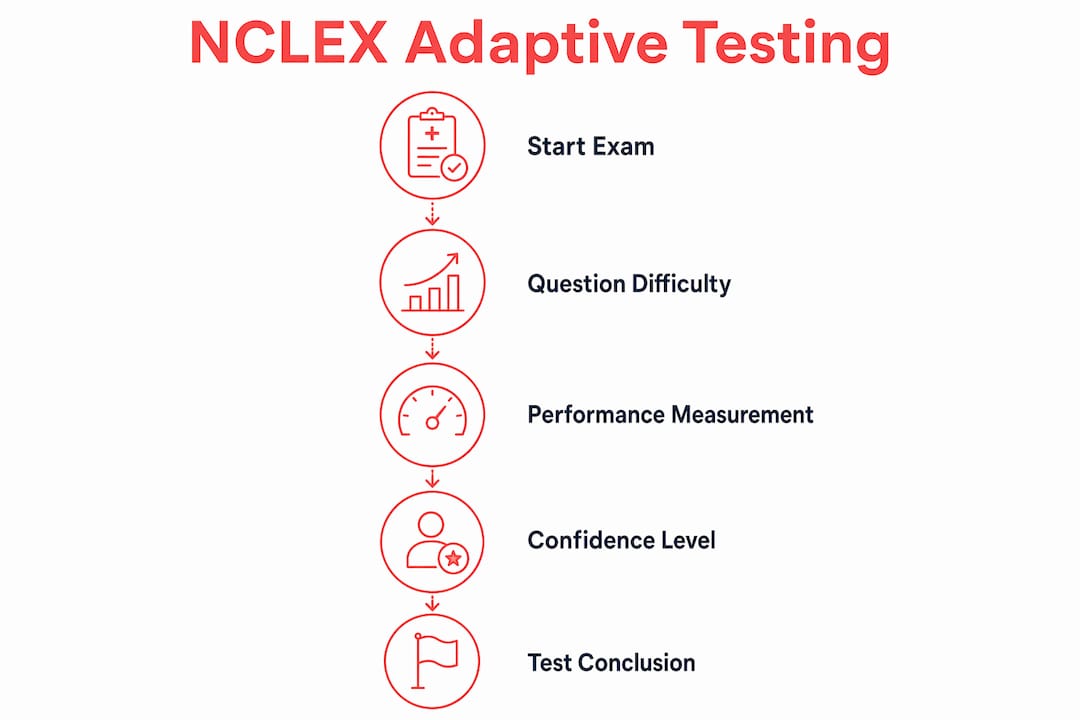
The mechanics follow a clear sequence:
- You answer question one. The computer assigns an initial ability estimate based on your response.
- The system recalibrates. After each answer, the algorithm recalculates your ability and selects the next question from a pool calibrated to that level.
- Difficulty adjusts continuously. A correct answer pulls the next question slightly harder. An incorrect answer pulls it slightly easier. This keeps questions near your ability level throughout the exam.
- The exam monitors confidence. The system tracks how certain it is that your ability is above or below the passing standard set by NCSBN.
- The test ends at 95% confidence. Once the algorithm reaches 95% confidence that your ability is clearly above or below the standard, the exam stops.
The NCLEX can end in as few as 85 questions or continue to a maximum of 150. If your performance is borderline, the test continues to 150 questions and uses your full cumulative response pattern to make a final decision. NCSBN applies these same CAT principles to both the NCLEX-RN and NCLEX-PN, though the two exams differ in content scope and question pools.
Pro Tip: Reaching 150 questions does not mean you failed. It means the algorithm needed more data to reach 95% confidence. Many students who answer all 150 questions pass.

Why does the NCLEX use adaptive questions?
The NCLEX uses CAT because traditional fixed-length exams waste time and produce less accurate results. A student who answers the first 20 questions correctly on a traditional test still faces 80 more questions, many of which are too easy to add meaningful information about their competency. CAT eliminates that inefficiency.
The core benefits of the adaptive NCLEX format include:
- Precision. Adaptive testing focuses questions near your ability level, avoiding questions that are too easy or too hard to measure you accurately.
- Efficiency. High-performing candidates can receive a pass decision in 85 questions. Low-performing candidates receive the same speed of decision. Neither group sits through irrelevant content.
- Fairness. Every candidate faces questions calibrated to their ability, not a one-size-fits-all item set. That produces a more valid pass/fail decision.
- Reduced anxiety. Adaptive testing can shorten the exam for candidates whose competency is clear early, reducing the mental load of a prolonged test session.
- Statistical rigor. The 95% confidence threshold means NCSBN makes pass/fail decisions with a level of certainty that fixed-percentage scoring cannot match.
The NCLEX does not ask whether you got 60% or 75% of questions right. It asks whether your demonstrated ability is above the passing standard. That is a fundamentally different and more accurate question.
Pro Tip: Because the exam targets your ability level, expect questions to feel challenging throughout. Consistent difficulty is a sign the system is working correctly, not a sign you are failing.
How does adaptive testing change your NCLEX prep strategy?
Knowing how CAT works should reshape how you study. The biggest mistake nursing students make is chasing a target score or question count. CAT makes both of those goals irrelevant.
Your preparation should focus on these priorities:
- Master core competencies across all content areas. The NCLEX-RN tests eight client needs categories. Weak performance in any one area can pull your ability estimate down and extend your exam. Build consistent strength everywhere, not just in your favorite topics.
- Practice with adaptive-format questions. Practice tests that mimic the NCLEX's adaptive format help you get comfortable with variable difficulty and unpredictable question length. Static practice sets do not replicate that experience.
- Stop counting questions during the exam. Whether you reach 85 or 150 questions tells you nothing about your pass/fail status in the moment. Counting questions creates anxiety without providing useful information.
- Focus on critical thinking, not memorization. CAT selects questions to probe your reasoning, not your ability to recall facts. Study by working through clinical scenarios and applying nursing judgment.
- Use your readiness data before exam day. An NCLEX readiness assessment gives you a clear picture of where your ability estimate stands before you sit for the real exam.
Nursepass builds its study platform around these exact principles. Its adaptive engine tailors over 1,200 practice questions to your current competency level, and its live readiness score tracks your ability estimate in real time. More than 3,000 nursing students have used Nursepass, and the platform reports a 95% pass rate among active users.
Understanding the CAT testing format also helps you pace yourself on exam day. Because the test can end at any point after the minimum question threshold, you cannot predict when your exam will stop. The only productive strategy is to answer each question as well as you can, then move forward without second-guessing.
Common misconceptions about NCLEX adaptive testing
Several persistent myths about CAT cause unnecessary stress for nursing students. Clearing them up is one of the most useful things you can do before exam day.
Misconception: You need to answer a certain percentage correctly to pass. The NCLEX does not use a raw score. Passing depends on your ability estimate, not on how many questions you answered correctly. A candidate can miss nearly 50% of questions and still pass if their competency remains above the passing standard throughout the exam.
Misconception: More questions means you are failing. Reaching the maximum question count means the algorithm needed more data. It does not indicate a pass or fail outcome. Borderline candidates receive more questions because the system needs greater certainty, not because they are performing poorly.
Misconception: You can guess your way through. CAT handles random guessing effectively. The algorithm tracks your full response pattern, not just individual answers. Consistent guessing produces an inconsistent pattern that the system detects and accounts for in your ability estimate.
Misconception: The exam gets easier if you are passing. The opposite is true. The NCLEX selects harder questions when you answer correctly, because harder questions provide more information about high-ability candidates. If your exam feels difficult throughout, that is a good sign.
Misconception: All candidates face the same exam. No two NCLEX exams are identical. Each exam is built in real time from a large question pool, calibrated to the individual candidate's ability. That is the entire point of CAT.
Key Takeaways
The NCLEX's Computerized Adaptive Testing system measures nursing competency through statistical precision, not raw scores, making your preparation strategy and mindset more important than any fixed question count or percentage target.
| Point | Details |
|---|---|
| CAT adjusts in real time | The algorithm recalibrates your ability estimate after every answer and selects the next question accordingly. |
| 95% confidence drives pass/fail | NCSBN ends the exam only when it is 95% confident your ability is above or below the passing standard. |
| Question count is not the signal | Reaching 85 or 150 questions says nothing definitive about your outcome; your ability estimate does. |
| Prep should mirror CAT format | Practice with adaptive-style questions that vary in difficulty to build comfort with the real exam experience. |
| Critical thinking beats memorization | CAT probes your clinical reasoning, so study through scenarios and nursing judgment, not rote recall. |
Why understanding CAT changed how I see NCLEX prep
Most nursing students I have spoken with treat the NCLEX like a traditional exam. They set a target score, count practice questions, and panic when a test session runs long. That mindset is the wrong fit for CAT, and it creates anxiety that has nothing to do with actual competency.
The shift I always encourage is this: stop treating the exam as something to survive and start treating it as a conversation. CAT is asking you questions to understand what you know. Your job is to answer honestly and completely, one question at a time. The algorithm handles the rest.
What I find most interesting is that CAT actually mirrors real nursing practice. A skilled nurse does not walk into a patient room with a fixed checklist. She assesses, adjusts, and responds to what she finds. CAT tests exactly that kind of adaptive thinking. Students who recognize that connection tend to approach the exam with more confidence and less dread.
The candidates who struggle most are the ones who try to game the system by tracking question difficulty or counting items. That energy is wasted. The only variable you control is the quality of your next answer. Put everything into that.
— Michael
Nursepass and adaptive NCLEX preparation
Adaptive NCLEX prep works best when your study tools match the format of the real exam.
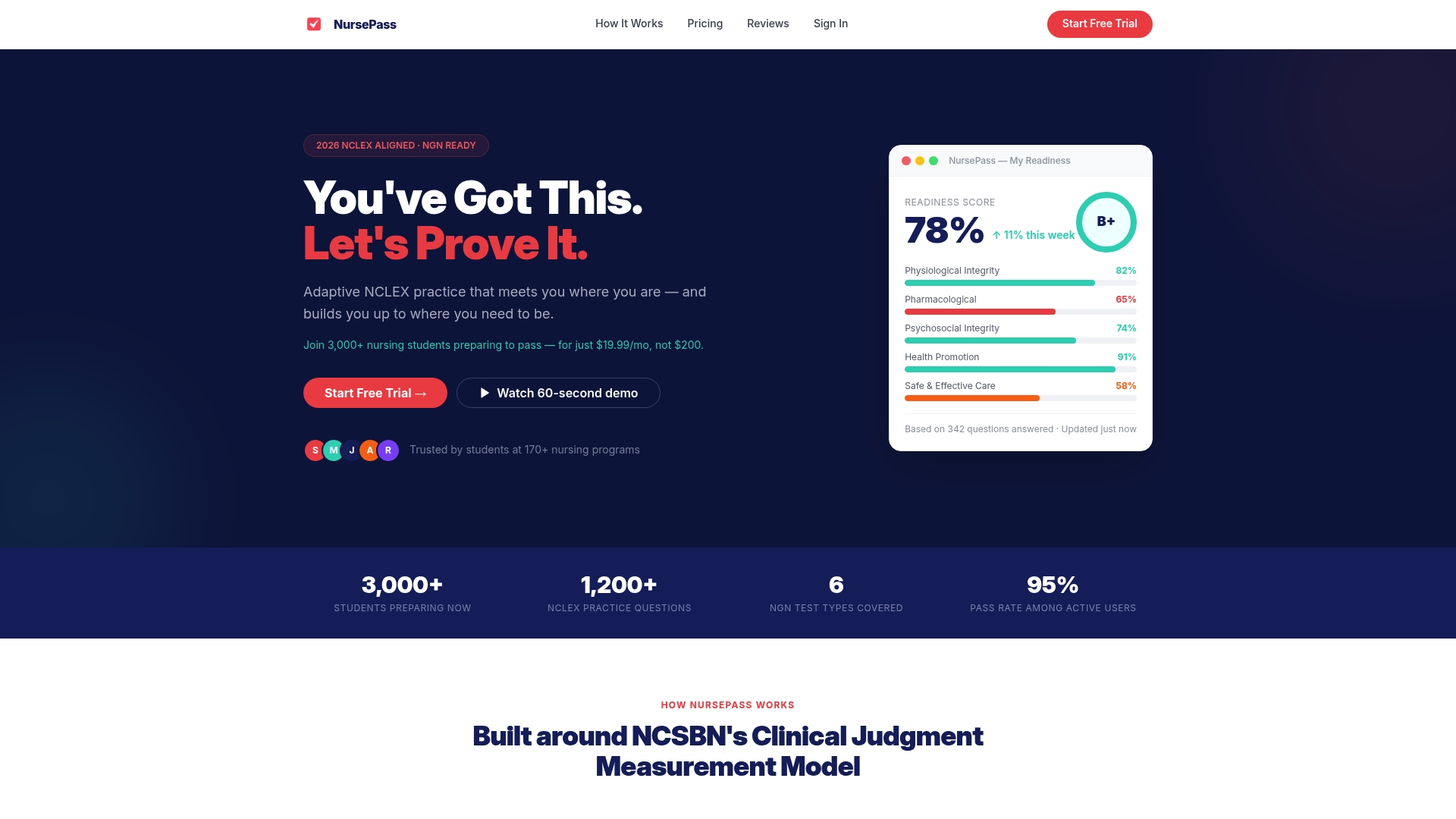
Nursepass builds its entire platform around CAT principles. Its adaptive engine adjusts question difficulty to your current competency, so every practice session targets the exact level where you need the most work. The live readiness score shows you where your ability estimate stands right now, and subcategory heat maps reveal the specific content areas pulling your score down. With over 1,200 NCLEX practice questions and a 95% pass rate among active users, Nursepass gives nursing students a preparation experience that reflects how the real exam actually works. Visit Nursepass to start building your personalized NCLEX readiness plan for 2026.
FAQ
What is Computerized Adaptive Testing on the NCLEX?
Computerized Adaptive Testing is the method NCSBN uses to administer the NCLEX. The system adjusts question difficulty after every answer to measure each candidate's nursing competency with 95% statistical confidence.
How many questions will I get on the NCLEX?
The NCLEX can end in as few as 85 questions or continue to a maximum of 150. The exam stops when the algorithm reaches 95% confidence that your ability is above or below the passing standard.
Does getting more questions mean I failed?
No. Reaching 150 questions means the algorithm needed more data to reach a confident decision. Many candidates who answer all 150 questions pass the NCLEX.
Do I need to answer a certain percentage correctly to pass?
No. The NCLEX does not use a fixed percentage. Passing depends on your ability estimate across your full response pattern, not on how many individual questions you answered correctly.
How should I prepare for the NCLEX adaptive format?
Practice with questions that vary in difficulty to simulate the CAT experience. Focus on clinical reasoning and core nursing competencies across all content areas, and use a readiness assessment to track your ability estimate before exam day.