
Asynchronous feedback in nursing exams is defined as delayed, reflective evaluation that targets clinical reasoning rather than simply marking answers right or wrong. This approach, formally called pedagogical feedback in nursing education, gives nursing students time to analyze their own decision-making before reviewing results. Async feedback nursing exams explained correctly means understanding that the goal is to develop clinical judgment, not just confirm correctness. The Next Generation NCLEX (NGN) format tests exactly this kind of reasoning, making asynchronous feedback one of the most direct preparation tools available. Nursepass integrates this principle into its adaptive learning engine, helping more than 3,000 nursing students build the reasoning skills the NCLEX demands.
How does async feedback improve nursing exam performance?
Asynchronous feedback improves exam performance by forcing nursing students to engage with their reasoning process, not just their answer selection. Reflective feedback uncovers reasoning gaps such as missed cues and prioritization errors rather than simply revealing the correct answer. That distinction matters because the NCLEX does not reward memorization. It rewards the ability to recognize a deteriorating patient, prioritize competing needs, and make safe decisions under pressure.

Studies show an average 5.72 point gain in OSCE performance when students use reflective feedback compared to traditional methods. A gain of that size reflects a meaningful shift in how students process clinical scenarios, not just a marginal improvement in recall. The mechanism is cognitive engagement: when you write down your reasoning before seeing the answer, you expose the exact moment your thinking went wrong.
Passive study methods produce no such exposure. Reading a textbook chapter or watching a lecture video gives you information, but it does not reveal where your clinical logic breaks down. Active learning with feedback loops is measurably more efficient than reading alone. That efficiency gap widens as NCLEX questions grow more complex.
Key mechanisms that make asynchronous feedback effective:
- Reasoning exposure: You identify the exact step where your clinical logic failed, not just the wrong answer.
- Iterative correction: Each feedback cycle builds on the last, compounding improvement over weeks of study.
- Self-paced reflection: You control the timing, which reduces cognitive overload during review.
- Patient safety focus: Criterion-based feedback targets communication, prioritization, and missed safety steps without giving away answers.
Pro Tip: After every practice block, write a one-sentence summary of why you chose each answer before reading any rationale. This single habit surfaces more reasoning errors than any other review technique.
What distinguishes asynchronous feedback from synchronous feedback?
Synchronous feedback is real-time. An instructor corrects you mid-simulation, or a platform flashes "incorrect" the moment you select an answer. Asynchronous feedback is delayed. You complete a question set, record your reasoning, and then review the feedback on your own schedule. Both have a place in nursing education, but they serve different cognitive purposes.
Delayed feedback prompts reflective reevaluation, which is critical for adaptive decision-making in clinical scenarios. When feedback arrives instantly, students often accept the correction without examining why their original reasoning failed. Delayed feedback removes that shortcut. You have to sit with your reasoning long enough to actually interrogate it.
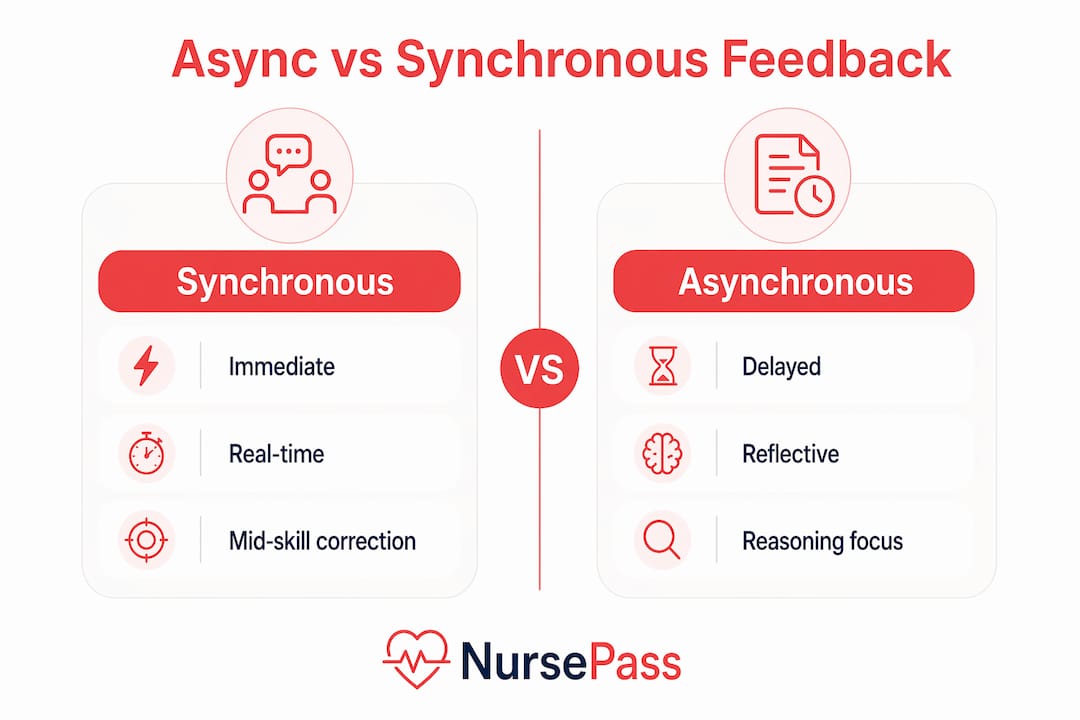
| Feature | Synchronous feedback | Asynchronous feedback |
|---|---|---|
| Timing | Immediate, real-time | Delayed, self-paced |
| Primary benefit | Fast error correction | Deep reasoning analysis |
| Best use case | Skills labs, simulations | Question banks, written exams |
| Cognitive demand | Lower during review | Higher, requires reflection |
| NCLEX alignment | Moderate | High, mirrors NGN reasoning demands |
Synchronous feedback works best when a physical skill needs immediate correction, such as IV insertion technique or patient positioning. Asynchronous feedback works best when the goal is clinical judgment, which is exactly what the NCLEX tests. The two methods complement each other. Students who use both perform better than those who rely on either alone.
How can nursing students build effective async feedback loops?
Building an effective asynchronous feedback loop requires structure. Without a deliberate process, students slip back into passive review habits and lose most of the benefit. The following method works for NCLEX 2026 preparation and applies to any nursing exam format.
- Complete a timed question block. Experts recommend 50–100 daily practice questions. Work through each question under timed conditions without stopping to look anything up.
- Write your decision log before reviewing answers. For each question, write one sentence explaining why you chose your answer. This is the most important step. Decision logs expose "gut feeling" guesses and reveal prioritization errors that automated feedback alone cannot catch.
- Review rationales with your log open. Compare your written reasoning to the rationale. Mark every question where your reasoning process was wrong, even if you got the answer right by accident.
- Categorize your errors. Group mistakes by type: knowledge gaps, prioritization errors, missed patient cues, or misread question stems. This categorization tells you where to focus next.
- Schedule a reflection session 24 hours later. Return to your error log the following day. Ask yourself whether your reasoning has changed after sleeping on it. This second pass often reveals patterns you missed in the first review.
- Track your subcategory performance over time. Use a heat map or simple spreadsheet to watch which clinical areas improve and which stay flat. Nursepass provides subcategory heat maps that make this tracking automatic.
Pro Tip: Never skip the decision log step, even when you are short on time. A 10-question block with a full decision log beats a 50-question block reviewed passively. Quality of reflection outweighs volume every time.
The pacing of feedback sessions also matters. Reviewing 100 questions in one sitting produces cognitive fatigue that undermines reflection quality. Two focused 30-minute sessions produce better retention than one exhausting 90-minute block. For more on managing exam pacing under pressure, structured review schedules consistently outperform marathon study sessions.
What challenges do nursing students face with async feedback?
The biggest challenge is a misconception about what feedback means. Most nursing students assume feedback means finding out which answers were right or wrong. That interpretation turns a powerful learning tool into a simple score report. Real asynchronous feedback targets the reasoning behind each choice, which requires more effort and feels less satisfying in the short term.
Common challenges and how to address them:
- Passive review habit: Students read rationales without engaging their own reasoning first. Fix this by always completing the decision log before opening any answer key.
- Treating correct answers as success: Getting an answer right for the wrong reason is a hidden failure. Mark any question where your reasoning was flawed, regardless of the outcome.
- Cognitive overload: Reviewing too many questions at once degrades reflection quality. Cap each feedback session at 25–30 questions and take a break before the next block.
- Inconsistent practice: Skipping feedback sessions breaks the iterative learning cycle. Set a fixed daily review time and treat it as non-negotiable.
- Ignoring subcategory patterns: Students often focus on total scores and miss the fact that one clinical area is dragging down their performance. Tracking by subcategory reveals these blind spots faster than overall score trends.
Motivation drops when progress feels invisible. The solution is to measure reasoning quality, not just score percentage. A student whose reasoning accuracy improves week over week is on track, even if their overall score has not yet moved. Linking your NCLEX readiness assessment to specific reasoning categories gives you a more honest picture of where you stand.
How does async feedback align with the 2026 NCLEX format?
The NGN uses computerized adaptive testing with 85–150 items over up to 5 hours, focusing on reasoning, prioritization, and safe nursing decisions. That structure is not compatible with rote memorization. Every case study on the NGN requires students to recognize clinical cues, analyze their significance, and decide on a course of action. These are exactly the skills that asynchronous feedback develops.
The table below maps NGN clinical judgment requirements to asynchronous feedback practices.
| NGN clinical judgment skill | Async feedback practice that develops it |
|---|---|
| Recognize cues | Decision log: note which cues you identified before reviewing |
| Analyze cues | Error categorization: identify why a cue was misread |
| Prioritize hypotheses | Rationale review: compare your prioritization to the correct reasoning |
| Generate solutions | Reflection session: evaluate alternative approaches you did not consider |
| Evaluate outcomes | Pattern tracking: monitor which reasoning errors recur across sessions |
First-time U.S. NCLEX pass rates run 82–86%. Students who build structured feedback loops into their daily practice consistently outperform those who rely on volume alone. Nursepass reports a 95% pass rate among active users, a result that reflects the platform's focus on adaptive, feedback-driven preparation rather than passive question exposure.
Integrating asynchronous feedback into your NCLEX study plan does not require more study hours. It requires better use of the hours you already have.
Key Takeaways
Asynchronous feedback is the most direct method for developing the clinical judgment that the 2026 NCLEX tests, and it works only when students engage their reasoning before reviewing answers.
| Point | Details |
|---|---|
| Definition matters | Async feedback targets clinical reasoning, not just right or wrong answers. |
| Decision logs are non-negotiable | Writing your reasoning before checking answers exposes errors no score report can reveal. |
| NGN alignment is direct | Every NGN clinical judgment skill maps to a specific async feedback practice. |
| Volume without reflection fails | 50 passive questions produce less learning than 20 questions with a full decision log. |
| Track subcategories, not just scores | Pattern tracking by clinical area reveals blind spots that overall scores hide. |
Why most nursing students misuse feedback and what to do instead
Most nursing students I have observed treat feedback as a verdict. They check their score, feel good or bad about it, and move on. That habit is the single biggest obstacle to NCLEX readiness, and it is almost universal among students who struggle on their first attempt.
The uncomfortable truth is that a high practice score built on shaky reasoning is more dangerous than a low score built on honest reflection. I have seen students score consistently in the high 70s on practice exams and still fail the NCLEX because they never interrogated why they were getting questions right. Their reasoning was fragile. It held up on familiar question types and collapsed on anything novel.
Asynchronous feedback fixes this, but only if you treat it as a reasoning audit rather than a score review. The decision log is the tool that makes this concrete. Writing down your reasoning before you see the answer is uncomfortable. It forces you to commit to a thought process you might be wrong about. That discomfort is the learning. Students who skip the log skip the growth.
The other mistake I see constantly is reviewing feedback in bulk at the end of a week. Feedback loses most of its value after 24 hours. The reasoning that led to your error is still fresh the same day. By the weekend, it is gone. Daily review, even for just 20 minutes, compounds in a way that weekly review never does.
If you are serious about passing the NCLEX on your first attempt, treat your feedback sessions as the most important part of your study day. Not the question block. The review.
— Michael
Nursepass: built for the feedback-driven student
Nursing students who commit to asynchronous feedback need a platform that tracks their reasoning patterns over time, not just their scores. Nursepass is built for exactly that.
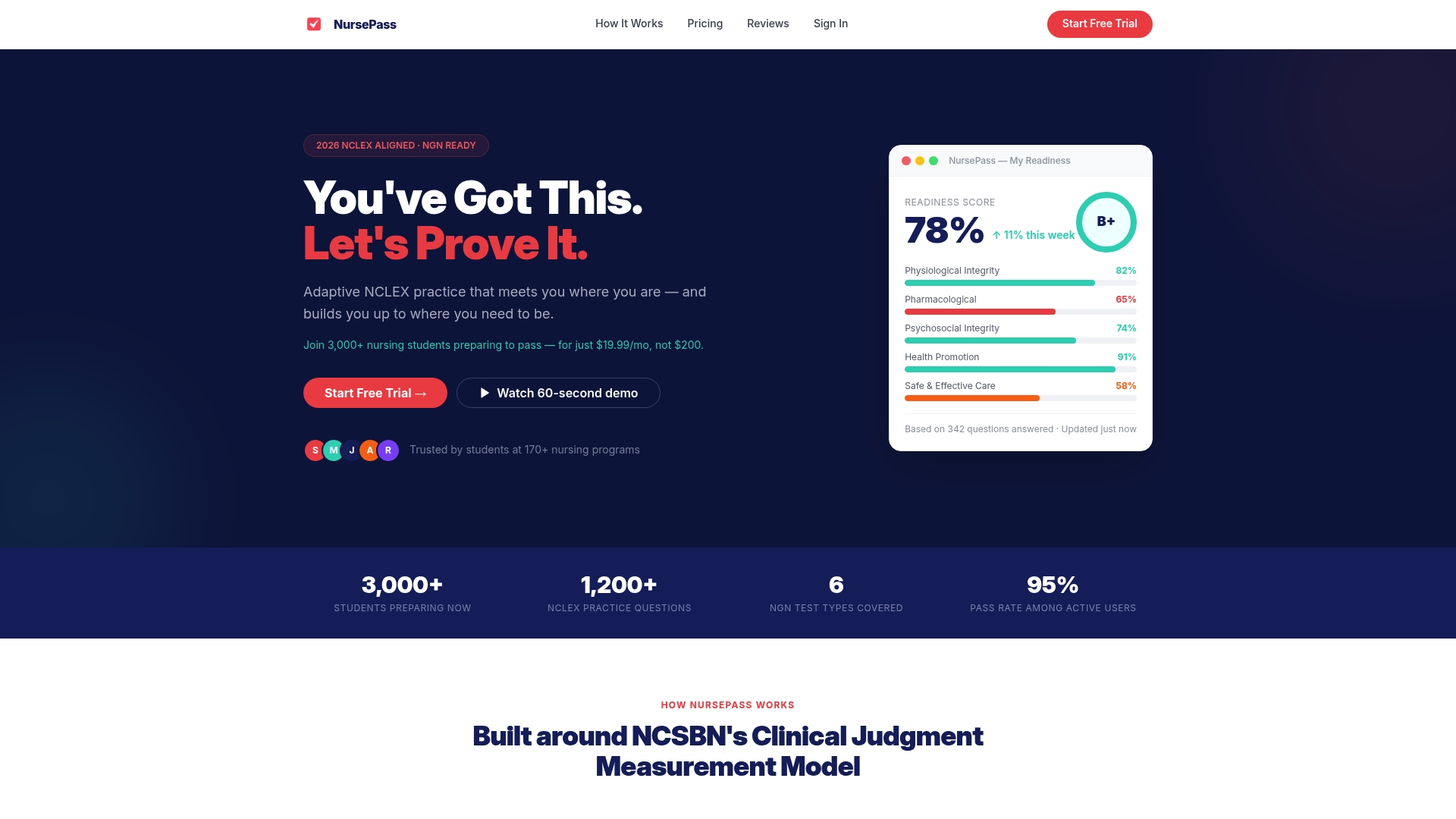
With over 1,200 NCLEX practice questions and a live readiness score that updates as you study, Nursepass shows you where your clinical reasoning is improving and where it is not. The subcategory heat maps make pattern tracking automatic, so you spend your review time on reflection rather than spreadsheets. More than 3,000 nursing students use Nursepass, and 95% of active users pass the NCLEX. If you are ready to study with feedback that actually builds clinical judgment, Nursepass is where to start.
FAQ
What is asynchronous feedback in nursing exams?
Asynchronous feedback is delayed, reflective evaluation that focuses on clinical reasoning rather than immediate right-or-wrong answers. It gives nursing students time to analyze their decision-making before reviewing results.
How does async feedback differ from regular exam review?
Standard exam review shows you what you got wrong. Asynchronous feedback requires you to examine why your reasoning failed, which develops the clinical judgment the NCLEX tests directly.
How many practice questions should I do daily for NCLEX prep?
Experts recommend 50–100 daily practice questions with full rationale review. Quality of reflection on each question matters more than raw volume.
Does the 2026 NCLEX test clinical judgment specifically?
The NGN uses computerized adaptive testing with 85–150 items focused on recognizing cues, prioritizing hypotheses, and making safe nursing decisions. Asynchronous feedback develops each of these skills systematically.
What is a decision log and why does it matter?
A decision log is a written record of your reasoning for each answer before you check the result. It exposes gut-feeling guesses and prioritization errors that automated feedback alone cannot identify.