
Clinical reasoning gaps, not content knowledge deficits, are the primary reason nursing students make wrong answers on the NCLEX. Most students who fail have studied hard. They know their pharmacology, their disease processes, and their lab values. What trips them up is the failure to apply that knowledge the way a practicing nurse would. The 2025 NCLEX pass rate decline highlighted this problem sharply, with even high-achieving students falling short because of the Next Generation NCLEX (NGN) format's emphasis on clinical judgment over memorization. Understanding exactly where reasoning breaks down is the first step to fixing it.
Why nursing students make wrong answers: the reasoning gap
The NCLEX does not test whether you can recall a fact. It tests whether you can use that fact to protect a patient. That distinction is where most wrong answers are born.
Clinical reasoning errors such as failing to connect vital signs with clinical history are a major source of wrong answers on NGN-style questions. A student might correctly identify that an oxygen saturation of 88% is low, but then select an intervention that addresses the number rather than the underlying cause in context. That is a content-to-reasoning failure. The knowledge is there. The application is not.

The NGN introduced question formats specifically designed to expose this gap. Bow-tie questions ask students to identify a condition, connect it to clinical cues, and select interventions that address the root problem. Matrix questions require evaluating multiple patient data points simultaneously. Both formats demand that you think in sequences, not in isolated facts.
Here is where common mistakes nursing students make become most visible:
- Treating each clinical cue as separate. Vital signs, history, and lab values must be read together, not in isolation.
- Selecting the most familiar answer. Students gravitate toward diagnoses and interventions they recognize, not necessarily the most urgent ones.
- Ignoring the patient's baseline. A heart rate of 100 means something different in a post-op patient than in a marathon runner.
- Misreading question scope. Some questions ask what to do first, not what to do eventually. These require prioritization, not just knowledge.
Polytomous scoring on NGN-style questions rewards partial credit, but many students lose points by treating complex items as all-or-nothing. Over-selecting options, or picking every plausible answer rather than every justified answer, costs points. The scoring demands clinical justification for each sub-answer, not a broad net.
Pro Tip: When reviewing any NGN practice question, write one sentence explaining why each option you selected is clinically justified. If you cannot write that sentence, you are guessing, not reasoning.
Does overconfidence cause students to fail the NCLEX?
Yes. High-achieving nursing students frequently underperform on the NCLEX due to what educators call the "fake security effect." This is the false confidence that comes from strong GPA scores, high ATI scores, and large volumes of practice questions completed. It leads students to underestimate how differently the NCLEX tests clinical judgment compared to classroom exams.
The fake security effect is particularly dangerous because it changes behavior. Students who feel prepared tend to do less deep remediation. They log more practice questions but spend less time understanding why wrong answers are wrong. They mistake familiarity with mastery.
"Doing 3,000 practice questions means nothing if you are not learning from each one. Volume without reflection is just expensive repetition."
The 2025 NCLEX pass rate data reinforced this. Students with strong academic records were among those most surprised by their results. Their preparation was wide but shallow. The NGN rewarded depth of reasoning, not breadth of exposure.
Kaplan recommends prioritizing deep remediation over sheer question volume. That means reading every rationale, including the rationales for questions you answered correctly. Getting the right answer for the wrong reason is still a reasoning gap.
Pro Tip: After each practice session, identify the one question you are least sure you understood, even if you got it right. Spend five minutes on that rationale before moving on.
Why do traditional study methods fail nursing students?
Passive study methods and overstudying without building mental frameworks lead to low recall and exam blanking, even after long hours of preparation. The core problem is that students treat all information as equally important. When everything feels urgent, nothing gets prioritized. That is the same cognitive error that causes wrong answers on the exam itself.
Passive studying such as re-reading notes, highlighting textbooks, and watching lecture videos creates a feeling of learning without building the retrieval pathways needed under exam pressure. Students overwhelmed by volume experience stress and memory loss at the exact moment they need clarity.
Active learning works differently. It forces your brain to retrieve and apply information rather than just recognize it. The methods that build lasting clinical judgment include:
- Retrieval practice. Close your notes and write out everything you know about a condition from memory. Then check what you missed.
- Teaching others. Explain a concept to a classmate or even out loud to yourself. Gaps in your explanation reveal gaps in your understanding.
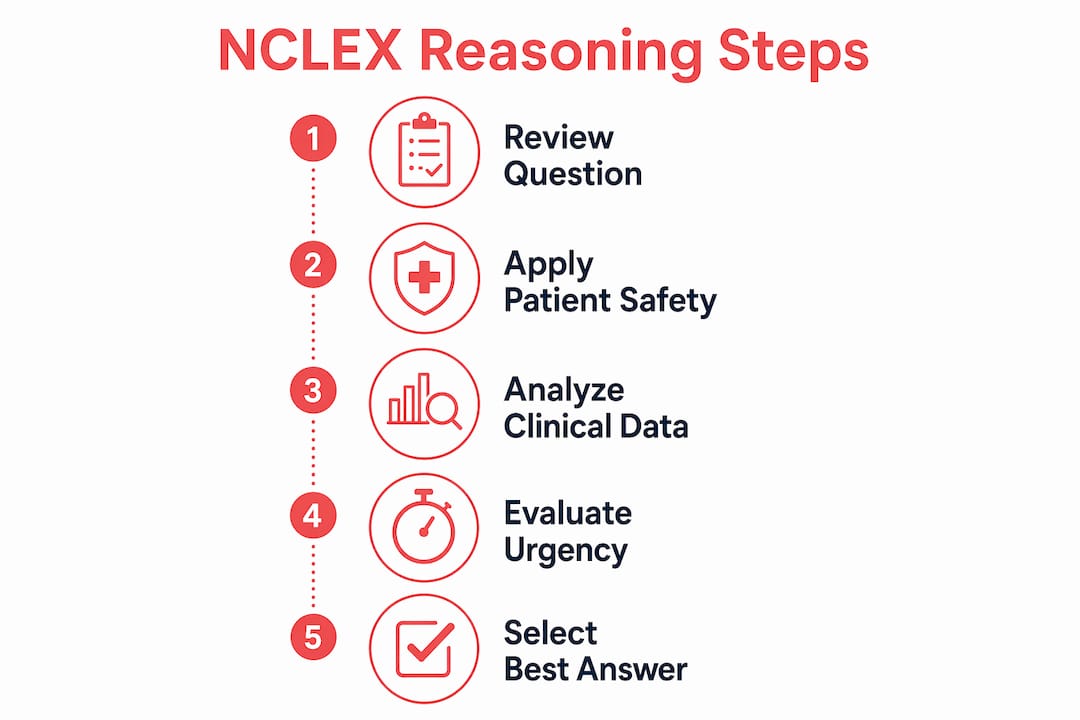
- Scenario application. Take a clinical scenario and walk through the NCLEX Clinical Judgment Measurement Model (CJMM) steps: recognize cues, analyze cues, prioritize hypotheses, generate solutions, take action, evaluate outcomes.
- Concept mapping. Draw connections between a diagnosis, its symptoms, its complications, and the nursing priorities. This builds the schema the NCLEX tests.
Active learning outperforms passive recognition during nursing exams because it mirrors the cognitive demand of the test itself. The NCLEX asks you to act, not recall.
The second failure of traditional studying is the absence of a patient safety framework. Most NCLEX failures stem from reasoning gaps, poor prioritization, and lack of safety logic, not content gaps. Students who memorize Maslow's hierarchy but cannot apply it to a clinical scenario in real time will still choose the wrong answer.
How can you avoid wrong answers and improve NCLEX performance?
Fixing the reasons for nursing exam errors requires a deliberate shift in how you practice, not just how much you practice. The strategies below target the specific reasoning failures that cause most wrong answers.
Remediate every question, not just the wrong ones
Reading rationales only for incorrect answers is one of the most common mistakes nursing students make. You need to understand why the correct answer is correct, why each distractor is wrong, and what clinical principle the question is testing. That three-part analysis builds the judgment framework the NCLEX rewards.
Apply a patient safety filter first
Students often pick medically correct answers that are unsafe in practice because they skip the patient safety lens. Before selecting any answer, ask: "Does this action protect the patient from immediate harm?" If two answers are both clinically sound, the one that addresses safety first is almost always correct.
Practice deciding between two close answers
Students stuck between two answer choices often fail because they have not developed the ability to think like a nurse, integrating all cues and prioritizing safety. The fix is deliberate practice with high-difficulty questions that force you to justify your final selection in writing.
Here is a direct comparison of two study approaches and their outcomes:
| Study Approach | What It Builds | NCLEX Outcome |
|---|---|---|
| High question volume, no rationale review | Pattern recognition only | Fails on novel NGN scenarios |
| Deep remediation of fewer questions | Clinical reasoning framework | Performs on bow-tie and matrix items |
| Passive re-reading of notes | Surface familiarity | Blanks under exam pressure |
| Active retrieval and scenario practice | Durable clinical judgment | Consistent performance across question types |
Prioritize urgency over familiarity
NGN emphasizes ranking hypotheses by risk and urgency, not familiarity. When you see a patient scenario, your first question should be: "What could kill or seriously harm this patient right now?" That question reorients your thinking from recognition to prioritization.
Self-care also belongs in this section. Chronic sleep deprivation and exam anxiety impair the prefrontal cortex, which is exactly the part of the brain responsible for clinical reasoning. Protecting your sleep and managing stress are not soft suggestions. They are performance requirements.
Key takeaways
Wrong answers on the NCLEX almost always trace back to clinical reasoning failures, not missing content knowledge, and fixing that gap requires active practice, deep remediation, and a patient safety-first mindset.
| Point | Details |
|---|---|
| Reasoning gaps cause most errors | Students fail because they cannot apply knowledge clinically, not because they lack it. |
| The fake security effect is real | Strong GPA and high question volume create false confidence that leads to shallow preparation. |
| Passive study builds false familiarity | Re-reading and highlighting do not build the retrieval pathways needed under exam pressure. |
| NGN scoring rewards justification | Polytomous scoring requires clinical reasoning for each sub-answer, not broad option selection. |
| Safety-first thinking changes outcomes | Filtering every answer choice through a patient safety lens corrects the most common prioritization errors. |
What i've learned watching students struggle with wrong answers
After years of working with nursing students through NCLEX preparation, the pattern I see most often is not ignorance. It is misplaced confidence in the wrong skill. Students arrive having studied intensely, and they are genuinely surprised when they miss questions on material they know cold.
The uncomfortable truth is that the NCLEX is not a knowledge test. It is a judgment test. And judgment cannot be built by reading. It has to be practiced through application, reflection, and honest self-assessment of where your thinking broke down.
The students who improve fastest are not the ones who study more hours. They are the ones who get comfortable being wrong during practice and then dig into exactly why. They treat every incorrect answer as a clinical case to analyze, not a failure to move past.
The misconception I fight most often is the belief that more questions equal more preparation. Quantity without quality reflection is the definition of the overstudying trap. I have seen students complete thousands of practice questions and still fail because they never stopped to build the reasoning framework underneath.
If you take one thing from this article, make it this: stop practicing to finish questions and start practicing to understand them. That shift alone changes outcomes.
— Michael
How Nursepass helps you build the reasoning skills that matter
Understanding why wrong answers happen is only half the work. The other half is building a practice system that actually corrects those reasoning gaps before exam day.
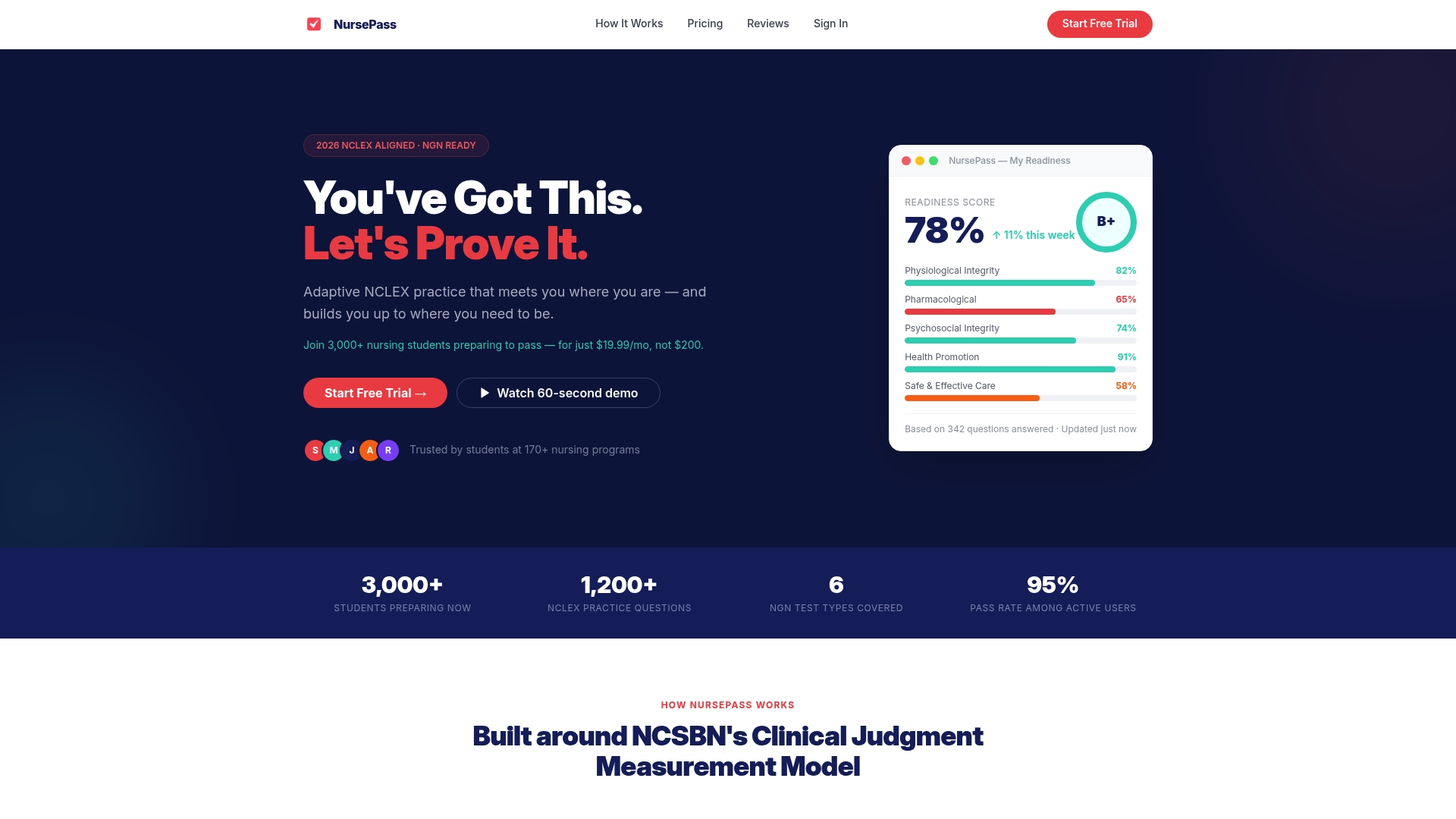
Nursepass is built specifically for this challenge. Its adaptive engine adjusts question difficulty to your current competency level, so you are always working at the edge of your reasoning ability, not coasting through familiar material. With over 1,200 NCLEX practice questions that include NGN-style formats, a live readiness score, and subcategory heat maps, you can see exactly where your clinical judgment breaks down. More than 3,000 nursing students have used Nursepass, and active users report a 95% pass rate. That result comes from focused, adaptive practice, not volume alone.
FAQ
What is the main reason nursing students get wrong answers?
The primary cause is clinical reasoning gaps, not missing content knowledge. Students fail to apply what they know in the context of patient safety and urgency, which is exactly what the NCLEX tests.
How does the NGN format change why nursing exams are difficult?
The NGN uses question types like bow-tie and matrix formats that require students to integrate multiple clinical cues and justify each answer choice. Polytomous scoring means partial credit is possible, but only when selections are clinically justified.
What is the fake security effect in NCLEX preparation?
The fake security effect occurs when strong academic performance creates false confidence, leading students to underestimate the clinical judgment demands of the NCLEX. It causes shallow preparation focused on question volume rather than reasoning depth.
Does doing more practice questions improve NCLEX scores?
Not automatically. Deep remediation of fewer questions outperforms high-volume practice without rationale review. Understanding why each answer is right or wrong builds the clinical framework the NCLEX rewards.
How do you choose between two close answer choices on the NCLEX?
Apply a patient safety filter first. The answer that addresses the most immediate risk to the patient is almost always correct. If both answers seem safe, prioritize the one that addresses the root cause rather than a symptom.