
A trend question on the NCLEX is a clinical judgment item that presents patient data collected across multiple time points and asks you to identify meaningful changes in the patient's condition. These questions are part of the Next Generation NCLEX (NGN), which launched in april 2023 and replaced the older single-fact recall format with scenario-based reasoning. Understanding what a trend question on the NCLEX actually tests, and how to approach it, is one of the most important shifts nursing students need to make before exam day. The Clinical Judgment Measurement Model (CJMM) drives the entire NGN framework, and trend questions sit at its core.
What is a trend question on the NCLEX?
A trend question presents a client scenario with clinical findings recorded over several time points, such as vitals taken every four hours or lab values drawn across two days. Your job is not to recall a fact. Your job is to detect a pattern, decide whether the patient is improving, deteriorating, or stable, and determine what that pattern means for nursing care.
These questions can appear as multiple choice, multiple response, or other NGN formats. The data sets typically include vital signs, laboratory results, and nursing notes. Each data point is timestamped, and the timestamps matter. A blood pressure of 88/54 mmHg at hour six means something very different if it was 120/78 mmHg at hour one.

Trend questions are not a new concept in clinical nursing. Experienced nurses constantly track patient trajectories rather than isolated values. The NGN simply formalized that skill into a testable exam format.
How do trend questions differ from traditional NCLEX questions?
Traditional NCLEX questions test isolated knowledge. A classic item might ask which medication is contraindicated in renal failure, or what the priority action is for a patient with a specific diagnosis. One data point, one answer.
Trend questions require you to hold multiple data points in mind at once and reason across time. That is a fundamentally different cognitive task. The table below shows the core differences:
| Feature | Traditional NCLEX question | NGN trend question |
|---|---|---|
| Data presented | Single scenario snapshot | Multiple timestamped data sets |
| Skill tested | Knowledge recall | Pattern recognition and clinical judgment |
| Answer format | Mostly multiple choice | Multiple choice, multiple response, drag and drop |
| CJMM stage targeted | Varies | Recognize cues, analyze cues, prioritize hypotheses |
| Time element | Absent | Central to the question |
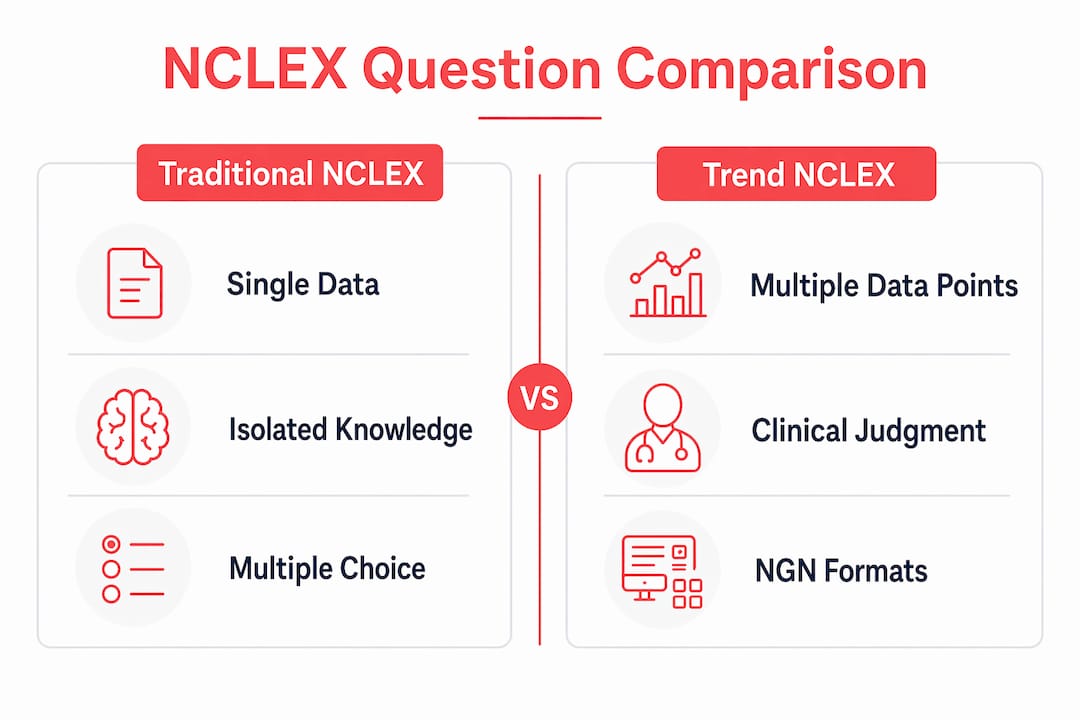
The NGN also introduced new interactive formats alongside trend items: drag and drop, cloze drop-down, hot spot highlighting, and matrix/grid items. These formats simulate real clinical decision-making more accurately than a standard four-option question ever could.
Pro Tip: When you see a trend question, read all the timestamps before you read the answer choices. Knowing the direction of change, whether values are rising, falling, or fluctuating, shapes every answer you consider.
Common data types you will see in trend questions include:
- Vital signs recorded at regular intervals
- Serial laboratory values such as hemoglobin, creatinine, or white blood cell count
- Nursing assessment notes documenting mental status or pain level changes
- Intake and output records over a 24-hour period
What is the CJMM and how does it relate to trend questions?
The Clinical Judgment Measurement Model defines six cognitive skills that nurses use when making clinical decisions: recognize cues, analyze cues, prioritize hypotheses, generate solutions, take action, and evaluate outcomes. The NGN scores candidates on these skills rather than on factual knowledge alone.
Trend questions primarily target the first three stages. Recognizing cues means spotting which data points in the timeline are clinically significant. Analyzing cues means interpreting what those changes indicate about the patient's condition. Prioritizing hypotheses means ranking the most likely explanations and the most urgent concerns.
| CJMM stage | What it means | How trend questions test it |
|---|---|---|
| Recognize cues | Identify relevant changes in patient data | Spot the abnormal value or shift in the timeline |
| Analyze cues | Interpret what the changes indicate | Connect the pattern to a clinical condition |
| Prioritize hypotheses | Rank urgency of possible explanations | Choose the most critical concern to address first |
| Generate solutions | Plan nursing interventions | Less common in trend items, more in bow-tie formats |
| Take action | Implement care | Rarely the focus of trend questions |
| Evaluate outcomes | Assess whether interventions worked | Appears in follow-up NGN case study items |
The CJMM aligns with the nursing process/02%3A_Healthy_Lifestyle/2.08%3A_Applying_the_Nursing_Process_and_Clinical_Judgment_Model_to_Promoting_Healthy_Lifestyles) but uses more specific language. Assessment maps to recognizing and analyzing cues. Diagnosis maps to prioritizing hypotheses. Understanding this connection helps you apply skills you already practiced in nursing school to the NGN format.
Pro Tip: Label each CJMM stage on scratch paper as you work through a trend question. Writing "recognize" next to the abnormal values and "analyze" next to your interpretation keeps your reasoning organized under timed conditions.
How to approach and answer NCLEX trend questions effectively
The NCLEX exam runs five hours and includes both evolving case studies and stand-alone questions. Trend items can appear in either format, so you need a repeatable approach that works under pressure.
Use this process every time you encounter a trend question:
- Read the scenario header first. Know the patient's age, diagnosis, and care setting before you look at any data.
- Scan all timestamps. Note how much time has passed between each data set. A two-hour window signals a different urgency than a 12-hour window.
- Identify the direction of change. Is the patient getting better, worse, or staying the same? Mark the trend clearly.
- Flag the most abnormal values. Not every data point is relevant. Focus on values that cross clinical thresholds, such as oxygen saturation dropping below 92% or heart rate climbing above 120 bpm.
- Apply CJMM reasoning. Ask yourself: what cues are present, what do they indicate, and which concern is most urgent?
- Eliminate answers that ignore the time element. A correct answer for a trend question must account for the change over time, not just the most recent value.
Common mistakes nursing students make on trend questions include treating the latest data point as the only relevant one, ignoring subtle but consistent changes in favor of dramatic single values, and skipping nursing notes because they seem less objective than lab numbers. Nursing notes often contain the cue that ties the entire trend together.
Pro Tip: Practice reading serial lab values in clinical settings or case studies before the exam. The faster you recognize a downward creatinine trend or a rising lactate, the more time you save on exam day.
Examples of trend questions with explanations
A sample trend scenario might look like this: A 68-year-old patient admitted for pneumonia has the following vital signs recorded over 12 hours.
| Time | Temperature | Heart rate | Respiratory rate | SpO2 |
|---|---|---|---|---|
| 0800 | 38.2°C | 88 bpm | 18/min | 96% |
| 1200 | 38.9°C | 102 bpm | 22/min | 93% |
| 1600 | 39.4°C | 118 bpm | 26/min | 89% |
| 2000 | 39.8°C | 124 bpm | 30/min | 86% |
The trend is clear: every value is worsening across all four time points. The question might ask which finding requires the most immediate nursing action. The correct answer targets the SpO2 of 86%, because hypoxia at that level is immediately life-threatening.
Recognizing the trend matters here because no single value at 0800 would trigger urgent action. The pattern across 12 hours is what signals clinical deterioration. Trend question reasoning mirrors real nursing practice by requiring you to integrate multiple data points and prioritize dynamically.
A second example involves lab values: a post-surgical patient shows creatinine rising from 0.9 to 1.4 to 2.1 mg/dL across three consecutive days. Each value alone might not alarm a test-taker. The consistent upward trajectory signals acute kidney injury, and the correct nursing action is to notify the provider and hold nephrotoxic medications.
How to integrate trend question practice into your NCLEX study plan
NGN practice questions feel different from standard multiple choice items, and early exposure before exam day is the single most effective preparation strategy. Waiting until the week before the exam to encounter your first trend item puts you at a serious disadvantage.
Build trend question practice into your study plan with these approaches:
- Use official NCSBN sample items. The National Council of State Boards of Nursing publishes free NGN sample questions, including trend items. These are the closest match to actual exam format.
- Practice with NGN-specific question banks. General NCLEX question banks built before 2023 do not include trend items. Seek out platforms that have updated their content for the NGN format.
- Study in timed blocks. Trend questions take longer than traditional items. Practice under timed conditions so you build the pacing skills the five-hour exam demands.
- Review every rationale, not just wrong answers. Understanding why a correct answer is correct teaches you the CJMM reasoning pattern, not just the answer to one question.
- Join study groups focused on clinical judgment. Talking through trend scenarios with peers forces you to verbalize your reasoning, which strengthens pattern recognition faster than silent review.
Teaching yourself to think in patient trajectories/02%3A_Healthy_Lifestyle/2.08%3A_Applying_the_Nursing_Process_and_Clinical_Judgment_Model_to_Promoting_Healthy_Lifestyles) rather than isolated values is the core mindset shift the NGN demands. Build that habit early and it becomes automatic by exam day.
Pro Tip: After each practice session, categorize your errors by CJMM stage. If you consistently miss "prioritize hypotheses" questions, that is your targeted study focus, not more general review.
Key takeaways
Trend questions test clinical judgment across time, and mastering them requires a systematic approach grounded in the CJMM framework.
| Point | Details |
|---|---|
| Trend questions defined | They present timestamped patient data and ask you to identify clinically significant changes. |
| NGN launched in 2023 | The Next Generation NCLEX replaced single-fact recall with CJMM-based clinical judgment scoring. |
| CJMM stages to master | Focus on recognizing cues, analyzing cues, and prioritizing hypotheses for trend items. |
| Approach every question systematically | Read all timestamps, identify the direction of change, and flag the most urgent abnormal values. |
| Practice early with NGN formats | Official NCSBN samples and NGN-specific question banks are the most effective preparation tools. |
Why trend questions are the most honest test nursing has ever had
I have reviewed hundreds of NCLEX preparation strategies over the years, and the shift to trend questions is the first time the exam has actually asked candidates to think like nurses. The old format rewarded memorization. A student who drilled enough facts could pass without ever developing real clinical reasoning. Trend questions close that gap.
The challenge most students face is not intelligence. It is habit. Years of test preparation built around single-answer, single-fact questions create a mental reflex that looks for the one right piece of information. Trend questions punish that reflex. They reward students who slow down, read the full timeline, and ask what the data means together rather than individually.
The students I see struggle most are the ones who treat the most recent data point as the only relevant one. They ignore the trajectory. A blood pressure of 100/60 mmHg looks borderline acceptable in isolation. When the previous three readings were 130/80, 118/72, and 108/64, that same value is an emergency.
My honest advice: stop practicing for the NCLEX you remember hearing about and start practicing for the one that actually exists. The NGN is not harder because it added new formats. It is harder because it requires you to think. That is a good thing. It means passing the exam actually signals you are ready to care for patients.
— Michael
Nursepass: built for the NGN era
Trend questions and clinical judgment items require a different kind of practice platform, one that adapts to where you actually are, not where the average student is.
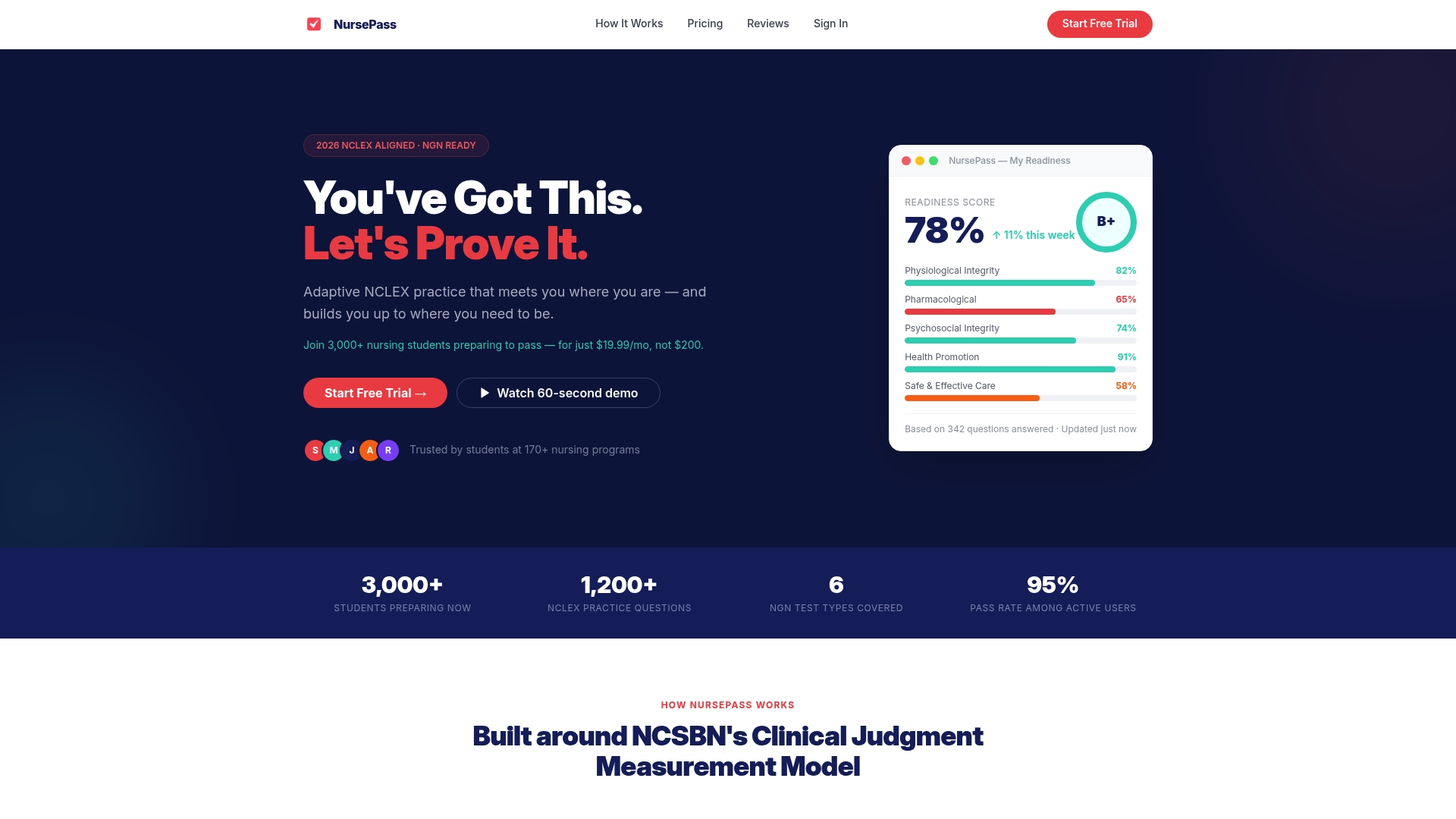
Nursepass offers over 1,200 NCLEX practice questions built for the NGN format, including trend items and clinical judgment scenarios. Its adaptive engine adjusts question difficulty based on your current performance, so you spend time on the skills that need work rather than repeating content you already know. The live readiness score and subcategory heat maps show you exactly where your gaps are. More than 3,000 nursing students have used Nursepass, and the platform reports a 95% pass rate among active users. If trend questions are your weak point, Nursepass identifies that fast and targets it directly.
FAQ
What is a trend question on the NCLEX?
A trend question presents timestamped patient data across multiple time points and asks you to identify clinically significant changes. These items are part of the Next Generation NCLEX and assess clinical judgment rather than factual recall.
When did trend questions become part of the NCLEX?
Trend questions became part of the official exam when the Next Generation NCLEX launched in april 2023. They replaced older single-fact question formats with CJMM-based clinical judgment items.
Which CJMM skills do trend questions test most?
Trend questions primarily assess recognizing cues, analyzing cues, and prioritizing hypotheses. These are the first three stages of the Clinical Judgment Measurement Model.
How are trend questions different from standard multiple choice questions?
Standard multiple choice questions test isolated knowledge with a single data point. Trend questions require you to analyze multiple timestamped data sets and reason about a patient's changing condition over time.
How should I practice for trend questions?
Use official NCSBN sample items and NGN-specific question banks that include trend formats. Early and consistent exposure to these question types is the most effective preparation strategy before exam day.